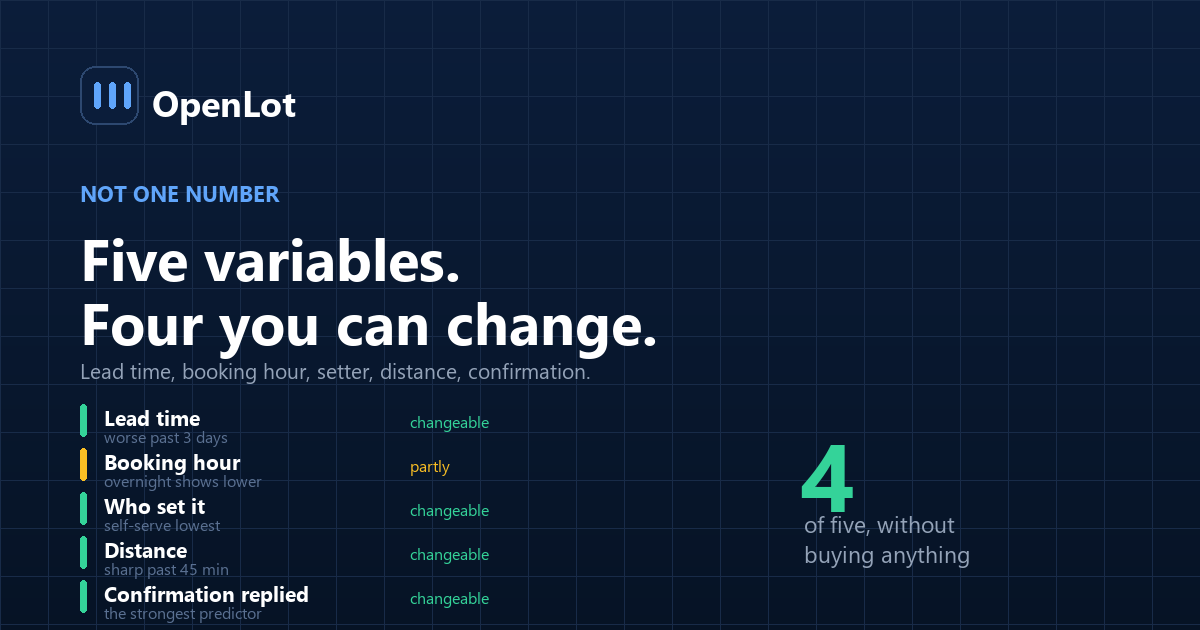
Most stores quote a single no-show rate, and the single number is the least useful version of it. The rate varies sharply by five variables — lead time, booking hour, who set the appointment, distance and confirmation status — and knowing which segment is failing tells you what to change.
This guide covers how to measure no-show rate honestly, the five variables that move it, which are controllable, where measurement goes wrong, and what to do about each segment.
How do you measure it honestly?
Three definitional traps, all of which flatter the number.
Trap 1: counting only firm appointments. If "appointment" quietly means "confirmed appointment" in the denominator, the rate improves without anything changing. Count every booking from the moment a time was agreed.
Trap 2: excluding reschedules. A customer who moved the appointment did not no-show, and counting them as one overstates the problem. A customer who moved it after the slot passed did no-show. Both need a rule, written down.
Trap 3: no record at all. The most common situation. If nobody logs whether a booked customer arrived, the store cannot tell a good appointment from a bad one, and no decision about appointment setting can be evaluated.
The working definition: attended ÷ appointments set, counted at the moment of agreement, with reschedules moved to their new date rather than counted as failures.
The five variables
Where the number actually varies
Illustrative shape, not benchmarks. Run these five cuts on your own data.
Variable Direction Lead time Worsens steadily past about 3 days Booking hour Late-night bookings show worse than daytime ones Who set it Self-serve worse than conversational Distance Worsens with travel time, sharply past ~45 minutes Confirmation replied Much better when the customer answered The last row is the strongest single predictor in most stores, and it is also the cheapest to act on — a confirmation that requires a reply is both a reminder and a filter.
1. Lead time
The longer between booking and appointment, the worse the rate. Life intervenes, enthusiasm fades, and the appointment was made in a different week.
What to do: offer the soonest genuine availability rather than the most convenient slot for the store, and increase confirmation touches for anything booked more than a few days out.
2. Booking hour
Appointments set late at night show at lower rates. This is partly real — a 11pm enquiry is further from a decision — and partly artefactual, because those are customers nobody was reaching before, so the comparison is against zero rather than against a daytime booking.
What to do: measure them separately and judge them in absolute terms. Do not conclude the overnight system is failing because its appointments show worse than a salesperson's.
3. Who set it
Self-served bookings show worse than conversationally set ones, because less commitment was required — the dynamic covered in why calendar links underperform.
What to do: stronger confirmation sequences on self-served bookings, not weaker.
4. Distance
Rarely measured, and it degrades sharply past around 45 minutes of travel. It interacts with time of day: a 6pm appointment an hour away, booked at 5:15, was never likely.
What to do: raise it conversationally at booking, which is free. "That's about an hour from you — would Saturday morning be easier?"
5. Confirmation status
The strongest predictor and the cheapest lever. A customer who replied to a confirmation is materially more likely to arrive than one who was merely sent one.
What to do: make the confirmation require a reply, and treat non-responders as a distinct group to work — the design covered in confirmation sequences.
Which can you change this month?
| Variable | Changeable | How |
|---|---|---|
| Lead time | Yes | Offer the soonest real slot, not the most convenient one |
| Booking hour | Partly | Confirm overnight bookings harder, earlier |
| Who set it | Yes | Conversation first, link third |
| Distance | Yes | Ask about it at booking. Free |
| Confirmation | Yes | Require a reply, work the non-responders |
Four of five are changeable without buying anything, which is unusual and worth acting on before any system is evaluated on its no-show numbers.
Where does the measurement go wrong?
1. A single blended number. The whole subject of this article.
2. The denominator moving. If the definition of "appointment" tightens after a deployment, the rate improves for free. Freeze definitions in writing at baseline.
3. Reschedules counted as no-shows. Overstates the problem and hides the thing that is working, since a reschedule means the confirmation did its job.
4. No arrival logging. No data, no decisions — and show rate is one of the four numbers to baseline before anything is deployed.
5. Comparing to an industry figure. Blended benchmarks mix store types, markets and definitions — the same trap as reading appointment-to-sold against a benchmark. Your own trend over 90 days is worth more than anyone else's level.
6. Treating service and sales as one number. Service no-shows have different causes and a different recovery window — see service no-show recovery.
What should you measure?
| Metric | How to compute | What it decides |
|---|---|---|
| Overall no-show rate | Missed ÷ set, consistent definition | The trend line |
| By lead time | Split by days between booking and appointment | Whether to push for sooner slots |
| By booking hour | Split by hour the appointment was set | Whether overnight bookings are acceptable |
| By setter | Human, conversational AI, self-serve | Where to add confirmation |
| By distance | Split by travel time bands | The free conversational fix |
| By confirmation reply | Replied vs not | The strongest predictor, and the lever |
Run all six once. The segment that stands out is usually obvious, and it will not be the one assumed before the data was cut.
Frequently asked questions
How do you calculate a dealership no-show rate?
Attended appointments divided by appointments set, counted from the moment a time was agreed rather than from confirmation, with reschedules moved to their new date instead of counted as failures. Writing the definition down matters, because small changes to the denominator move the rate without anything real changing.
What is a good no-show rate for a dealership?
Less useful than your own trend, because published figures blend store types, markets and definitions that do not match yours. The actionable version is to cut your rate by lead time, booking hour, setter, distance and confirmation status and compare segments against each other.
Does lead time affect whether customers show up?
Yes, and it is one of the strongest effects. Appointments booked further out show at lower rates because life intervenes and enthusiasm fades. Offering the soonest genuine availability, rather than the slot most convenient for the store, is a free improvement.
Do appointments booked overnight show up less often?
Generally yes, and that is not automatically a failure. Those customers were not being reached at all previously, so the comparison is against zero rather than against a daytime booking made by a salesperson. Judge them on absolute contribution rather than relative show rate.
Does distance matter to no-show rate?
Substantially, and it is rarely measured. The rate degrades sharply past roughly three quarters of an hour of travel, and it interacts badly with late-day appointments. Raising it at booking — offering an alternative that suits the journey — costs nothing and prevents a failure that would be blamed on the customer.
What is the best single predictor of attendance?
Whether the customer replied to a confirmation. A confirmation that requires a response works as a filter as well as a reminder, and the gap between responders and non-responders is usually the largest in the whole dataset.
Should reschedules count as no-shows?
No. A customer who moved the appointment before it passed did not fail to attend, and counting them that way hides the fact that the confirmation worked. A customer who moved it only after the slot had passed is a different case and should be counted as missed.
Are service and sales no-shows the same problem?
No. Service no-shows are usually caused by forgetting, transport or a time that stopped working, with a recovery window measured in hours, while sales no-shows are more sensitive to lead time and commitment level. Blending them into one rate hides both.
Conclusion
- One number is the least useful version. Cut by five variables and the failing segment appears.
- Confirmation reply is the strongest predictor, and the cheapest lever available.
- Four of the five variables are changeable without buying anything.
- Freeze the definition in writing. A tightening denominator improves the rate for free.
- Do not judge overnight bookings against daytime ones. The alternative was no appointment at all.
Last updated: