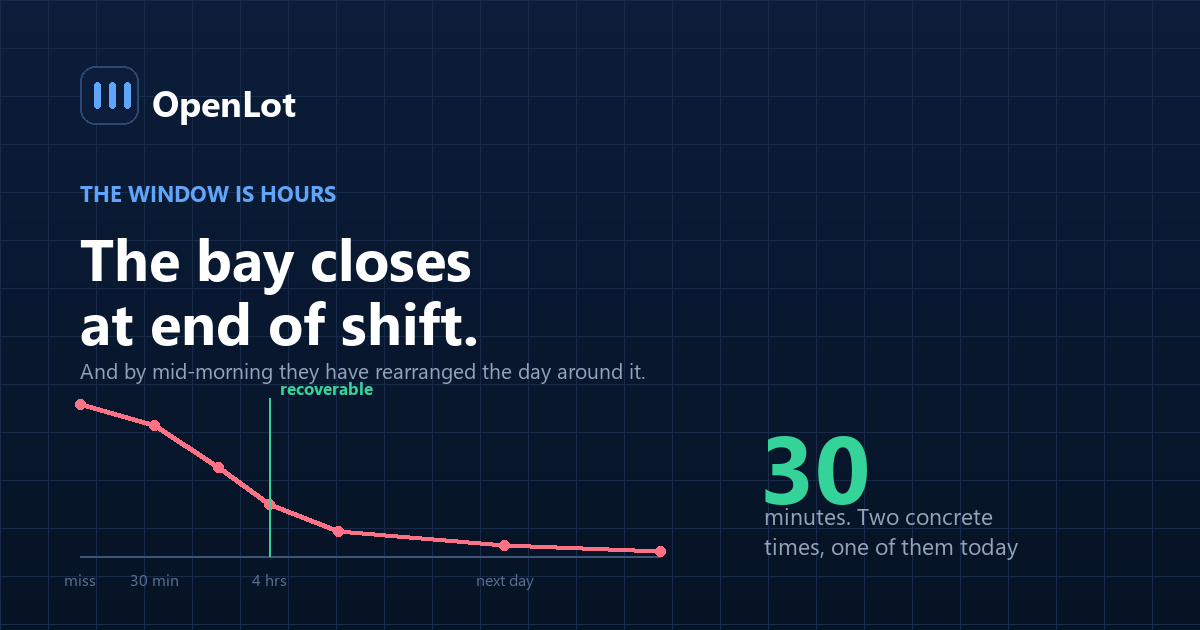
A service no-show is not a lost customer — it is a customer whose day changed. The recovery window is measured in hours, not days, because the open bay you are trying to fill closes at the end of the shift and the customer's willingness to rearrange decays almost as fast.
This guide covers what a no-show actually costs, the four causes behind most of them, why the recovery window is short, the confirmation sequence that prevents them, and what to measure.
What does a service no-show cost?
Two things, and the second is larger.
The unsold hours. A missed two-hour appointment at a shop running near capacity is two hours of technician time that cannot be recovered, because capacity is perishable — the day ends whether or not it was sold. The capacity arithmetic is what makes this concrete.
The deferred relationship. A customer who no-showed and was never contacted frequently does not rebook at all. The service they needed still needs doing; it gets done somewhere else, and the next maintenance visit follows it.
Sizing it
Illustrative. Substitute your own rate and your own effective labour rate.
A shop booking 25 ROs a day, 22 working days, with a 14% no-show rate:
Step Figure Appointments booked per month 550 No-shows 77 Average hours per RO 2.2 Unsold hours 169 Not all of that is recoverable — some days have slack to absorb it, and some no-shows rebook on their own. But the gap between "no process" and "a same-day rebook attempt" is usually a meaningful share of those hours.
Run it against your own numbers. The input you are least likely to have is the no-show rate itself, which is its own finding.
Why do service customers no-show?
Four causes, and three of them are addressable before the appointment.
1. They forgot. Booked two weeks ago, no reminder, or a reminder that arrived too early to act on.
2. Transport. They realised they have no way to get to work while the car is in. Almost always solvable if raised in advance — loaner, shuttle, or a wait-appointment instead of a drop-off.
3. The time stopped working. Something changed in their week and rescheduling felt like more effort than not showing up. This is a flow problem: if rescheduling takes a phone call during business hours, not showing up is easier.
4. They got it done elsewhere. The only genuinely lost category, and the smallest.
Three of the four are visible in advance if the confirmation asks rather than announces.
What does a confirmation sequence that works look like?
The common mistake is announcing. "Your appointment is Thursday at 9am" is a notification, and notifications do not surface problems.
| When | Message | Purpose |
|---|---|---|
| At booking | Confirm, and ask whether they need transport | Surfaces cause 2 immediately |
| T–48 hours | "Still works for Thursday 9am? Reply 1 to confirm, 2 to move it" | Surfaces causes 1 and 3 while the slot is still fillable |
| T–2 hours | Short reminder with address and what to expect | Catches the morning-of forgetting |
The middle row is the one that does the work, and the reason is operational rather than psychological: a customer who moves their appointment 48 hours out frees a slot you can still sell. A customer who no-shows frees a slot you cannot.
Make rescheduling trivially easy. Two taps, no phone call, and never a form that rebuilds the booking — the flow problem covered in service scheduling. Consent and contact-time rules apply to every one of these messages, with the store accountable under the Safeguards Rule. Every unit of friction in the reschedule path converts a reschedule into a no-show, and the reschedule is worth more than the confirmation.
Why is the recovery window hours?
Because two things are decaying at once.
The bay. The hole in the schedule exists today. Filling it tomorrow is a normal booking, not a recovery.
The customer's day. Someone who missed a 9am appointment has, by 11am, rearranged their day around not having the car in the shop. By tomorrow they have made other plans for the week.
Which gives a practical sequence:
- Within 30 minutes: message. Not accusatory — "we missed you this morning, is everything alright? We can still take the car today at 2pm or tomorrow at 8am."
- Two concrete times, one of them today. An open calendar converts far worse than two options.
- If no reply by end of day: one more attempt the following morning, then move them into the normal reminder flow rather than chasing.
Three touches total, then stop. Past that you are generating an opt-out on a customer who is still, technically, yours.
Where does no-show recovery go wrong?
1. No baseline rate. Most stores cannot say what their service no-show rate is, which makes any intervention unmeasurable.
2. Recovering instead of preventing. Recovery is the smaller lever. A confirmation sequence that asks rather than announces prevents more than recovery recaptures.
3. An accusatory message. "You missed your appointment" produces silence. The tone that works assumes something came up, because something usually did — the same framing that makes a close-out message outperform a chase.
4. Offering an open calendar. Two concrete times, one today. A link to a scheduler is more work than the customer is willing to do at that moment.
5. Chasing past three touches. Converts a recoverable customer into an opt-out.
6. Recovering into a full shop. If the day has no slack, there is nothing to fill, and the same-day offer is empty — the sequencing issue that runs through all service drive automation.
What should you measure?
| Metric | How to compute | What it tells you |
|---|---|---|
| No-show rate | Missed ÷ booked | The baseline nobody has |
| No-show rate by lead time | Split by days between booking and appointment | Usually rises sharply past a week |
| Reschedule rate at T–48 | Moved ÷ confirmations sent | The prevention metric that matters |
| Same-day recovery rate | Rebooked today ÷ no-shows | What the window is worth |
| 48-hour recovery rate | Rebooked within two days ÷ no-shows | The realistic ceiling |
| Unsold hours from no-shows | No-shows × average hours per RO | The number that funds the fix |
The second row usually settles the argument about confirmation timing. If no-show rate climbs steeply for appointments booked more than a week out, the T–48 confirmation is where the programme should start.
Frequently asked questions
How long do you have to recover a service no-show?
Hours. The open bay exists only for the rest of that shift, and the customer has typically rearranged their day around not having the car in the shop by mid-morning. A message within the first half hour with two concrete times, one of them today, is the version that recovers appointments rather than simply rebooking them later.
Why do service customers miss appointments?
Four reasons: they forgot, they had no transport arrangement, their week changed and rescheduling felt harder than not showing, or they had the work done elsewhere. Only the last is genuinely lost, and the first three are all visible in advance if the confirmation asks whether the time still works instead of announcing it.
What is the difference between a confirmation and a reminder?
A reminder announces the appointment; a confirmation asks whether it still works and offers an easy way to move it. The second surfaces problems while the slot can still be resold, which is why a confirmation at roughly 48 hours prevents more lost hours than any recovery attempt afterwards recaptures.
When should the confirmation be sent?
Around 48 hours before, with a short practical reminder a couple of hours before the appointment. Forty-eight hours is far enough out that a freed slot can still be sold and close enough that the customer knows their week.
Should the recovery message mention that they missed the appointment?
Only gently. An accusatory framing produces silence, while a message that assumes something came up and immediately offers two alternative times gets replies. The goal is rebooking, not accountability.
How many times should we chase a no-show?
Three touches at most: one within the first half hour, one the following morning, then stop and let the customer return to the normal reminder flow. Chasing further converts a customer who is still yours into an opt-out.
Does no-show recovery help if the shop is already full?
Less than it appears. Recovery depends on there being slack in the day to fill, so at a shop consistently at capacity the value shifts to prevention — moving the appointment at the 48-hour mark so the slot can be sold to someone else rather than lost.
What is a typical service no-show rate?
Less useful than knowing your own, which most stores cannot state. Measure missed against booked, then split by lead time between booking and appointment — the rate almost always rises for appointments made more than a week out, and that split tells you where to intervene.
Conclusion
- The window is hours. The bay closes at end of shift and the customer's day is already rearranged.
- Prevention beats recovery. A confirmation that asks surfaces three of the four causes in advance.
- Make rescheduling trivial. Friction in the reschedule path converts reschedules into no-shows.
- Two concrete times, one today. An open calendar is more work than the moment allows.
- Three touches, then stop, or you convert a recoverable customer into an opt-out.
Last updated: