The service drive leaks revenue in six distinct places, from the call nobody answered to the recommendation nobody followed up. They happen in sequence, and the order matters — fixing a downstream leak while an upstream one is open moves customers into a queue rather than into a bay.
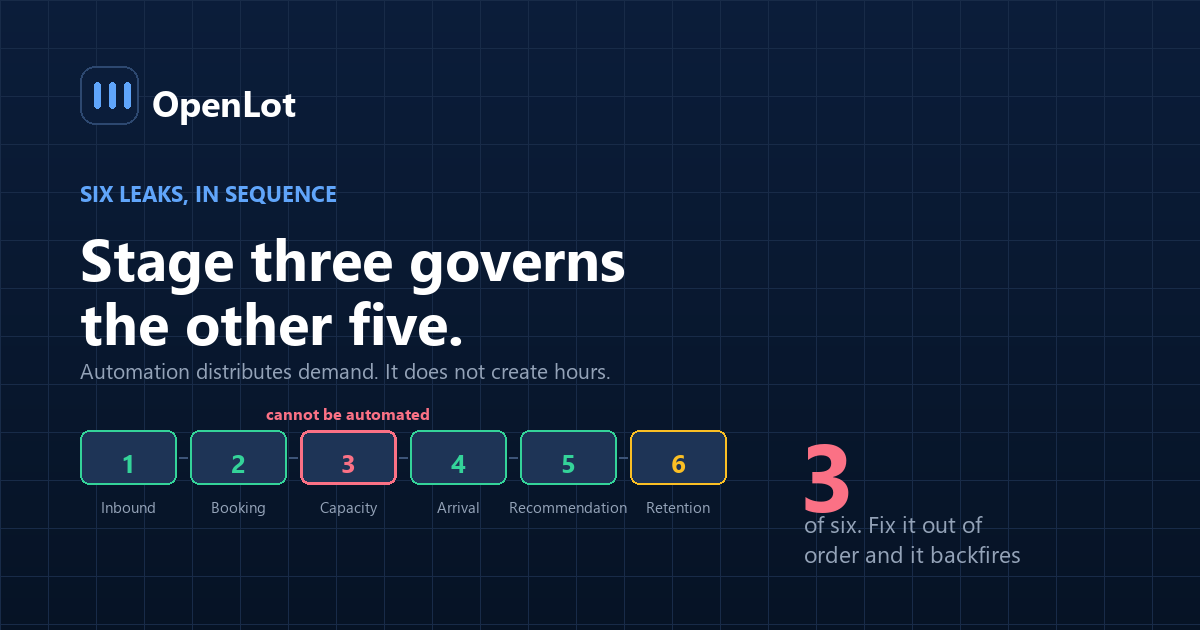
This guide covers the six leaks in order, which ones automation closes and which it cannot, why fixing them out of sequence backfires, and what to measure at each stage.
Why does fixed ops leak in six places rather than one?
Because the service drive is a sequence, and each stage has its own failure mode. A store that measures only "appointments booked" cannot see five of the six.
| # | Stage | The leak | Closable by automation? |
|---|---|---|---|
| 1 | Inbound contact | Calls unanswered, abandoned on hold, voicemails unreturned | Yes, largely |
| 2 | Booking | Online scheduler abandoned; customer cannot find a slot | Partly |
| 3 | Capacity | Booked past what the shop can produce, or bays idle | No — this is a planning problem |
| 4 | Arrival | No-shows, late arrivals, rescheduled and lost | Yes, via confirmation sequences |
| 5 | Recommendation | Declined work, never followed up | Yes, and it is the cheapest win |
| 6 | Retention | Customer never returns; equity never surfaced | Partly |
Stage 3 is the one that cannot be automated away, and it is the one that determines whether fixing any of the others produces revenue.
The six, in order
1. Inbound contact
The service department answers fewer calls than anyone thinks, and loses them in the same five places sales does: rang out, hold abandonment, menu abandonment, voicemail, misrouting. The arithmetic for sizing it is the same as for missed calls on the sales side, and the service number is usually worse, because service calls cluster into two sharp peaks.
What automation does well: answers at peak, texts back on a miss, handles "is my car ready" without a human.
What it must not do: diagnose, or quote a repair. A price given before inspection is a commitment the shop has to honour or walk back.
2. Booking
Most dealership online schedulers are abandoned mid-flow. The common causes are concrete: too many steps, a vehicle lookup that fails, no visible availability, and a form that asks for a VIN the customer does not have to hand.
What automation does well: conversational booking that asks three questions instead of eleven, and offers real slots rather than a request form.
3. Capacity
Here is the stage that makes or breaks everything else.
A shop produces a finite number of billable hours per day. Booking more appointments than that does not generate more revenue — it generates longer waits, later promise times, and customers who do not come back. Booking fewer leaves technicians idle.
Automation cannot create capacity. It can only distribute demand against it, which is why a scheduling system that is not integrated with real bay and technician availability makes the drive worse by filling it faster.
Why stage 3 governs the other five
Illustrative. Substitute your own shop.
A shop with 8 technicians at 7 billable hours a day produces 56 hours of capacity. At an average 2.2 hours per repair order, that is roughly 25 ROs a day.
If you book What happens 18 a day Technicians idle. Capacity wasted, fixed cost unchanged 25 a day The target 34 a day Promise times slip, advisors firefight, CSI falls Now add automation at stage 1 and 2 that raises bookings by 30% with no change to stage 3. A store at 25 goes to 32 — into the bottom row.
The system worked and the outcome got worse. This is the single most common way fixed ops automation disappoints, and it is a planning failure rather than a technology one.
4. Arrival
Booked is not arrived. No-shows in service have a different cause profile than in sales — the customer forgot, needed a ride, or the promise time stopped working for them — and all three are addressable by a confirmation sequence that asks rather than announces.
5. Recommendation
The highest-return leak in the entire list, and the least worked. A customer was told they need brakes, declined on the day, and nothing happened afterwards. That is documented intent, already paid for, sitting in your DMS.
6. Retention
The customer who stops coming after the warranty ends, and the one sitting in positive equity nobody surfaced. Partly a communication problem, partly a data one.
Which leaks should you close first?
Not in numerical order. In order of cost to fix divided by what they return:
- Stage 5 — declined work. The list already exists, the intent is documented, and nobody is working it.
- Stage 1 — inbound contact. Measurable in an afternoon, fixable with routing and text-back.
- Stage 4 — no-shows. Confirmation sequences are cheap and the effect is immediate.
- Stage 3 — capacity. Not a quick fix, but it has to be understood before 1, 2 and 4 are scaled.
- Stage 2 — booking. Worth fixing, usually a vendor change rather than an addition.
- Stage 6 — retention. Longest payback, most dependent on clean data.
The sequencing caveat: know your capacity number before you scale stages 1, 2 and 4. If the shop is already at capacity, the gain from those three is not more ROs — it is a better mix of ROs, which is a different and smaller business case that still needs making honestly.
Where does service drive automation go wrong?
1. Filling a shop that is already full. Covered above. The most common and most expensive error.
2. Quoting before inspection. An automated system that offers a price for brakes creates an obligation before anyone has looked at the vehicle.
3. Reminders sent on the wrong trigger. Interval-based reminders to a customer who drives 4,000 miles a year read as spam and train people to ignore you.
4. Status updates nobody asked for. "Your vehicle is in the queue" four times a day is noise. One update at a meaningful change is signal.
5. Working declined work without the context. Contacting a customer about brakes without knowing they already had them done elsewhere is worse than not contacting them, and that is a data quality problem before it is an automation one.
6. Consent treated as a sales-side concern. Service messaging carries the same obligations, and the dealership is the accountable party — see the Safeguards Rule and the messaging rules alongside it.
What should you measure?
| Stage | Metric | Why |
|---|---|---|
| 1 | Call answer rate and voicemail return latency | The cheapest leak to find |
| 2 | Online booking start-to-complete rate | Abandonment is invisible without it |
| 3 | Hours sold ÷ hours available | The governing number |
| 4 | No-show rate, and same-day rebook rate | Booked versus arrived |
| 5 | Declined work follow-up rate and recapture rate | Usually near zero before anyone looks |
| 6 | Service retention by vehicle age band | Where customers actually leave |
Row 3 is the one to compute first, even though it is the hardest. Everything else is interpreted against it.
Frequently asked questions
What does AI do for a dealership service drive?
It closes four of the six places fixed ops leaks: answering inbound contact at peak and after hours, making booking conversational rather than a long form, running confirmation sequences that reduce no-shows, and working declined recommendations that currently go untouched. It cannot create shop capacity, which is the leak that governs whether the others produce revenue.
Why does service automation sometimes make things worse?
Because it increases demand against fixed capacity. A system that raises bookings by 30% at a shop already at capacity produces slipping promise times, firefighting advisors and falling satisfaction. The capacity number — hours sold against hours available — has to be known before the front of the funnel is scaled.
What is the highest-return place to start?
Declined work. The customer was told they needed a repair, declined on the day, and in most stores nothing happens afterwards. The list already exists in the DMS, the intent is documented, and the acquisition cost was paid long ago, which makes recapture the cheapest revenue in fixed ops.
Should an AI system quote service prices?
No. A price offered before the vehicle has been inspected becomes an obligation the shop has to honour or walk back, and walking it back costs more than the convenience gained. Pricing questions should escalate to an advisor, with the system saying so plainly rather than guessing.
How do I calculate my shop capacity?
Multiply technicians by realistic billable hours per day to get available hours, then divide by your average hours per repair order to get a daily RO target. Track hours sold against hours available over time — that ratio, rather than appointment count, is what tells you whether more bookings would help or hurt.
What causes service no-shows?
Mostly forgetting, transport problems and a promise time that stopped working, rather than a change of mind. That makes them addressable by a confirmation sequence that asks whether the slot still works and offers an alternative, rather than one that simply announces the appointment back to the customer.
Do service messages carry the same compliance obligations as sales?
Yes. Automated service reminders, status updates and declined-work follow-ups are outbound messaging with the same consent, contact-time and opt-out requirements, and the dealership is the accountable party regardless of which system sends them. Service-side messaging is frequently set up without the consent logging the sales side has.
How many reminders should a service customer receive?
Few, and each triggered by something meaningful. Four status updates in a day is noise that trains customers to ignore you; one update at a genuine change in state is signal. The same applies to maintenance reminders, where the trigger matters more than the frequency.
Conclusion
- Six leaks, in sequence. A store measuring only bookings can see one of them.
- Stage 3, capacity, governs the rest. Automation distributes demand; it does not create hours.
- Start with declined work. Documented intent, already paid for, almost never worked.
- Never quote before inspection. A price is an obligation the shop has to honour.
- Hours sold ÷ hours available is the number to compute first, even though it is the hardest.
Last updated: