Most dealership service schedulers lose customers in the middle of the booking, not at the start. The cause is almost always step count — a flow that asks for a VIN, an exact concern and a preferred advisor before showing a single available time, when the customer wanted to know if Thursday works.
This guide covers where booking flows lose people, what a conversational flow changes, what the system must check before offering a time, where scheduling AI fails, and what to measure.
Where do customers actually abandon?
Not at the start. People who open a service scheduler have already decided to book — the abandonment happens between that decision and the confirmation.
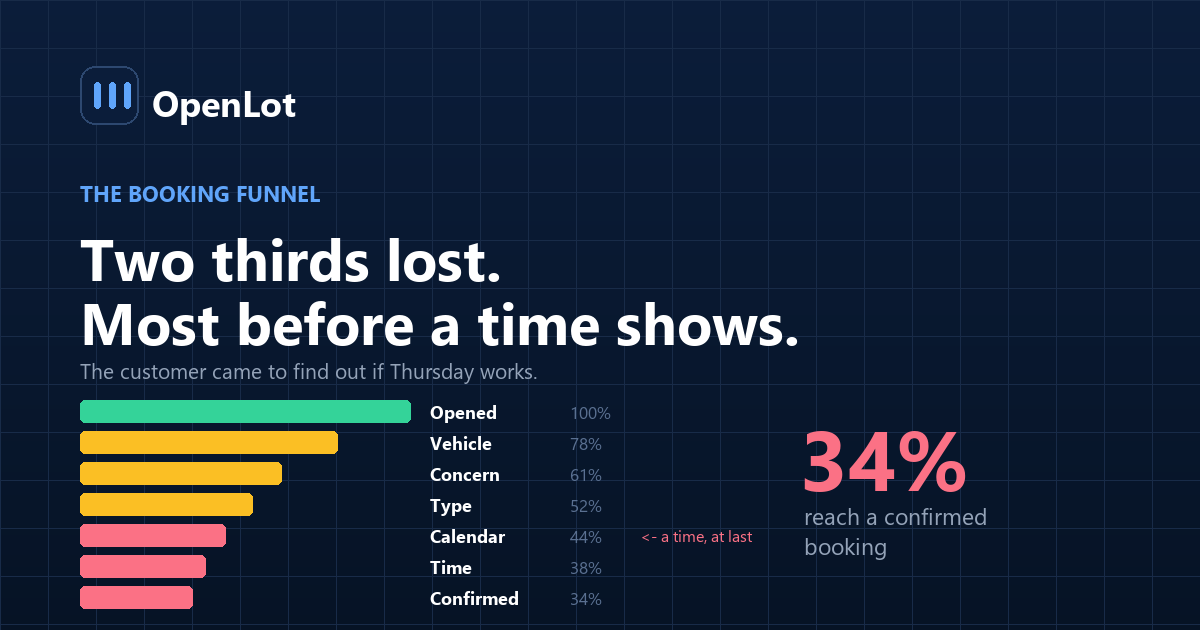
The booking funnel
Illustrative. Instrument your own; most schedulers will not report this without being asked.
Step Still with you Opened the scheduler 100% Selected a vehicle 78% Entered the concern 61% Chose a service type 52% Reached the calendar 44% Selected a time 38% Confirmed 34% Two thirds lost, and the largest single drop is before anyone sees a time. The customer wanted availability and was given a form.
The diagnostic version of this is to flip the order and measure again. Showing availability first, then collecting detail, usually moves the completion rate more than any amount of redesign within the existing sequence.
The six things that cost you customers
- Vehicle lookup that fails. VIN entry, a year/make/model picker that does not include their trim, or a "we could not find your vehicle" dead end.
- Asking for the concern as free text, first. The customer does not know the right words. "Making a noise" is what they have.
- Service-type menus written for the shop. "30k interval maintenance" means nothing to someone who wants an oil change.
- No visible availability. A request form that promises a callback is not a booking, and the customer knows it.
- Required fields that are not required. Preferred advisor, secondary phone, mileage to the exact digit.
- No price or duration anywhere. Booking blind is uncomfortable, and the discomfort shows up as abandonment.
What does a conversational flow change?
It inverts the order. Availability first, detail second, and detail collected only where it changes the booking.
| Form-based | Conversational | |
|---|---|---|
| First thing shown | Vehicle lookup | A time that works |
| Questions before a time | Six to eleven | One to three |
| Unknown concern | Dead end or free text | Handled by asking what they noticed |
| Wrong vehicle in system | Blocks the booking | Asks and continues |
| Changing the appointment | Start over | Continue the thread |
The last row matters more than it looks. Reschedules are a large share of service traffic, and a flow that forces a customer to rebuild the whole booking produces a phone call — which lands in the service department's call queue at the worst time of day.
The three questions that are actually needed
Everything else can be collected later or inferred:
- Which vehicle — resolved from phone number or plate where possible, asked only when ambiguous.
- What they noticed — in their words, not a service-code menu.
- When — offered against real availability, two or three concrete options rather than an open calendar.
Advisors can refine the rest at check-in. A booking is not a repair order.
What must the system check before offering a time?
This is where scheduling AI either works or quietly damages the shop.
Capacity, not calendar slots. An open slot on a calendar is not the same as available technician hours. A system offering times without reference to bay and technician capacity will book a shop past what it can produce, which turns a booking win into a promise-time failure.
Skill match. A diesel concern does not fit in a slot where the only available technician is not diesel-certified.
Parts. For known-concern bookings, whether the part is on the shelf or needs ordering changes which day to offer.
Duration by concern type. An oil change and a check-engine diagnosis are not the same block of time, and a scheduler that treats them identically creates the overbooking the shop then absorbs.
A scheduler without these four checks is a calendar with a dealership logo on it.
Where does scheduling AI fail?
1. Offering slots the shop cannot produce. Covered above, and it is the failure that converts a successful deployment into a complaint queue.
2. Collecting detail the advisor re-collects anyway. If the customer answers eight questions online and is asked the same eight at check-in, the online flow added friction and removed nothing.
3. Guessing a price. A duration estimate is reasonable; a repair price before inspection is a commitment the shop has to honour.
4. No path to a person. Some bookings are genuinely complex, and the escalation boundary is the same one that governs the rest of the service drive. A flow with no visible escalation produces an abandoned session rather than a phone call.
5. Breaking on the reschedule. The most common real-world interaction after booking, and frequently the least designed.
6. Treating service consent as covered by sales consent. Service messaging has its own obligations, and the dealership is the accountable party under the Safeguards Rule and applicable messaging rules.
What should you measure?
| Metric | How to compute | What it catches |
|---|---|---|
| Step-by-step completion | Customers remaining at each step ÷ started | The exact abandonment point |
| Time to first availability shown | Steps, or seconds, before a real slot appears | The single biggest lever |
| Questions asked before confirmation | Count | Usually three times what is needed |
| Reschedule completion rate | Completed reschedules ÷ attempted | The flow nobody designs |
| Booked-to-arrived | Attended ÷ booked, online bookings only | Whether online bookings are as real as phone ones |
| Overbooked days | Days where hours booked exceeded hours available | Whether the scheduler respects capacity |
The second row is the one to act on first. If a customer has to pass four steps before seeing a time, the redesign is the fix and no amount of conversational polish substitutes for it.
Frequently asked questions
Why do customers abandon dealership online service booking?
Mostly because they have to answer several questions before seeing any availability. The largest single drop in a typical flow happens before a time is ever shown, which means the customer came to find out whether Thursday works and was given a form instead. Step count, not interface design, is the usual cause.
How many questions should a service booking ask?
Three before confirming: which vehicle, what the customer noticed in their own words, and when. Everything else — exact mileage, preferred advisor, service codes — can be refined by an advisor at check-in, because a booking is not a repair order.
What does conversational service scheduling change?
It inverts the order, offering real availability first and collecting detail only where it changes the booking. It also handles the cases a form cannot: an unknown concern, a vehicle that is not in the system correctly, and a reschedule that continues the existing thread rather than starting over.
Can a scheduling system book past what the shop can handle?
Yes, and it routinely does when the system works from calendar slots rather than from technician hours. An open slot is not available capacity. A scheduler that does not check hours, skill match, parts availability and duration by concern type will fill the shop faster than it can produce, which converts a booking gain into slipping promise times.
Should the scheduler show service prices?
It can show durations and published maintenance pricing, but not repair estimates for an uninspected concern. A price offered before anyone has looked at the vehicle becomes an obligation, and withdrawing it costs more than the convenience of having quoted.
Why does the reschedule flow matter so much?
Because rescheduling is one of the most common interactions after booking, and a flow that forces the customer to rebuild the entire appointment produces a phone call instead — usually landing in the service call queue during its busiest hour. Reschedules should continue the existing conversation.
Do online service bookings show up as reliably as phone bookings?
Not automatically, and it is worth measuring separately. Bookings made with less friction can carry less commitment, so booked-to-arrived should be tracked by channel. If online bookings show at a materially lower rate, the fix is usually a confirmation sequence rather than a harder booking flow.
Does service messaging need its own consent handling?
Yes. Service reminders, confirmations and status updates are outbound messaging with their own consent, contact-time and opt-out requirements, and service-side systems are frequently configured without the consent logging the sales side already has. The dealership is the accountable party regardless of which vendor sends the message.
Conclusion
- The biggest drop happens before a time is shown. Availability first, detail second.
- Three questions, not eleven. Vehicle, what they noticed, when.
- Calendar slots are not capacity. Check hours, skill, parts and duration or the shop absorbs it.
- Design the reschedule. It is the most common post-booking interaction and the least built.
- Never quote a repair before inspection. A duration is help; a price is an obligation.
Last updated: