A missed call at a dealership is a customer who chose the phone, which is the highest-intent channel you have. Most stores have never counted theirs — the number sits in the phone system report nobody opens, and it is usually larger than the volume of any single paid lead source.
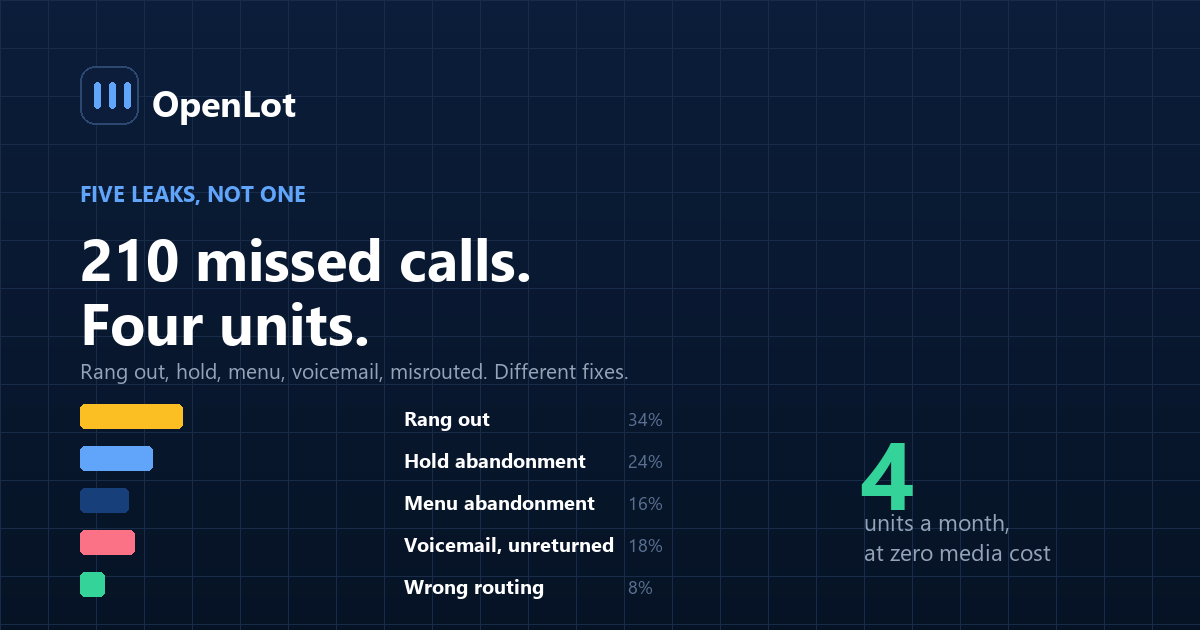
This guide covers how to size your own missed-call leak, the five places calls disappear, which ones are worth recovering, what actually works, and what to measure.
How big is the leak?
Pull the report. Almost every phone system has it, and almost nobody opens it.
What you want is not one number but five: calls that rang unanswered, calls abandoned on hold, calls that hit a menu and hung up, calls routed to voicemail, and voicemails never returned. They are different problems with different fixes, and a single "missed calls" figure blends them into something unactionable.
Sizing the leak
Illustrative. Substitute your own counts and your own closing numbers.
A store taking 1,400 inbound calls a month, of which 210 are missed by any definition — 15%, which is not an unusual figure once hold abandonment and unreturned voicemails are included.
Step Figure Missed calls 210 Sales and service enquiries, not vendors or wrong numbers ~55% → 116 Would have reached a two-way conversation ~45% → 52 Would have set an appointment ~35% → 18 Would have shown and bought ~20% → 4 units Four units a month, at contribution rather than gross. Run it with your own ratios — the point is that the chain is short and every term in it is something you already measure.
Note the second row. Roughly half of "missed calls" are not customers at all, which is why an unfiltered number overstates the problem and an uncounted one understates it.
The leak has a second property that makes it worse than the arithmetic suggests: a customer who calls has higher intent than one who submits a form. They chose the slower, more committal channel. Losing them costs more per head than losing a form fill — the dynamic behind why dealership phones lose deals.
Where do the calls actually go?
| Where | What happened | Usually caused by |
|---|---|---|
| Rang out | Nobody picked up | Everyone on another call, or after hours |
| Hold abandonment | Picked up, then abandoned | Hold time past roughly 45 seconds |
| Menu abandonment | Hung up in the phone tree | Too many options, or the right one is not there |
| Voicemail, never returned | Left a message into a box nobody checks | No owner for the box |
| Wrong routing | Reached the wrong department, gave up | A menu built around the org chart |
The last two are the ones stores underestimate. A voicemail box with no named owner is a hole in the floor, and a call routed to the service drive when the customer wanted sales is frequently recorded as answered.
The ones worth recovering
Not all of them. In descending order of value:
- After-hours rings. Highest intent, zero coverage, cheapest to fix.
- Unreturned voicemails. The customer already told you what they wanted.
- Hold abandonment during peak. Predictable, and solvable with routing.
- Menu abandonment. Fixable by simplifying, often in an afternoon.
- Wrong routing. Worth fixing, but it is a process change rather than a recovery.
What actually recovers them?
Text-back on a missed call. The single highest-return change available, and the cheapest. An automatic message within a minute — "Sorry we missed you, this is [store], can we help with the [vehicle]?" — converts a dead call into an open thread on a channel the customer can answer at their convenience. It works because it moves the conversation rather than asking the customer to try again.
Voicemail with a named owner and a deadline. Not technology. A person, a box, and a standard: every voicemail returned within two hours during business hours and by 10am the next morning otherwise.
Overflow routing. When the primary line is busy, ring a second group rather than a voicemail box. Most phone systems already do this and most stores have not configured it.
After-hours coverage. Whatever is covering your after-hours leads should cover the phone too, or you have solved half the problem — the options and their trade-offs are in after-hours lead response.
A shorter menu. Three options, not seven. Every layer loses callers.
What does not work
Adding a receptionist to a volume problem that is concentrated in two peak hours. Buying call tracking and never reading the reports. And asking staff to "answer faster," which is not a mechanism.
Where does missed-call recovery go wrong?
1. Counting unfiltered. Half of raw missed calls are vendors, wrong numbers and robocalls. An unfiltered number is unusable and gets dismissed, which is why nobody acts on it.
2. Text-back with nothing behind it. The automatic text goes out, the customer replies, and the reply lands in an inbox checked twice a day. Worse than not sending it — and it is the same notification gap as in the three free response fixes.
3. Consent ignored. An automated text to a missed caller is outbound messaging, with the consent and opt-out obligations that implies, and the dealership is the accountable party — see the Safeguards Rule requirements.
4. Fixing the menu without fixing the hours. The tree gets shorter and the 7pm calls still ring out.
5. No attribution. Recovered calls that are not tagged as recovered cannot be defended at budget time, and the programme quietly dies — the same gap as in lead source attribution.
What should you measure?
| Metric | How to compute | What it tells you |
|---|---|---|
| Missed calls, filtered | Raw misses minus vendors, robocalls, wrong numbers | The real size of the leak |
| Missed calls by hour | Bucketed, including after hours | Whether it is a staffing or a coverage problem |
| Hold abandonment rate | Abandoned ÷ calls placed on hold | Whether routing or headcount is the issue |
| Voicemail return rate and latency | Returned ÷ left, and median time | Usually the worst number in the set |
| Text-back reply rate | Replies ÷ text-backs sent | Whether recovery is producing conversations |
| Recovered to appointment | Appointments from recovered calls | The number that defends the programme |
Run the first two before buying anything. A leak concentrated between 5pm and 9pm is a coverage problem; one concentrated at 11am Saturday is a staffing problem, and they do not have the same fix.
Frequently asked questions
How many calls does a typical car dealership miss?
More than most stores assume, with figures in the low-to-mid teens as a share of inbound calls once hold abandonment, menu abandonment and unreturned voicemails are counted alongside unanswered rings. The only number worth acting on is your own, pulled from the phone system and filtered to remove vendors, robocalls and wrong numbers.
What is the fastest way to recover missed calls at a dealership?
An automatic text-back within a minute of a missed call, identifying the store and referencing what the caller likely wanted. It converts a dead call into an open thread on a channel the customer can answer when convenient, and it requires no additional headcount. It only works if someone is actually watching the replies.
Is a missed call worth more than a missed form lead?
Generally yes, because the customer chose a slower and more committal channel. Picking up the phone signals higher intent than submitting a form, so the loss per missed call tends to exceed the loss per unworked form lead, even though form leads usually receive far more operational attention.
Why do callers abandon while on hold?
Because hold time past roughly three quarters of a minute starts shedding callers quickly, and dealership hold times cluster during predictable peaks. The fix is usually routing rather than headcount: configuring overflow so a busy primary line rings a second group instead of dropping the caller into a voicemail box.
Should automated text-backs worry us from a compliance standpoint?
They are outbound messaging and carry the consent, contact-time and opt-out obligations that implies, with the dealership as the accountable party regardless of which vendor sends them. In practice this means the system has to log consent state, honour opt-outs immediately, and keep an auditable record — features to confirm before deployment rather than after.
What should happen to voicemails?
They need a named owner and a written standard: returned within a couple of hours during business hours and by mid-morning the next day otherwise. Voicemail return rate and median return latency are usually the worst numbers in the set, and they are fixed by assignment rather than by technology.
How do we tell whether the problem is staffing or coverage?
Bucket missed calls by hour and weekday. A leak concentrated outside staffed hours is a coverage problem that more headcount during the day will not touch. A leak concentrated inside staffed hours at predictable peaks is a routing or staffing problem, and automation aimed at nights will not help it.
How do we prove the recovery programme is working?
Tag recovered calls as a source and follow them to appointment and sale, the same way any lead source is tracked. Recovery efforts that are not attributed cannot be defended when budgets are reviewed, and they tend to be quietly dropped despite working.
Conclusion
- Count it before fixing it, and filter out the vendors and robocalls or the number gets dismissed.
- Five different leaks, not one. Rang out, hold abandonment, menu abandonment, voicemail, misrouting.
- Text-back is the highest-return fix and it is cheap — provided someone watches the replies.
- Voicemail is fixed by assignment, not technology: a named owner and a deadline.
- Bucket by hour first. Coverage problems and staffing problems look identical in a single total.
Last updated: