Inbound phone handling is where dealerships lose customers who were already sold on calling. A study of nearly 3,000 U.S. dealerships found an average hold time of 3 minutes and 5 seconds, and that 31.8% of unconnected calls were customers who hung up waiting. These are not cold leads. They are people who found you, chose to call, and gave up.
This guide covers where inbound calls actually die, why the losses are invisible from inside the store, and what to change first.
Where do dealership phone calls actually die?
Not, mostly, in the conversation. Before it.
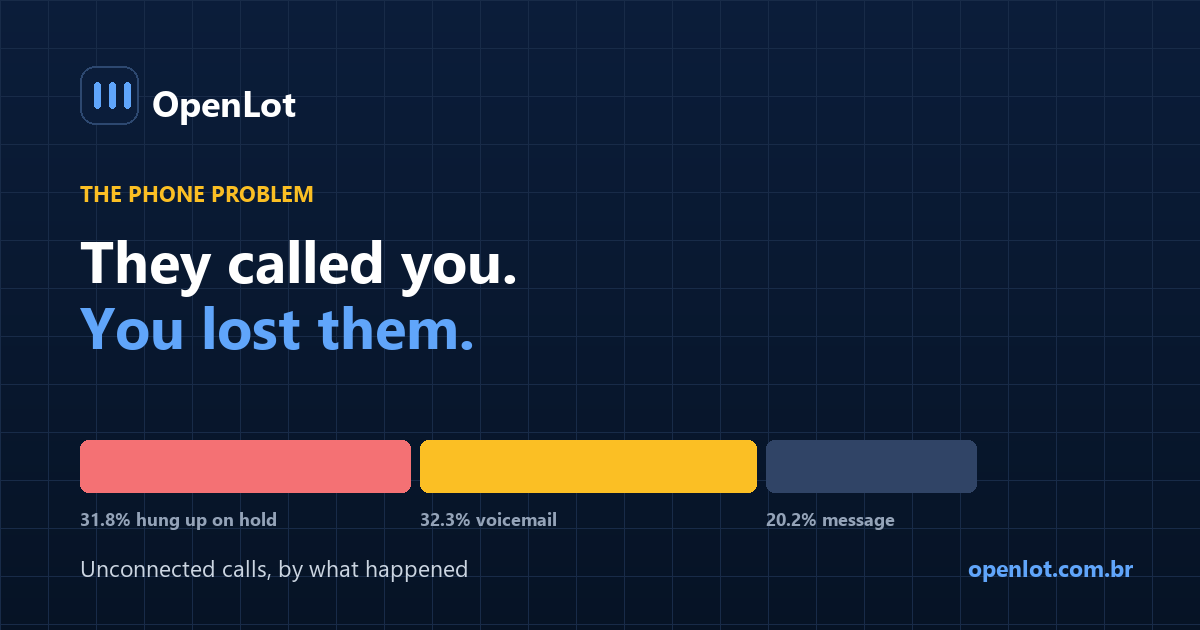
The Car Wars analysis of nearly 3,000 dealerships across 2024 broke down calls that never connected to a person:
| Outcome | Share of unconnected calls |
|---|---|
| Hung up while on hold | 31.8% |
| Left a voicemail | 32.3% |
| Left a message with a person | 20.2% |
Read that top row carefully. Roughly a third of calls that failed to connect were people actively waiting to talk to you — and the average hold time across those stores was 3 minutes and 5 seconds.
Three minutes is a long time to hold for a car. It is not a long time to spend calling the next dealer.
Why this is worse than a lost internet lead
A phone call is further down the funnel than a form. The customer has already chosen you specifically, already decided to spend effort, and is available to talk right now — which is the condition every follow-up process exists to manufacture.
Losing that call means losing the highest-intent contact you will get that day, and you paid the marketing cost to produce it.
Why the problem is invisible from inside the store
Three structural blind spots.
Abandoned calls leave no trace anyone reviews. A customer who hangs up at 2:40 on hold generates no lead, no CRM record, no voicemail and no complaint. Nobody in the store experiences the loss. The only place it exists is the phone system log, which most stores never open.
The team's experience contradicts the data. Salespeople remember the calls they took. Nobody remembers the call they did not receive because the customer gave up in the queue.
Peak hours are exactly when nobody is free to look. Call volume concentrates — Monday is the busiest day, 10 AM to noon the heaviest window, July and August the peak months. Those are also when the floor is most occupied, so the hold queue is longest precisely when the most callers are in it.
The pattern compounds: your worst phone experience happens during your highest-value hours.
What the queue actually costs
A framework — substitute your own call volume.
A store taking 600 inbound sales calls a month, with 25% failing to connect, has 150 unconnected calls. Applying the 31.8% abandonment share, roughly 48 of those were people on hold who gave up.
- At a 20% appointment rate on connected sales calls → about 10 lost appointments
- At a 50% show rate → about 5 showroom visits
- At a 30% close rate → roughly 1.5 units per month
Small-sounding, until you annualize: 15 to 20 units a year, from customers who called you, on marketing you already bought.
And unlike a lead-quality problem, this one has no acquisition cost attached to fixing it.
What to fix, in order
1. Measure it before anything else
Pull from your phone system, for 30 days:
- Total inbound sales calls
- How many connected to a person
- Abandonment rate and average time before abandonment
- Hold time distribution — the median and the tail, not just the average
- Abandonment by hour and day
If your system cannot produce these, that is the first finding. A phone system that cannot report on abandonment is a phone system that guarantees the problem stays invisible.
2. Set a hold ceiling and route past it
Thirty seconds is a reasonable ceiling for a sales call. Past that, the call should route somewhere — an overflow group, a BDC, an answering service — rather than continuing to wait. A caller who is transferred at 30 seconds has a better experience than one who waits three minutes and reaches the same person.
3. Fix the IVR before fixing anything else
Every menu layer sheds callers. A sales caller who has to navigate three levels to reach a human has already been given three chances to quit.
Test it yourself: call your own main number as a customer, from outside, and count the presses and seconds before a human could possibly answer. Most dealer principals are surprised, and the test costs two minutes.
4. Treat voicemail as a failure, not a capture
Voicemail accounted for 32.3% of unconnected calls. Those customers are calling other stores while waiting for a callback. Every voicemail should generate an immediate outbound attempt — measured in minutes, with an owner — or it is just a record of a customer you lost.
5. Staff the queue to the peak, not the average
Monday morning and mid-morning generally. Staffing to average volume guarantees the queue every time volume is above average, which by definition is half the time.
6. Log every call to the CRM
A call that is not logged did not happen, as far as follow-up is concerned. If logging is manual, it will be incomplete — reliably, under exactly the pressure that makes the call matter most.
What about missed calls after hours?
Same analysis, different answer. After-hours calls do not have a hold problem; they have a nobody-there problem.
| Scenario | Fix |
|---|---|
| On hold during business hours | Route past a 30-second ceiling |
| Ringing unanswered, staffed hours | Staffing and routing |
| After hours | Overflow service, or automation that can actually answer |
| Voicemail left | Callback SLA measured in minutes |
The distinction matters because the fixes cost different amounts. Hold abandonment is usually a routing configuration — cheap. After-hours coverage is a staffing or vendor decision — not cheap. Stores that do not separate the two often buy the expensive fix for the cheap problem.
Frequently asked questions
How long will a customer hold before hanging up at a dealership?
Industry analysis found average hold times of 3 minutes 5 seconds across nearly 3,000 dealerships, with 31.8% of unconnected calls being customers who abandoned while waiting. Thirty seconds is a reasonable internal ceiling before routing the call elsewhere.
What percentage of dealership calls never reach a person?
It varies by store, which is why you should measure yours. What the industry data establishes is the composition of those failures: roughly a third abandon on hold, a third leave voicemail, a fifth leave a message with a person.
Is voicemail an acceptable way to capture dealership calls?
Only if it triggers an immediate callback with a named owner and a response time measured in minutes. Otherwise it is a record of a customer who is now calling your competitor.
How do I know if my dealership has a phone problem?
Call your own main number from outside during Monday mid-morning and count the seconds and menu presses before a human could answer. Then pull 30 days of abandonment data from your phone system. Those two checks answer the question.
Should dealerships use an IVR menu for sales calls?
Keep it minimal. Every menu layer sheds callers, and sales calls are the highest-intent contacts you receive. If a menu is unavoidable, the path to a human should be one press.
Why do my salespeople say the phones are fine?
Because they experience the calls they answered. Abandoned calls generate no record anyone reviews — no lead, no CRM entry, no complaint. The loss is only visible in the phone system logs.
Are phone leads more valuable than internet leads?
Generally yes, because the customer is further along and available to talk immediately. That is also why losing them on hold is more expensive than losing a form submission.
Conclusion
- A third of unconnected calls are people who waited and gave up. They had the highest intent of anyone who contacted you that day.
- The loss is invisible internally. No lead, no record, no complaint — only a line in a log nobody opens.
- Peak volume and worst service coincide. The queue is longest exactly when the most people are in it.
- Set a 30-second hold ceiling and route past it. This is usually a configuration change, not a hiring decision.
- Separate hold abandonment from after-hours. Different problems, very different costs to fix.
Call your own number Monday at 10 AM, from outside, and time it. That single test tells you whether to keep reading or start reconfiguring.
Source: Car Wars analysis of nearly 3,000 U.S. dealerships, 2024, as reported by DealershipGuy.
Last updated: