After-hours lead response is what happens to an internet lead that arrives when nobody is working. At a well-staffed store that is 99 hours a week, and there are only four ways to cover it: longer shifts, an outsourced BDC, an on-call rotation, or automation. Each one breaks differently.
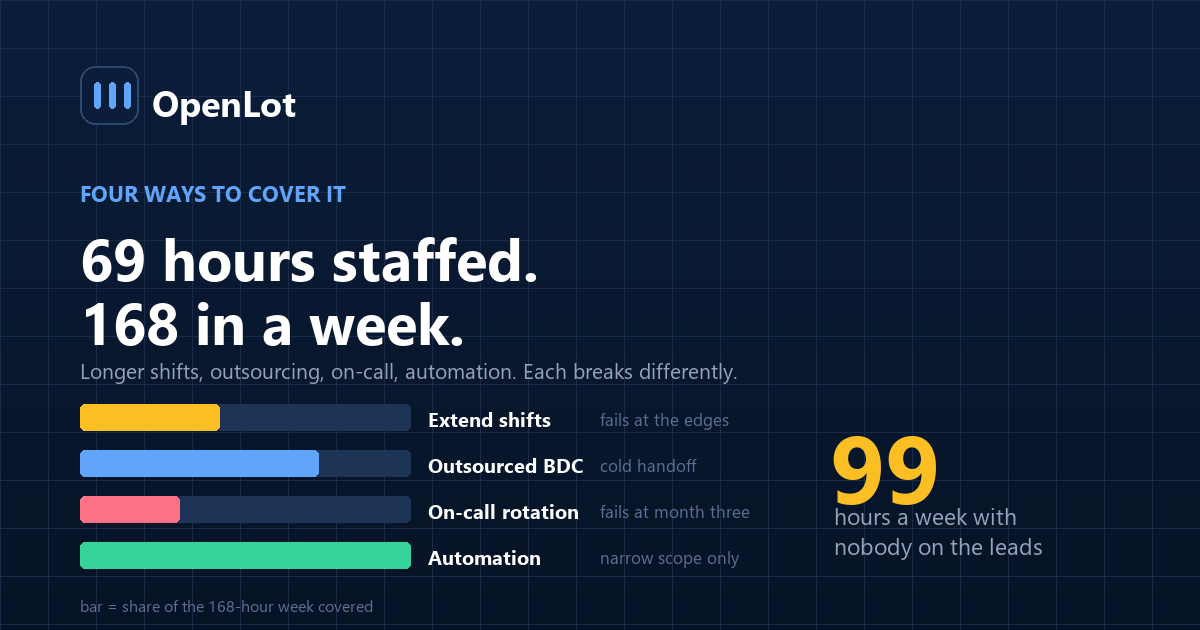
This guide covers how to measure your own gap rather than quoting someone else's, the four ways to cover it with their real costs, where each one fails, and what to measure before and after.
How big is the gap, actually?
Two numbers, and you need both. One is how many hours nobody is working. The other is how many leads land in those hours — and they are not the same number, because leads do not arrive evenly.
The coverage arithmetic
Illustrative. Run it against your own schedule.
A well-staffed BDC works Mon–Fri 8am–8pm and Sat 9am–6pm, closed Sunday.
- Staffed: (12 × 5) + 9 = 69 hours
- A week: 168 hours
- Uncovered: 99 hours — 59% of the week
Most stores are worse than this. A BDC working 9–6 weekdays with a half-day Saturday covers 49 hours, which is 71% uncovered. And the worst single block is the same every week: Saturday evening to Monday morning.
The second number has to come from your own CRM. The industry working range puts somewhere around 56–60% of leads outside business hours, but that figure circulates without a primary study behind it and your market is not the average. Pull 90 days of lead timestamps, bucket by hour and weekday, and count.
The two numbers together tell you what the gap is worth. 59% of the week uncovered with 20% of leads arriving in it is an annoyance. 59% uncovered with 60% of leads arriving in it is the largest controllable problem in the store.
And the staffed block is not automatically safe either: 19% of dealers take more than an hour to answer an internet lead during business hours — DAS Technology's Lead Response Study, 1,700 U.S. dealerships, collected Q3–Q4 2024 and presented at NADA 2025. Coverage is necessary and not sufficient, which is the subject of response time benchmarks.
What are the four ways to cover it?
| Option | Latency achieved | Cost shape | Breaks when |
|---|---|---|---|
| Extend shifts | Minutes, during extended hours only | Wages + shift premium, recurring | You try to staff 11pm or Sunday |
| Outsourced BDC | Minutes, if contracted that way | Per lead or per seat, recurring | Scripts go off-brand; handoff is cold |
| On-call rotation | 15–60 minutes, inconsistent | Low cash, high goodwill | The third month |
| Automation | Seconds, all 168 hours | Licence + integration + internal hours | It is asked to do more than respond |
None of these is the obvious answer for every store, and the right one depends on how many leads are in the gap and what you are trying to do with them.
Extend shifts
The straightforward option, and the one that works best for the first two hours past close. Evening traffic is real and an 8pm shift is staffable.
It stops working at the edges. A 10pm–2am slot in a BDC is hard to hire for, harder to retain, and the people who accept it are frequently the people looking hardest for something else — which feeds the turnover problem rather than the coverage one. Sunday is its own fight.
Cost is honest and visible: wages plus premium, every week, forever.
Outsourced BDC
Buys coverage without hiring, and a good vendor answers in minutes at 1am — though what a vendor means by 24/7 varies more than the phrase suggests.
Two things determine whether it works. First, how cold the handoff is — an outsourced agent who qualified a customer at midnight is not in your showroom at 10am, so the context has to transfer, and usually it transfers as a CRM note nobody reads. Second, whether the scripts sound like your store. Per-lead pricing also means the cost rises precisely in the months you are doing well.
On-call rotation
A manager keeps a phone. Cheap in cash and expensive in everything else.
Response times are real but inconsistent — 15 minutes if awake, 9 hours if not — and the arrangement degrades on a schedule. Month one it is a team effort. Month three it is resented. It is a bridge, not a plan.
Automation
Responds in seconds across all 168 hours, runs the follow-up cadence without anyone remembering to, and logs everything.
It covers one narrow job well: respond, qualify, book, escalate. Ask it to negotiate, quote or handle an upset customer and it produces commitments you have to unwind — the boundary covered in AI BDC failure modes. It also amplifies a dirty database rather than revealing it.
And it does nothing at all if the handoff is unstaffed. Which leads to the thing most stores get wrong.
Where does after-hours coverage actually fail?
1. The gap was never measured. Buying coverage without knowing what share of leads is in the gap is buying a solution sized by a vendor's average rather than your store's data.
2. Fast response, nothing behind it. The DAS study also measured quality: 74% of responses included no price quote, 90% sent no vehicle photos, and 26% omitted vehicle information entirely. A sixty-second reply that answers nothing is a sixty-second reply that answers nothing.
3. The handoff is unstaffed. The 11pm lead gets an instant reply, agrees to come in Saturday, and the thread sits until Monday because the morning queue is a person deep. The bottleneck moved; it did not close.
4. Only the hours moved, not the behaviour. Extending to 8pm does nothing if the 8:05pm lead still waits until morning because the last hour is spent on admin.
5. Consent and hours rules ignored. Automated outbound at 11pm touches contact-time restrictions and consent records, and the dealership is the accountable party — see your Safeguards Rule obligations.
How do you choose between them?
Three questions, in order.
What share of your leads is in the gap? Under 25%, extend shifts and stop. Over 45%, no staffing answer covers it economically and you are choosing between outsourcing and automation.
What happens to a lead you reach at midnight? If nobody can continue the conversation before 10am, the realistic goal is a booked appointment with a confirmation, not a live conversation. That favours automation, which is good at booking and bad at conversation.
Who picks up the handoff, and when? If the answer is "whoever is free," you have not finished designing the coverage. Front-of-funnel speed only produces revenue if something absorbs it.
What should you measure?
| Metric | How to compute | What it decides |
|---|---|---|
| Leads by hour and weekday | 90 days of timestamps, bucketed | The size of the gap, in your market |
| First-touch time, by day-part | Lead timestamp → first outbound, per bucket | Where the latency actually lives |
| Contact rate, in-gap vs in-hours | Two-way conversations ÷ leads, split | Whether gap leads are reachable at all |
| Handoff pickup time | Escalation → first human reply | Whether coverage can convert |
| Appointment show rate, by source hour | Attended ÷ set | Whether midnight appointments are real |
The last row is the one that settles arguments. Appointments booked at midnight that nobody attends are activity, not revenue.
Frequently asked questions
What is after-hours lead response at a dealership?
It is how a store handles internet leads that arrive outside staffed hours. At a well-staffed BDC working weekdays 8am–8pm and Saturday 9am–6pm, 99 of the week's 168 hours are unstaffed, and leads arriving in that window wait until the next shift unless some form of coverage exists.
What percentage of car dealership leads come in after hours?
The figure commonly cited across the industry sits somewhere in the 56–60% range, but it circulates without a primary study behind it and should be treated as a prompt to measure rather than a fact. Pull 90 days of lead timestamps from your CRM, bucket them by hour and weekday, and compare against your staffed block — the number for your market is the only one that matters.
Is it cheaper to extend BDC hours or automate?
Extending hours is usually cheaper and simpler for the first two hours past close, where shifts are still staffable. Past roughly 10pm and on Sundays the wage premium and turnover cost rise sharply while lead volume thins, which is where automation becomes the economical option. The crossover depends on what share of your leads actually lands in the late window.
Does an outsourced BDC solve after-hours coverage?
It covers the hours, and whether it works depends on the handoff. An agent who qualified a customer at 1am is not in your showroom the next morning, so unless the context transfers in a form the day team actually reads, the customer repeats themselves and the advantage is lost. Per-lead pricing also scales the cost up in your strongest months.
Why does an on-call rotation stop working?
Because it runs on goodwill rather than structure. Response times are inconsistent by design — fast if the manager is awake, hours if not — and the arrangement reliably degrades after the first couple of months as the novelty wears off. It is a usable bridge while something durable is built, not a plan.
What happens if we respond instantly but have nobody to follow up?
The bottleneck moves rather than closing, and the customer experience gets worse rather than better. An instant reply sets an expectation of responsiveness that an unattended queue then breaks, which lands worse than a slow first response would have. Staffing the handoff point is part of the coverage decision, not a separate problem.
Is a fast response enough on its own?
No. The DAS Technology study that measured response time also measured content, and found 74% of dealer responses included no price quote, 90% sent no vehicle photos and 26% omitted vehicle information altogether. Speed without substance produces a timestamp, not a conversation.
Are there legal limits on contacting leads late at night?
Yes, and they are yours to observe regardless of who or what sends the message. Automated outbound touches contact-time restrictions, consent records and opt-out handling, and the dealership is the accountable party under the FTC Safeguards Rule and applicable messaging rules. Whatever covers your after-hours window needs to log consent and honour opt-outs as a first-class feature.
Should we cover Sunday?
Measure it before deciding. Sunday is the single most commonly uncovered day and in many markets a meaningful share of weekly leads arrives on it, with the Saturday-evening-to-Monday-morning stretch producing the longest waits of the week. Whether it is worth covering depends entirely on what your own timestamps show.
Conclusion
- Two numbers, not one. Hours uncovered and share of leads in those hours. The second one has to come from your CRM.
- Four options, each breaking differently. Shifts fail at the edges, outsourcing fails at the handoff, on-call fails at month three, automation fails when over-scoped.
- Under 25% of leads in the gap, extend shifts. Over 45%, no staffing answer covers it economically.
- Speed without substance is a timestamp. Three quarters of dealer responses contain no price and no photos.
- Staff the handoff or the coverage does not convert. Front-of-funnel speed needs something to absorb it.
Last updated: