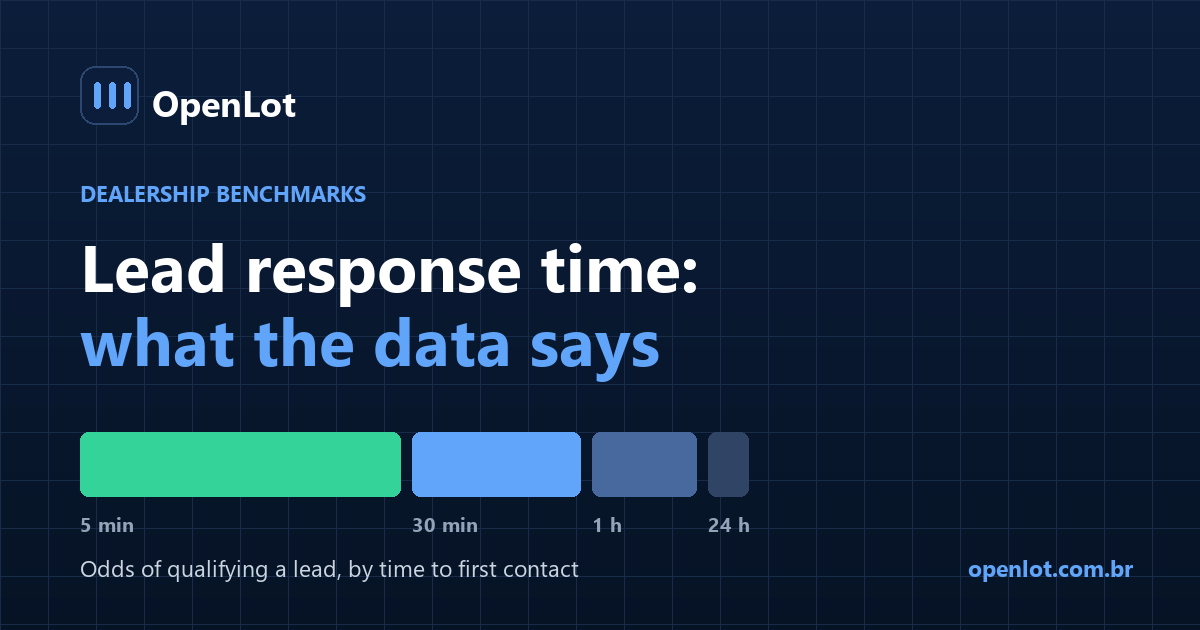
Dealership lead response time is the elapsed time between an internet lead arriving and a salesperson or automated system making first contact. The research consensus is narrow: respond within five minutes. Past that window, the odds of ever qualifying that lead fall sharply, and most dealers are nowhere near it — roughly one in five take more than an hour, while more than half of all leads arrive when the showroom is closed.
This guide covers what the benchmark actually is, why most stores miss it, how to measure your own number, and what fixes it.
What is dealership lead response time, and how is it measured?
Lead response time is measured from lead timestamp — the moment the lead hits your CRM — to first meaningful outbound contact, meaning a call connected, a text sent, or a personalized email delivered.
Three things are often confused, and conflating them is why so many stores believe their number is better than it is:
| Metric | What it measures | Why it misleads |
|---|---|---|
| Auto-responder time | Time until the automated "thanks for your interest" email fires | Near-instant by design. Tells you nothing about human engagement |
| First-touch time | Time until a human attempts contact | The number that matters, and the one this article uses |
| Time to connect | Time until the customer actually answers | Useful, but confounded by the customer's availability |
If your CRM reports a two-minute average response time, check whether it is counting the auto-responder. Most do.
What counts as a "lead" for this metric?
Only leads where the customer expects a reply: website form fills, third-party marketplace leads (Autotrader, Cars.com, CarGurus), chat transcripts with contact details, and inbound texts. Service appointments and finance pre-approvals usually run on separate SLAs and should be measured separately.
How fast should a dealership respond to a lead?
Within five minutes. That is the operative benchmark, and it comes from response-time research that has been replicated across industries for over a decade.
The two foundational findings:
- Contacting a lead within five minutes versus 30 minutes makes a firm roughly 21x more likely to qualify that lead — and 100x more likely to connect with it at all. From Dr. James Oldroyd's research at MIT Sloan with InsideSales.com, covering three years of data across six companies, 15,000+ leads and 100,000+ call attempts.
- Firms that responded within an hour were nearly 7x more likely to qualify a lead — defined as having a meaningful conversation with a key decision maker — than those that waited just one hour longer, and more than 60x more likely than those that waited 24 hours or more. From "The Short Life of Online Sales Leads," Harvard Business Review (2011), an audit of 2,241 U.S. companies. That same audit found 23% never responded at all.
Translated into the windows a dealership actually operates in:
| Time to first contact | Practical reading |
|---|---|
| Under 5 min | The benchmark. Customer is still on your site or a competitor's |
| 5–30 min | Still viable, but qualification odds drop steeply across this band |
| 30–60 min | Customer has very likely submitted a form to another store |
| 1–24 h | Recovery, not response. Expect to compete on price |
| 24 h+ | Effectively a cold lead |
The reason the curve is so steep is not customer impatience — it is parallel shopping. A car buyer rarely submits one form. They submit three or four in the same session. The response window is not a courtesy standard; it is a race against the other stores that received the same lead at the same minute.
Why do most dealerships miss the five-minute window?
Not because salespeople are slow. Because of three structural gaps that no amount of coaching fixes.
1. Leads arrive when nobody is working
Industry estimates consistently put 56–60% of dealership leads arriving after business hours, when most showrooms are closed. Treat this as a working range rather than a hard figure — it circulates widely in automotive vendor reporting without a single primary study behind it. Measure it in your own CRM before planning around it; the day-part split in your lead export will give you the real number for your store.
This is the dominant cause, and it is arithmetic, not effort. A store open 12 hours a day has the lights off for half the week. Evenings and Sundays are exactly when people shop for cars — after work, from the couch. A lead that arrives at 9:48 PM Saturday and gets a call at 9:15 AM Monday has a 35-hour response time, no matter how fast the BDC moves on Monday morning.
2. Leads land in more than one place
Marketplace leads arrive in the vendor's own dashboard, the CRM, and often an email alias. When three systems each hold part of the truth, nobody owns the clock. The lead is not ignored — it is assumed handled by someone else.
3. The measurement itself is wrong
19% of dealers take more than an hour to answer an internet lead, and 4% never respond at all — DAS Technology Lead Response Study, 1,700 non-DAS U.S. dealerships, Q3–Q4 2024, presented at NADA 2025. That figure runs consistently higher than what dealers self-report, because most stores are reading the auto-responder timestamp, not first human touch.
The same study found that speed is only half the problem. Among dealers who did respond: 74% did not include a price quote, 90% sent no vehicle photos, and 26% omitted vehicle information entirely. A fast reply that answers none of the customer's questions is a timestamp, not a response.
What does a slow response actually cost?
Here is the part most response-time articles skip: the month-level arithmetic.
The response leak model
This is our own framework, not a published study. The inputs are yours to replace — the point is the structure, not our placeholder numbers.
Take a single rooftop receiving 300 internet leads per month.
- 56% arrive after hours (the industry working range — use your own CRM figure) → 168 leads land with nobody on shift
- Of those, assume half are still reachable the next morning → 84 leads meaningfully delayed
- Apply a conservative 3x qualification penalty for the delay (well below the 21x the five-vs-thirty-minute research implies)
- At a 10% baseline close rate on qualified leads, those 84 would have produced ~8.4 sales; at one third of that, they produce ~2.8
Gap: roughly 5–6 units per month, per rooftop. At $2,500 average front-and-back gross, that is $12,500–$15,000 monthly — leaking from leads you already paid to generate.
Run it with your own lead volume, close rate and gross. The number is usually larger than the cost of fixing it, which is why response time is typically the highest-ROI operational metric in a dealership.
The important framing: this is not lost marketing spend. You already bought these leads. The loss happens entirely after acquisition.
How do you measure your own lead response time?
Do this before buying any solution. Most stores discover their real number is 3–10x worse than their dashboard claims.
- Pull 30 days of leads from the CRM, exported raw — not a summary report.
- Record two timestamps per lead: lead created, and first human outbound activity. Exclude auto-responders explicitly.
- Calculate the median, not the average. One lead answered at 40 hours drags an average badly; the median tells you what a typical customer experiences.
- Split the data by day-part: business hours, after hours, weekend. This isolates whether you have a speed problem or a coverage problem — the fixes are completely different.
- Split by source. Marketplace leads and website leads usually have very different response profiles.
If your after-hours median is dramatically worse than your business-hours median, you have a coverage problem, and hiring faster salespeople will not touch it.
What actually fixes dealership lead response time?
Three approaches, with honest trade-offs:
| Approach | Covers after hours | Typical monthly cost | Main limitation |
|---|---|---|---|
| Extend BDC hours | Partially | High — salary plus benefits per seat | Hard to staff nights and Sundays; turnover is punishing |
| Outsourced BDC / answering service | Yes | Medium | Agents lack inventory context; quality of first touch varies |
| Automated first response + human handoff | Yes | Low to medium | Requires real DMS/CRM integration to answer with actual inventory |
The distinction that matters is whether the first response can reference the specific vehicle the customer asked about and its real availability. A generic "thanks, someone will call you Monday" is a timestamp, not a response — it satisfies the metric while doing nothing for the customer.
That is where most automation fails: it responds fast but says nothing, because it is not connected to the DMS. Speed without inventory context converts no better than silence.
What good looks like
- First contact under 60 seconds, 24/7, including Sundays and holidays
- The reply names the specific vehicle and confirms whether it is still available
- Qualification questions asked in the first exchange (trade, timeline, financing)
- Warm handoff to a human with full conversation context, not a blank lead record
- Every touch logged back to the CRM automatically — if it is not logged, it did not happen
Frequently asked questions
What is a good lead response time for a car dealership?
Under five minutes for first human contact. Under 60 seconds is achievable with automation and is the practical target for after-hours coverage. Measure the median, not the average, and exclude auto-responders from the calculation.
How fast should a dealership respond to a lead at night or on weekends?
The same standard applies — the customer does not adjust expectations for your hours. Since the majority of leads arrive outside business hours, night and weekend coverage is where the largest gains are, not during the day when your team is already responsive.
Does an automated email reply count as responding to a lead?
No. An auto-responder confirms receipt; it does not engage the customer, answer a question about a vehicle, or begin qualification. Counting it as a response is the single most common reason dealerships believe their response time is good when it is not.
Why is my CRM reporting a much faster response time than reality?
Almost always because it counts the auto-responder as first touch. Re-run the report filtering to human activities only — calls, texts, personalized emails — and compare. The gap is usually large.
Is it worth responding to leads that are already a day old?
Yes, but treat them as a different motion. Research on 24-hour-plus delays shows a dramatic drop in reaching a decision maker, so expect lower conversion and more price competition. Work them, but do not let recovery effort disguise a broken response process.
Will faster response times hurt lead quality or annoy customers?
No. The customer submitted a form expecting contact. Speed does not create irritation — irrelevance does. A fast response that names the wrong vehicle or ignores the question performs worse than a slower, accurate one.
How many leads does a typical dealership lose to slow response?
It depends on volume, close rate, and how much of your traffic arrives after hours. Use the response leak model above with your own numbers. For most single rooftops, the recoverable gap lands somewhere between three and eight units per month.
Do I need to replace my CRM to fix response time?
Usually not. Response time is a coverage and integration problem, not a CRM problem. If the system can receive leads and log activity via API, the gap can generally be closed without a rip-and-replace.
Conclusion
- The benchmark is five minutes, and the qualification curve decays steeply past it — this is a race against the other stores receiving the same lead.
- The majority of leads arrive after hours, which makes response time a coverage problem, not a staffing-effort problem.
- Your reported number is probably wrong. Auto-responders inflate it. Measure first human touch, use the median, and split by day-part.
- The loss happens after acquisition. You already paid for these leads, which is why response time usually carries the highest ROI of any operational fix.
- Speed alone is not enough. A fast reply that cannot name the vehicle or confirm availability satisfies the metric without serving the customer.
The first step is not buying anything — it is measuring honestly. Pull 30 days, exclude the auto-responders, and look at the after-hours median.
Last updated: