Every vendor in this category claims 24/7 lead response, and the phrase covers four genuinely different things. Only one of them continues a conversation at 2am. Six questions separate them, and all six can be asked in a single call before anyone sends a proposal.
This guide covers the four things 24/7 means, the six questions that separate them, what round-the-clock coverage genuinely cannot do, and what to put in the contract.
What are the four things 24/7 means?
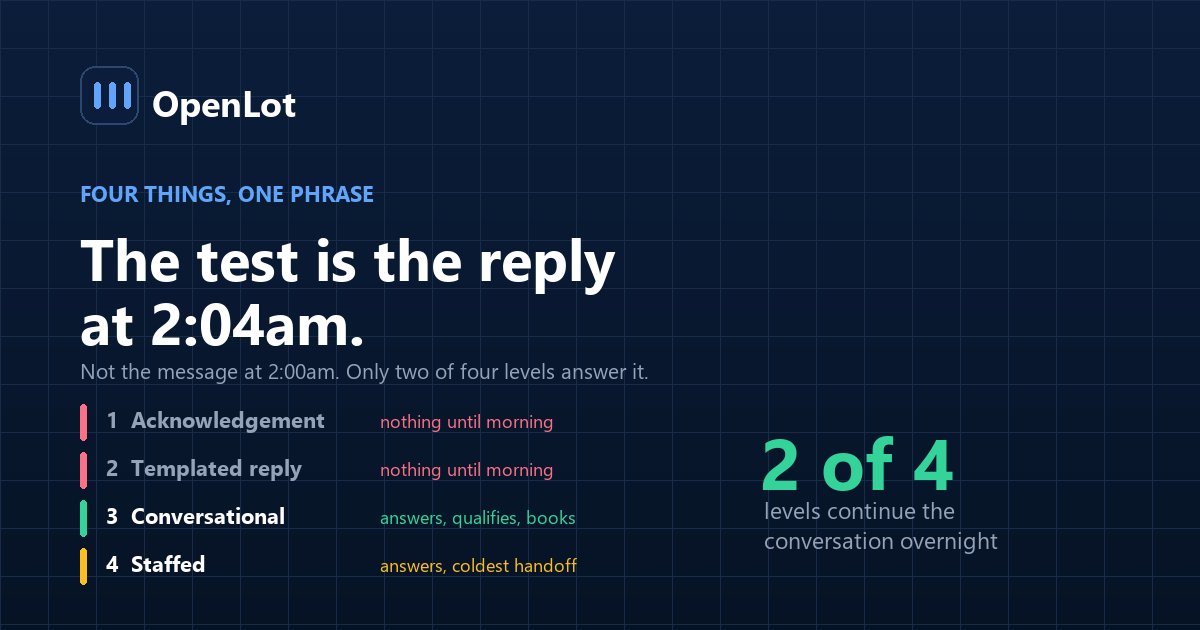
| Level | What happens at 2am | What it is worth |
|---|---|---|
| 1 — Acknowledgement | An automated "we got your request" | Close to nothing. The customer is still waiting |
| 2 — Templated reply | A generic message, possibly with the vehicle name | Something. Still cannot answer a follow-up |
| 3 — Conversational | A real exchange: qualification, booking, escalation | The thing worth paying for |
| 4 — Staffed | A human, offshore or outsourced | Highest capability, highest cost, coldest handoff |
Levels 1 and 2 are frequently sold with the same language as level 3. The distinguishing test is not what the first message looks like — it is what happens when the customer replies to it at 2:04am.
At level 1 and 2, nothing happens until morning. The store has converted a nine-hour silence into a two-minute message followed by a nine-hour silence, which is better but much less than it sounds — and it leaves the coverage gap essentially where it was.
The six questions
Ask these before the proposal
Six questions, one call. Each one separates a level from the one below it.
If a customer replies to the first message at 2:04am, what happens? The whole question in one. "It is logged for the morning team" is level 1 or 2.
Is the integration real-time or batch? A nightly sync cannot support any response commitment measured in minutes, regardless of what the system does once it has the lead. This is the most common hidden disqualifier — see what integration work contains.
Which lead sources are covered? Website forms are easy. Third-party marketplaces, phone and chat are each separate work, and "all your leads" frequently means "the ones that arrive by email".
What does it do with a price question at 2am? The right answer is that it escalates and says so honestly. A system that quotes creates commitments the store has to unwind.
What happens to an engaged conversation overnight? If it queues until 10am, your 24/7 response is a 24/7 first message. That is not nothing, but it is not what was sold.
Show me the audit log for a 2am message, including consent state at send time. Live, in the demo. Not a documentation claim.
A vendor operating at level 3 answers all six comfortably. A vendor at level 1 or 2 will answer questions 1 and 5 with process language rather than with a mechanism.
What can 24/7 coverage not do?
Three things, regardless of level, and they are the reason round-the-clock response is necessary rather than sufficient.
It cannot staff the morning. A system that books six appointments overnight hands six engaged conversations to whoever opens. If that is one person with a full day, the constraint has moved to 8am. This is the most common way genuinely good coverage produces no measurable result.
It cannot make a lead reachable that was never reachable. Some share of leads are not real, not serious, or not contactable on any channel. Round-the-clock contact raises the ceiling; it does not remove it — the ceiling discussed in why leads never answer.
It cannot negotiate, quote or recover an upset customer. The scope that works overnight is narrow: respond, qualify, book, escalate. Everything else creates work rather than removing it, which is the boundary set out in AI BDC failure modes.
What belongs in the contract?
| Term | Why |
|---|---|
| Response time commitment, as a number | "Fast" is not a term. Seconds or minutes, stated |
| Hours of conversational coverage | Distinguish first-message coverage from conversation coverage |
| Lead sources in scope, named | Per source, not "all leads" |
| Escalation triggers, enumerated | What the system refuses to answer, in writing |
| Audit log contents | Including consent state at time of send |
| Per-rooftop pricing, explicit | The usual surprise in group deployments |
The second row is the one that resolves the whole category. A contract that says "24/7 lead response" without separating first-message coverage from conversational coverage has not defined what was bought.
Where does 24/7 go wrong?
1. Level 2 bought as level 3. The most common outcome, and it survives for months because the response-time dashboard looks excellent.
2. Batch integration underneath. The system is capable and the data arrives at 6am. Nothing the vendor does downstream can fix this.
3. Only email leads covered. Phone and marketplace leads continue to fall into the gap, and those are frequently the higher-intent ones.
4. No morning capacity. Covered above, and it is the failure that makes a genuinely good deployment look like a bad one.
5. Consent state not logged at send time. The system checks consent and does not record the check, so compliance for any specific overnight message cannot be demonstrated afterwards.
What should you measure?
| Metric | How to compute | What it proves |
|---|---|---|
| First-touch time, 10pm–7am | Median, overnight bucket only, against your baseline | Whether coverage is real |
| Overnight reply continuation rate | Customer replies that got a same-session response ÷ replies | Level 2 versus level 3, measured |
| Morning handoff pickup time | Overnight escalation → first human reply | Whether the constraint moved to 8am |
| Coverage by source | First-touch time split by lead source | Which sources actually fall in scope |
| Show rate, overnight-booked appointments | Attended ÷ set, overnight only | Whether 2am appointments are real |
The second row is the single most useful number in this article and almost nobody computes it. Take every customer reply that arrived between 10pm and 7am and measure what share received a substantive response before morning. That is your actual level, independent of what the contract says.
Frequently asked questions
What does 24/7 lead response actually mean?
It covers four different things: an automated acknowledgement, a templated reply, a genuine conversational exchange, or a staffed human team. Only the last two continue a conversation when the customer replies at two in the morning, and the first two are frequently marketed with identical language.
How do I tell whether a vendor offers real 24/7 coverage?
Ask what happens when a customer replies to the first message at 2:04am. If the answer involves logging the reply for the morning team, the product sends messages around the clock but does not hold conversations around the clock. The distinction is worth confirming before a proposal rather than after deployment.
Can a nightly data sync support 24/7 lead response?
No. If leads reach the system in an overnight batch, nothing the system does afterwards can produce a response measured in minutes, regardless of its conversational capability. Integration latency should be stated as a number in the scope, and it is the most common hidden disqualifier in this category.
Does 24/7 response cover phone calls and marketplace leads?
Often not. Website form leads are the easiest to integrate and are frequently the only ones genuinely in scope, while phone, chat and third-party marketplace leads each require separate work. Ask for the covered sources to be named individually rather than accepting "all your leads".
What should an overnight system do with a price question?
Escalate, and say so honestly. A system that quotes a payment or a trade value at 2am creates a commitment the store then has to honour or walk back, and the cost of unwinding that exceeds whatever was gained by answering immediately.
Why do good 24/7 deployments sometimes show no result?
Usually because the morning has no capacity. A system that books six appointments and hands six engaged conversations to one person at 8am has moved the constraint rather than removing it, and the customer experiences a fast overnight response followed by silence. Staffing the handoff is part of the coverage decision.
What should the contract say about response times?
A specific number rather than an adjective, with first-message coverage and conversational coverage separated. A contract promising "24/7 lead response" without that distinction has not defined what was purchased, which is why the same phrase can describe an auto-responder and a full conversational system.
How do I measure what level I actually bought?
Take every customer reply that arrived between 10pm and 7am over the last 90 days and compute what share received a substantive response before morning. That ratio is your real level of coverage, independent of marketing language or dashboard response times, and almost no store calculates it.
Conclusion
- Four products, one phrase. Acknowledgement, templated reply, conversational, staffed.
- The test is the reply at 2:04am, not the message at 2:00am.
- Batch integration disqualifies everything downstream, and it is rarely volunteered.
- Name the lead sources in the contract. "All your leads" usually means the email ones.
- Measure overnight reply continuation rate. It tells you what you actually bought.
Last updated: