An AI BDC is software that handles the opening stages of dealership lead follow-up — responding, qualifying and booking appointments — without a person initiating each touch. It is not a replacement for a BDC team. It covers the hours your team does not work and responds inside the window that decides whether a lead is reachable at all.
This guide covers what an AI BDC actually does, how it compares to a human BDC, where it reliably fails, and the four numbers to measure before and after you deploy one.
What is an AI BDC, and what does it actually do?
An AI BDC is an automated layer that works internet leads the way a business development center does: it answers, it asks qualifying questions, it follows up on a cadence, and it tries to set an appointment.
The scope that works today is narrow and specific:
- First response within seconds of the lead arriving, at any hour
- Conversational qualification — vehicle of interest, trade, timeframe, financing intent
- Multi-touch follow-up on leads that go quiet, without a human remembering to
- Appointment setting against real calendar availability
- Handoff to a person once the customer is engaged or asks something the system should not answer
That last item is what separates a working deployment from a bad one. The job is to get a human into a conversation that is already warm, not to run the whole deal.
What an AI BDC is not
It is not a chatbot on your VDP that answers "what are your hours." It is not an auto-responder email. And it is not a salesperson.
The distinction matters because stores frequently already have the first two, conclude they "have AI," and never close the gap the technology is actually good at closing.
Why are dealerships looking at AI BDC now?
Because the constraint was never headcount. It was coverage.
The five-minute response benchmark is not a stretch goal — past that window the odds of qualifying a lead fall steeply. But a BDC is staffed during showroom hours, and leads are not submitted during showroom hours. Shoppers research after work, after dinner, and on Sundays.
The coverage arithmetic
Illustrative. Run it against your own staffing schedule and lead timestamps.
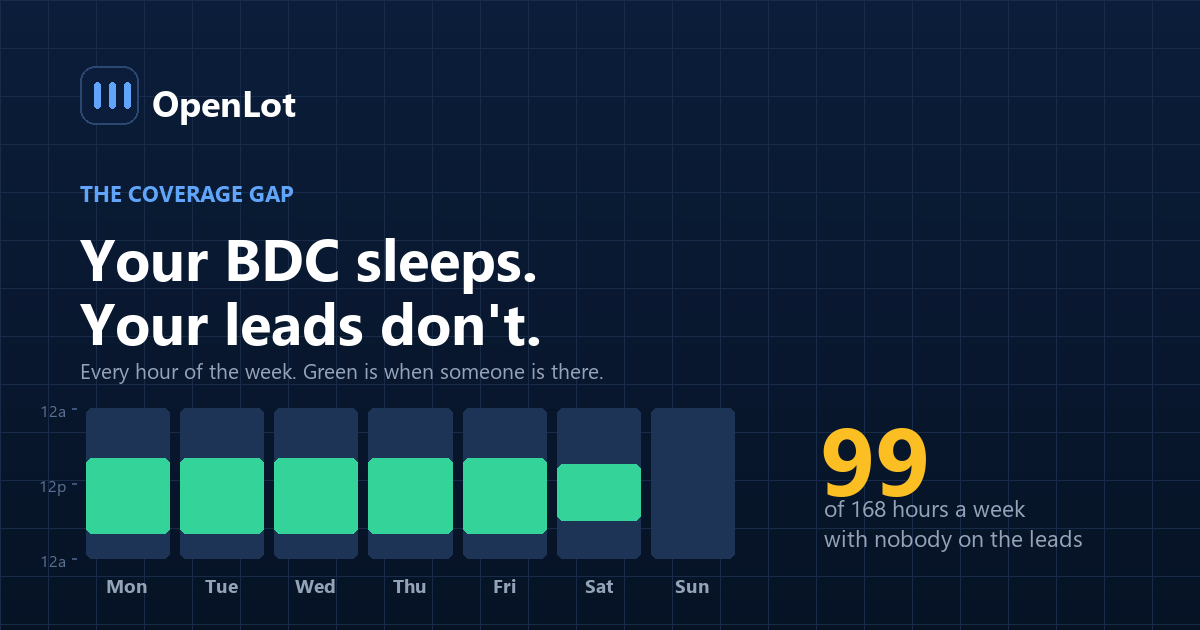
A well-staffed BDC works Mon–Fri, 8am–8pm and Sat, 9am–6pm. Sunday closed.
- Staffed: (12 × 5) + 9 = 69 hours
- A week: 168 hours
- Uncovered: 99 hours — 59% of the week
That is before accounting for the skew, and the skew is the larger half of the problem. 56% of dealership leads arrive after business hours, when most showrooms are closed — Flai, Dealership Customer Experience Statistics (2026). Leads do not arrive evenly across the clock; they cluster in exactly the evening and weekend hours that fall inside the uncovered 59%.
Nor is the staffed block itself safe: 19% of dealers take more than an hour to answer an internet lead — DAS Technology's Lead Response Study, across 1,700 U.S. dealerships (2025). Coverage is necessary and not sufficient.
A lead submitted Saturday at 6:01pm, at a store closed Sunday, waits until Monday 8am. That is 38 hours against a five-minute benchmark.
Pull your last 90 days of lead timestamps and bucket them by hour and weekday. The bars falling outside your staffed block are the number that matters.
Adding people does not fix this without adding shifts, and night shifts in a BDC are expensive and hard to retain — which is its own turnover problem.
AI BDC vs human BDC: what is each actually good at?
"AI versus human" is the wrong framing. They fail at opposite things, which is why the deployments that work run both.
| Capability | AI BDC | Human BDC |
|---|---|---|
| Response latency | Seconds, consistently | Minutes to hours, degrading with volume |
| Coverage | 168 hrs/week | Staffed hours only |
| Consistency under load | Unchanged at 10 or 500 leads | Degrades exactly when volume spikes |
| Follow-up persistence | Executes the full cadence every time | Drops off after the first few attempts |
| Activity logging | Automatic and complete | Manual, incomplete when busy |
| Reading an ambiguous customer | Poor | Strong |
| Handling an upset customer | Poor — must escalate | Strong |
| Negotiation and commitment | Should not attempt | The actual job |
| Judgment on exceptions | None | Strong |
The honest division of labor: AI owns the first touch and the boring middle. People own the conversation once it is real.
Why AI wins on persistence, not intelligence
The most common failure in BDC follow-up is not a bad script. It is attempt two through eight never happening. A cadence that is written down and not executed is worth nothing, and execution collapses under volume — which means it collapses on your best lead days.
Software does not get busy. That is the whole advantage, and it has nothing to do with the model being smart.
Where does AI BDC fail?
Any vendor who will not tell you this is selling badly. Five failure modes, in the order they bite:
1. It answers what it should have escalated. Payment quotes, trade values, out-the-door pricing, "will you take X" — an AI that engages here creates commitments the store has to unwind. Escalation rules matter more than conversational quality.
2. It runs on bad data. An AI BDC working a CRM full of duplicates will contact the same human three times from three threads. Deploying on a dirty database amplifies the mess rather than revealing it — see CRM data decay.
3. It is obviously a robot. Not because customers object to AI in principle, but because generic, instantly-generated, over-eager copy reads as spam and gets ignored. Disclosure handled honestly outperforms a bad impersonation.
4. Nobody picks up the handoff. The AI books the appointment, sets an engaged conversation on a tray, and it sits in a queue for six hours. The bottleneck simply moves. If your contact rate is limited by staffing at the handoff point, AI at the front makes the queue longer, not the outcome better.
5. Compliance is treated as the vendor's problem. Automated outbound at volume touches consent and record-keeping obligations, and the dealership is the party on the hook. Whatever you deploy has to log consent and honor opt-outs as a first-class feature, alongside your Safeguards Rule obligations. Ask to see the audit trail before you sign.
What should you measure before and after?
Four numbers. Take the baseline before anything is installed, or you will never know what the system did.
| Metric | How to compute | What AI should move |
|---|---|---|
| First-touch time, by day-part | Lead timestamp → first outbound, bucketed by hour | Collapses to seconds in the uncovered hours |
| Contact rate | Leads reaching a two-way conversation ÷ total leads | Up, driven almost entirely by off-hours leads |
| Attempts per lead | Logged outbound touches ÷ lead, over 14 days | Up, and the variance between leads should shrink |
| Set-to-show | Appointments shown ÷ appointments set | Watch for decline — the warning sign |
The fourth catches an AI BDC that looks good and is not. A system optimizing for appointments set will book people who were never going to come. Appointments set rising while set-to-show falls is a system generating activity, not sales.
Split every one of these by day-part. A blended average hides the entire effect, because the effect lives in the hours you were not covering.
How do you evaluate an AI BDC vendor?
Bottom-line questions, in rough order of how much they predict a bad outcome:
- What does it refuse to answer, and how is that configured? If pricing and trade guardrails are not editable by you, keep looking.
- How does handoff work, and what happens if nobody takes it? There must be a timeout and an escalation path.
- Does it write every touch back to the CRM as a logged activity? If not, your reporting goes darker, not clearer.
- How is consent captured, stored and revoked? Ask for the record format.
- What does it do with a lead that has no phone number, a bad email, or a duplicate record? The answer tells you whether they have run this on real dealership data.
- Can you see first-touch time by day-part in their reporting? If the only dashboard is a blended average, they are hiding the thing you are buying.
- What is the exit? Who owns the conversation history if you leave.
Run a pilot on a single lead source, against a clean baseline, for at least 30 days. Judge it on contact rate and set-to-show, not on how impressive the transcripts read.
Frequently asked questions
What is an AI BDC for car dealerships?
An AI BDC is software that performs the opening stages of internet lead follow-up at a dealership — instant first response, conversational qualification, multi-touch follow-up and appointment setting — then hands the customer to a person. It covers the hours a staffed BDC does not work rather than replacing the team.
Will an AI BDC replace my BDC team?
No. AI is strong on latency, coverage, persistence and logging, and weak on judgment, negotiation and reading an ambiguous or upset customer. The deployments that work use AI for the first touch and the follow-up cadence, and people for the conversation once the customer is actually engaged.
How fast does an AI BDC respond to a lead?
Within seconds, at any hour, which is the point. The response-time research puts the practical benchmark at five minutes, and 56% of dealership leads arrive after business hours according to Flai's 2026 dealership customer experience data — so the gain is concentrated in nights, weekends and holidays rather than spread evenly across the week.
Do customers know they are talking to AI?
They should. Honest disclosure consistently outperforms a system trying to pass as human, because a failed impersonation reads as spam and kills the thread. What customers react badly to is generic, over-eager copy, not the disclosure itself.
What does an AI BDC cost compared to hiring BDC staff?
Pricing is usually per-store or per-lead rather than per-seat, so the comparison people reach for is against a salary. The more useful comparison is against the cost of covering 99 uncovered hours a week with night and weekend shifts, which is where the staffing math breaks down regardless of what the software costs.
Can an AI BDC work leads from third-party sources like Autotrader or Cars.com?
Yes, and marketplace leads are usually where it earns the most, because they arrive around the clock and the shopper has typically submitted to several stores at once. Speed of first contact matters more on those leads than on any other source.
What happens if the AI books an appointment and nobody shows?
Track set-to-show as a primary metric from the start. A system tuned to maximize appointments set will book people with no real intent, which shows up as appointments rising while show rate falls. If set-to-show declines after deployment, the qualification logic is too loose.
Is an AI BDC compliant with texting and privacy rules?
Compliance obligations sit with the dealership, not the vendor. Any system doing automated outbound has to capture and store consent, honor opt-outs immediately, and produce an audit trail on demand. Treat those as required features and ask to see the record format before signing.
Conclusion
- The problem is coverage, not headcount. Roughly 59% of the week is unstaffed at a well-staffed store, and 56% of leads arrive after hours — the two numbers describe the same gap from opposite sides.
- AI and humans fail at opposite things. AI owns latency, persistence and logging. People own judgment, negotiation and recovery.
- Persistence is the real advantage, not intelligence. Attempts two through eight are where human follow-up collapses under volume.
- Bad data in, amplified mess out. Deduplicate before deploying, not after.
- Watch set-to-show. Appointments up with show rate down means the system is manufacturing activity.
- Baseline first. Measure first-touch time by day-part before anything is installed, or the result is unfalsifiable.
Pull 90 days of lead timestamps and plot them by hour against your staffing schedule. The leads landing outside the staffed block are the entire business case, and you can size it before you talk to a single vendor.
Last updated: