A dealership Business Development Center is a dedicated team that handles inbound leads and calls, sets appointments, and hands qualified customers to the sales floor. Done well, it converts more of the traffic you already pay for. Done badly, it becomes an expensive layer between the customer and the person who can actually sell them a car — and the difference is usually structural, not personal.
This guide covers the models available, how to size the team against real lead volume, which metrics predict results, and when a BDC is the wrong solution to the problem you have.
What does a dealership BDC actually do?
At minimum: answer inbound internet leads and phone calls, qualify the customer, set an appointment, and confirm it. The point is not to sell the car — it is to get the right customer in front of the right salesperson at a time both can keep.
Stores extend the scope in different directions, and scope creep is a common failure. A BDC asked to handle sales leads, service scheduling, unsold follow-up, equity mining and outbound prospecting simultaneously usually does none of them well.
| Function | Belongs in a BDC? | Note |
|---|---|---|
| Inbound internet leads | Yes — core | The reason the department exists |
| Inbound sales calls | Yes — core | Same skill, same systems |
| Appointment confirmation | Yes | Cheapest lever on show rate |
| Unsold follow-up | Usually | Needs its own cadence and scripts |
| Service scheduling | Separate team | Different systems, different skills |
| Equity mining / outbound | Only if staffed for it | Will be crowded out by inbound every time |
That last row matters. Outbound work is always the first thing to collapse when inbound volume spikes, because inbound has a customer waiting. If outbound matters to you, it needs protected capacity.
Centralized, in-store, or outsourced?
| Model | Best for | Main weakness |
|---|---|---|
| In-store BDC | Single rooftops, stores with distinct local inventory | Hard to cover nights and weekends with a small team |
| Centralized group BDC | Multi-store groups | Agents lose store-level inventory familiarity |
| Outsourced BDC | After-hours and overflow coverage | Limited inventory context; quality varies by provider |
| Hybrid | Most stores in practice | Handoff between layers must be clean or leads fall between them |
The hybrid pattern — in-store during business hours, outsourced or automated after hours — is where most stores land, and the failure point is always the same: the handoff. A customer who talks to an after-hours agent on Saturday and gets a Monday morning call that starts from zero has effectively been contacted twice and served once.
How many BDC agents do you need?
Start from lead volume and handling time rather than a rule of thumb.
Agents needed = (monthly leads × touches per lead × minutes per touch) ÷ productive minutes per agent per month
Working figures to start from, which you should replace with your own:
- Touches per lead: 6–8 across the full follow-up cadence
- Minutes per touch: 3–5 including CRM logging
- Productive minutes per agent: roughly 6,000 per month — about 70% of a full-time schedule, because nobody is on the phone 100% of the time
Worked example
A store taking 400 internet leads a month, at 7 touches and 4 minutes each:
- 400 × 7 × 4 = 11,200 minutes of work
- ÷ 6,000 productive minutes = 1.9 agents
Call it two for the workload — but two agents cannot cover 12 hours a day, six or seven days a week. Coverage, not workload, is what actually sets headcount, and that is why the arithmetic usually produces a smaller number than the schedule requires.
This is also why after-hours coverage is the most expensive hour to staff and the most common one to leave uncovered.
Two adjustments worth making: phone leads consume more minutes than form leads, and lead volume is not evenly distributed — if your peak day is double your average day, staffing to the average guarantees a queue on peak days.
What should a BDC measure?
Most BDC scorecards measure activity. Activity is easy to inflate and weakly related to outcomes.
| Metric | Why it matters | Realistic direction |
|---|---|---|
| Response time (first human touch) | Strongest predictor of qualification | Under 5 minutes |
| Contact rate | Reached a live human | Track your own trend |
| Appointment set rate | Of leads contacted | The core BDC output |
| Appointment show rate | Of appointments set | Where confirmation process shows up |
| Show-to-sold | Sales floor handoff quality | Diagnoses the handoff, not the BDC |
| Touches before contact | Cadence discipline | Rising means cadence is slipping |
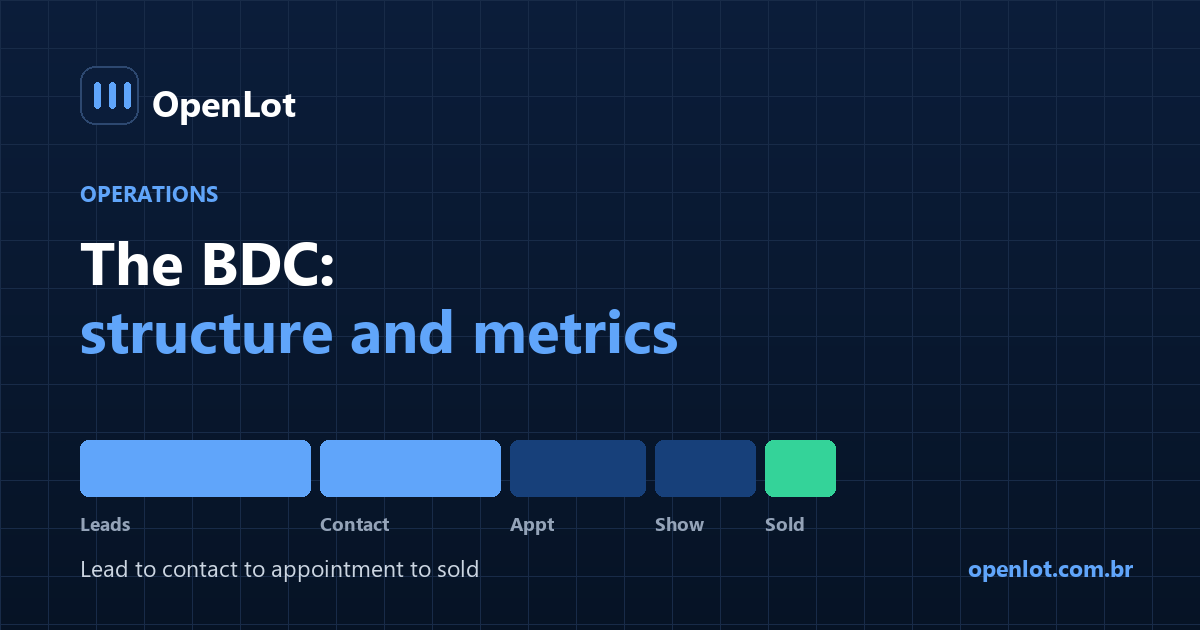
The chain that matters is lead → contact → appointment → show → sold. Measuring only the last number tells you something is wrong without telling you where.
The two metrics that diagnose everything else
Response time and show rate isolate most problems:
- Poor contact rate with fast response time → a data quality or cadence problem, not a speed problem
- Good set rate with poor show rate → a confirmation process problem
- Good show rate with poor show-to-sold → a sales floor handoff problem, not a BDC problem at all
That last case is worth dwelling on. A BDC delivering customers who show up and do not buy is doing its job. Blaming it for close rate is how stores end up fixing the wrong department.
Why BDCs fail
Four causes, all structural:
Coverage, not capacity. If the majority of your leads arrive outside business hours, a fully staffed daytime BDC still leaves most leads waiting. This is arithmetic, and hiring more daytime agents does not touch it.
No handoff protocol. The customer repeats everything to the salesperson. Whatever the BDC accomplished is discarded at the door.
Agents who cannot see inventory. An agent who cannot confirm a vehicle is still available can only offer to check and call back — which is the moment the customer's attention moves to the next store.
Compensation misaligned with outcomes. Paying on appointments set rewards setting appointments that do not show. Paying on shows aligns better; paying on shows plus a unit bonus aligns best.
When a BDC is the wrong answer
Be honest about which problem you have.
| The actual problem | Does a BDC fix it? |
|---|---|
| Leads not answered fast enough during the day | Yes |
| Leads arriving at 10 PM Saturday | No — that is coverage |
| Salespeople not following up | Partly — it relocates the work |
| Lead quality is poor | No — that is a marketing problem |
| Leads scattered across three systems | No — that is an integration problem |
| Close rate is low on customers who show | No — that is a sales floor problem |
Three of those six are fixed upstream of the BDC. Hiring agents to compensate for a data problem adds payroll and does not change the outcome.
Frequently asked questions
How many BDC agents does a dealership need?
Calculate from lead volume, touches per lead and handling time, then check the result against your required coverage hours. A store with 400 monthly leads needs roughly two agents by workload, but coverage across evenings and weekends usually drives headcount higher than workload alone suggests.
Should a BDC be in-store or outsourced?
In-store gives better inventory knowledge and cleaner handoffs. Outsourced covers hours you cannot staff. Most stores run a hybrid, and the deciding factor is whether the handoff between the two is clean enough that the customer never repeats themselves.
What is a good appointment set rate for an automotive BDC?
It varies too much by lead source, market and lead quality for a single benchmark to be useful. Track your own trend, segment by source, and pair it with show rate — a set rate that rises while show rate falls is not an improvement.
Should the BDC or the salesperson own follow-up?
Whichever one will actually do it consistently. Splitting ownership without a clear rule is worse than either choice, because it produces both duplicate contact and no contact.
How should BDC agents be compensated?
Paying on appointments set rewards volume over quality. Paying on appointments shown aligns better with the outcome you want, and adding a unit-sold component aligns the BDC with the sales floor rather than against it.
Does a BDC solve slow after-hours lead response?
Only if you staff it after hours, which is expensive and hard to retain. If most of your leads arrive outside business hours, the problem is coverage, and automation or an outsourced overflow layer usually addresses it more economically than headcount.
What should the BDC hand off to the salesperson?
The full conversation, the specific vehicle discussed, stated timeline, trade and financing situation, and the appointment details. If the salesperson opens with questions the customer already answered, the handoff failed.
Conclusion
- A BDC solves speed and consistency during staffed hours. It does not solve coverage, lead quality or integration.
- Coverage sets headcount, not workload. The arithmetic gives a smaller number than the schedule requires.
- Response time and show rate diagnose most problems. Activity metrics mostly measure activity.
- The handoff is where value leaks. A customer who repeats themselves got no benefit from the department.
- Compensation drives behavior. Pay on shows, not sets.
Before adding headcount, split your lead volume by hour and day. If most of it lands when the lights are off, you have a coverage problem, and a bigger daytime team will not touch it.
Last updated: