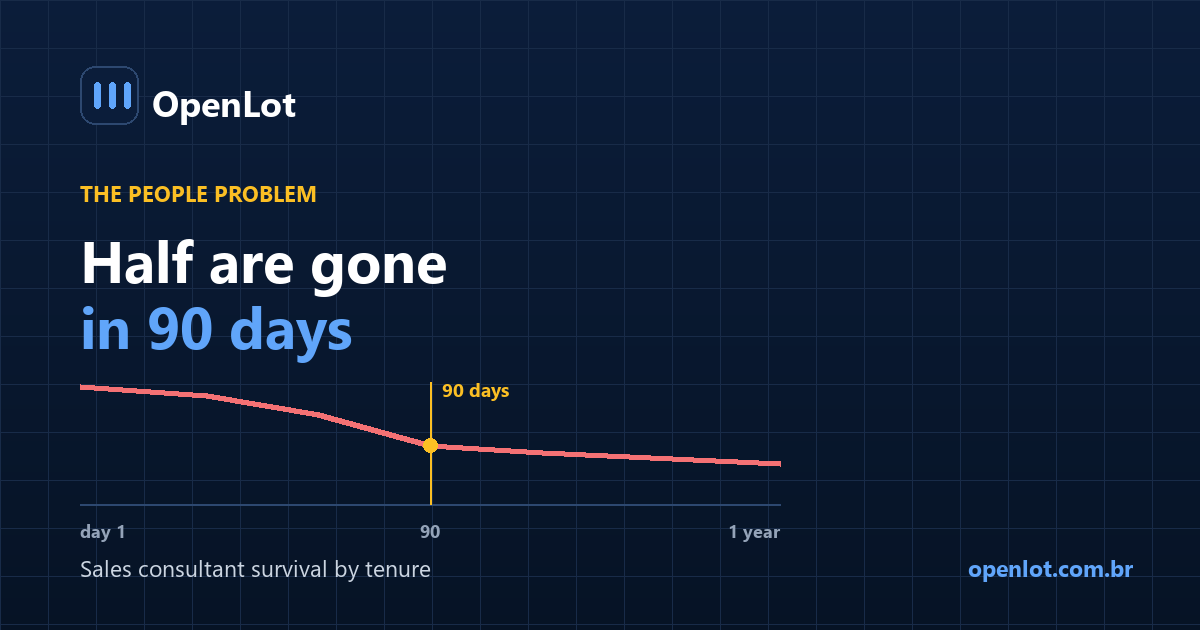
Car dealership sales turnover is among the highest in U.S. retail, with widely reported figures putting non-luxury sales consultant turnover near 73% and roughly half of new sales hires leaving within 90 days. The cost is not mainly recruiting. It is the customers a churning floor never follows up with.
This guide covers what the turnover numbers actually say, why the 90-day cliff exists, what it costs beyond recruiting, and which changes move retention.
On the numbers below: figures attributed to the NADA Dealership Workforce Study circulate widely in trade press, but the primary report sits behind a paid subscription and we have not verified the underlying data directly. Treat them as well-reported industry figures rather than confirmed primary research, and measure your own store before acting.
How bad is dealership sales turnover?
Widely reported figures from the 2025 NADA Dealership Workforce Study cycle:
| Segment | Reported annual turnover |
|---|---|
| Overall dealership workforce | ~42% |
| Sales consultants, non-luxury | ~73% |
| Sales consultants, luxury | ~42% |
The figure that matters more than the annual rate: roughly half of new sales hires leave within 90 days. Turnover is not spread evenly across the year — it is concentrated at the front, among people who never became productive.
That distinction changes the diagnosis entirely. A 73% annual rate driven by experienced people leaving is a compensation and management problem. A 73% rate driven by a 90-day cliff is an onboarding and expectation-setting problem, and it responds to different interventions.
The 90-day cliff
Most sales consultants who leave early are not poached. They leave because the first 90 days went like this:
- Minimal structured training — shadow someone, read the inventory, start
- Commission-heavy pay in a period when they cannot yet sell
- No pipeline of their own, so they depend on floor traffic
- Little feedback until the first bad month, delivered as pressure
- Income below what the interview implied
Very little about that sequence involves the pay plan's design. It involves the ramp.
What does turnover actually cost?
Recruiting and training are the visible costs and the smaller ones.
Direct costs. Advertising, interviewing, onboarding, training, licensing. Figures commonly cited for hire-and-train run around $15,000 per sales consultant, with higher estimates once lost productivity is included. Estimates vary enormously by source and methodology — several of the larger figures circulate from vendors selling retention products, so treat the range skeptically and build your own.
The costs nobody counts:
| Hidden cost | What happens |
|---|---|
| Orphaned customers | Pipeline goes unworked while unassigned |
| Broken relationships | Repeat and referral customers lose their contact |
| Ramp gap | Months at reduced productivity, twice — leaving and arriving |
| Manager time | Recruiting and training instead of coaching |
| Team drag | Constant churn depresses everyone's performance |
| Customer experience | The new person does not know the inventory yet |
Where the money actually goes
A framework — substitute your own figures.
A store with 10 salespeople at 70% annual turnover replaces 7 people a year.
- Direct replacement at $15,000 → $105,000
- Each departure leaves roughly 60 active customer records orphaned; at a 10% close rate, unworked pipeline costs ~6 units per departure → 42 units a year
- Each new hire runs ~3 months below full productivity; at 4 units/month below par → 84 units of ramp gap
The recruiting line item is the one that shows up in the budget. The unit loss is roughly an order of magnitude larger and appears nowhere, because it looks like normal variation in sales performance.
That last point is why turnover persists as an accepted cost of doing business. The expensive part is invisible; the cheap part is on a spreadsheet.
Why do salespeople actually leave?
Exit interviews say pay. Pay is frequently the stated reason and rarely the whole one — it is the socially easiest answer and the hardest for the store to argue with.
The patterns underneath:
Income volatility, not income level. A pay plan averaging well but swinging wildly month to month is harder to live with than a lower, steadier one. People leave for predictability more often than for a higher ceiling.
Schedule. Bell-to-bell with rotating weekends is genuinely incompatible with a lot of family arrangements. This drives more departures than most stores acknowledge, and it disproportionately removes experienced people with families.
No path. "Do this for three years and then what?" with no answer is a reason to leave once the novelty ends.
Management quality. The oldest finding in retention research, and it holds in stores. People leave managers.
Process friction. A salesperson who spends their day fighting the CRM, chasing inventory information and re-entering data has less time selling — which on a commission plan is a direct pay cut administered by your systems.
That last one is worth taking seriously. Operational friction is a compensation issue on any commission plan, and it is the one most within a store's control.
What reduces turnover?
In rough order of impact.
1. Fix the first 90 days. Structured onboarding with weekly milestones, a named mentor, and explicit expectations for month one, two and three. This is where the losses concentrate, so this is where intervention pays most.
2. Guarantee the ramp. A declining guarantee over the first 90 days removes the income cliff during the period when someone genuinely cannot sell yet. It is cheaper than replacing them.
3. Reduce income volatility. A higher base with a lower commission rate can improve retention without raising total cost, because predictability has real value to the person receiving it.
4. Address the schedule. Set shifts, guaranteed days, or a four-day week. This is the lever most stores refuse to consider and the one experienced candidates ask about first.
5. Remove process friction. Every hour not spent on data entry is sellable. Automatic activity logging and accessible inventory information raise earnings without changing the pay plan.
6. Handle orphaned customers deliberately. Reassignment should be a same-day checklist item at departure, not something discovered weeks later.
7. Measure retention by cohort, not annually. Track 30, 60, 90 and 180-day survival for each hiring cohort. An annual percentage tells you there is a problem; cohort curves tell you where.
Frequently asked questions
What is the turnover rate for car dealership salespeople?
Widely reported figures from the NADA Dealership Workforce Study put non-luxury sales consultant turnover near 73% and luxury near 42%, with overall dealership workforce turnover around 42%. The primary report is subscription-based, so treat these as reported industry figures and benchmark your own.
How much does it cost to replace a dealership salesperson?
Commonly cited hire-and-train figures run around $15,000, with higher estimates once lost productivity is counted. Estimates vary widely by methodology, and the largest figures often come from vendors selling retention products. The larger cost is usually orphaned pipeline and ramp gap, not recruiting.
Why do half of new dealership sales hires leave within 90 days?
Because the first 90 days typically combine minimal structured training, commission-heavy pay during a period when they cannot yet sell, no pipeline of their own, and feedback that arrives as pressure after the first bad month. The ramp, not the pay plan, is usually the cause.
Does raising pay reduce dealership sales turnover?
Less than expected. Income volatility drives more departures than income level, so a steadier plan often retains better than a higher-ceiling one at the same total cost. Schedule and management quality frequently outrank pay entirely.
What happens to customers when a salesperson leaves?
Without a reassignment process, their records sit unassigned and unworked. For a salesperson with an active pipeline, that is a meaningful number of customers receiving no follow-up during the window when it matters most.
How should dealerships measure sales retention?
By cohort survival at 30, 60, 90 and 180 days, not by annual percentage. An annual rate confirms a problem exists; the cohort curve shows where people are actually leaving, which determines what to fix.
Can better systems reduce turnover?
Indirectly but measurably. On a commission plan, time spent on manual data entry and chasing information is lost earning time. Reducing that friction raises effective pay without changing the plan.
Conclusion
- Turnover concentrates at 90 days. That makes it an onboarding problem more than a pay problem.
- The recruiting cost is the small one. Orphaned pipeline and ramp gap are larger and invisible.
- Volatility beats level. People leave unpredictable income more readily than modest income.
- Schedule is underrated and is the first question experienced candidates ask.
- Process friction is a pay cut on any commission plan, and it is the most controllable factor.
Pull your last four hiring cohorts and plot survival at 30, 60, 90 and 180 days. If the drop is at 90, no pay plan change will fix what onboarding is doing.
Last updated: