If your salespeople call internet leads repeatedly and reach almost no one, the problem is probably not effort and probably not lead quality. It is that your number never reaches the customer as a call worth answering. Spam labeling, channel mismatch and bad timing account for most of the gap between leads submitted and humans reached.
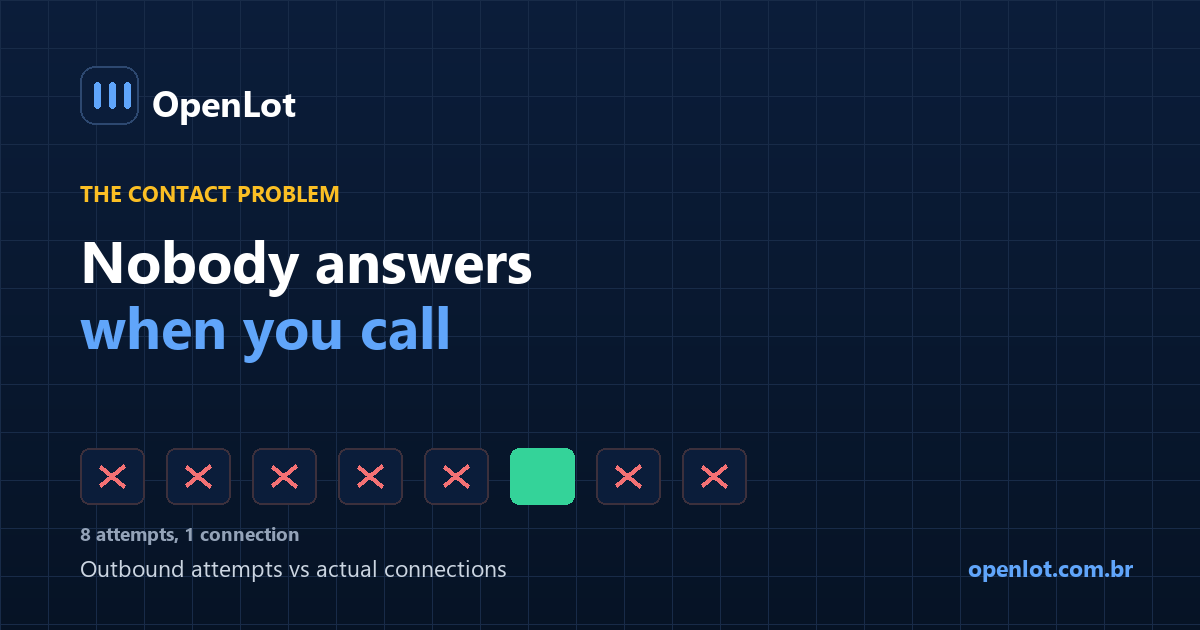
This guide covers why contact rates fall, how to diagnose which cause is yours, and what changes it — in order of how much they move the number.
Why don't leads answer when we call?
Four causes, and the first one is invisible from inside the dealership.
1. Your number is labeled "Spam Likely" before it rings
Carriers and phone operating systems score outbound numbers. A number that makes many short outbound calls with a low answer rate looks, statistically, exactly like a telemarketer — because the behavior is identical. Once flagged, the call either displays a warning or never rings at all.
This creates a spiral worth understanding: low answer rates cause flagging, and flagging causes lower answer rates. A store that starts having trouble will get worse on its own, without anything else changing.
You cannot see this from your own phone. Check it from outside: use a carrier lookup tool, and call a few staff phones on different carriers from each dealership outbound number to see how it displays.
2. The customer submitted a form, not a call request
Someone who filled out a web form at 10 PM chose a written channel. Answering an unknown number from an unknown area code is a different act with a different social cost — especially for anyone under 40, for whom an unexpected call from an unknown number reads as a problem, not service.
This is not customer rudeness. It is channel mismatch, and the fix is not more call attempts.
3. You are calling when they cannot talk
Leads arrive heavily in evenings and weekends. Call attempts cluster in the business day. Which means a substantial share of attempts land while the customer is at work, in a meeting, or driving — and every unanswered attempt further trains both the carrier's spam score and the customer to ignore you.
4. The number is wrong
Typos, deliberately fake numbers, and disconnected lines. This is real but smaller than dealers assume — it is usually the explanation reached for when the first three have not been examined.
How do I know which cause is mine?
Run this diagnostic before changing anything. It takes an afternoon.
| Check | How | What it tells you |
|---|---|---|
| Spam labeling | Call staff phones on 3 carriers from each outbound number | If flagged, this dominates everything else |
| Attempts per contact | Attempts ÷ unique contacts, from CRM | Rising over months means labeling or list decay |
| Contact rate by hour | Connections ÷ attempts, bucketed by hour | Exposes calling-window mismatch |
| Contact rate by channel | Compare call, text and email response | If text far outperforms call, it is channel, not effort |
| Bad number rate | % disconnected or invalid | Above ~10% points to form or source quality |
The single most diagnostic comparison is call contact rate versus text response rate on the same leads. If text materially outperforms, the issue is channel, and no volume of additional dialing will fix it.
Why "more attempts" makes it worse
A framework, not a study — the mechanism is what matters.
A store frustrated by low contact rates raises the cadence from 6 attempts to 12.
- Outbound volume doubles
- Answer rate does not improve, so the ratio of unanswered to answered calls doubles
- That ratio is close to what carrier spam algorithms actually score
- The number's reputation degrades, and contact rate falls further
The store now has worse contact rates than before, having done more work. The intervention that felt like effort was the thing making it worse.
This is the trap: the obvious response to a low contact rate is the one that deepens it.
What actually raises contact rate?
In order of impact per unit of effort.
1. Lead with a text, not a call. A text arrives without demanding an immediate decision, is read within minutes, and carries the store name. For a lead that arrived by web form, text-first respects the channel the customer already chose. Follow with a call once they have replied — now it is an expected call from a known store.
2. Register your numbers and monitor labeling. Carrier-level registration exists specifically so legitimate businesses can avoid being scored as spam. Check your numbers monthly; a flagged number can be remediated, but only if you know it is flagged.
3. Call within the first five minutes, then match their hours. A call that arrives while the customer is still on your website is a call they are expecting. After that window, schedule attempts against when they submitted, not when your team is on shift.
4. Use a consistent local number. Rotating through many outbound numbers to dodge flagging is a tactic that accelerates flagging and prevents the customer from ever recognizing you.
5. Make the first message specific. A voicemail that names the exact vehicle and confirms availability gets a callback. "Calling about your inquiry" does not.
6. Reduce attempts, increase relevance. Fewer, better-timed, more specific touches outperform high-volume dialing on both contact rate and number reputation.
A cadence that respects the channel
| Timing | Channel | Content |
|---|---|---|
| Under 5 min | Text + call | Name the vehicle, confirm availability |
| 1 hour | Text | One concrete question, easy to reply to |
| Same evening | Call | Only if they engaged; voicemail names the vehicle |
| Day 2 | Photos, pricing, alternatives | |
| Day 4 | Text | Different angle — trade value, financing |
| Day 7+ | Long-cycle nurture, low frequency |
Six touches across a week, three channels, each with a reason to exist. That outperforms twelve calls in three days on every measure that matters, including how your number is scored.
What contact rate should we expect?
There is no credible universal benchmark. Contact rate varies with lead source, price band, market and how quickly you respond — a five-minute first attempt and a next-morning attempt are not the same measurement.
Measure your own, segment it, and trend it. What matters:
- By source. Marketplace leads and website leads behave differently.
- By channel. Call, text and email separately, never blended.
- By hour of attempt. This is where the calling-window mismatch shows up.
- Over time. A declining trend on stable sources is the signature of number reputation decay.
Treat a falling trend on unchanged sources as a phone-system problem until proven otherwise.
Frequently asked questions
Why do my dealership's calls show up as "Spam Likely"?
Carriers score outbound numbers on calling patterns. High volumes of short, unanswered outbound calls match the telemarketing profile, so the number gets flagged regardless of intent. Increasing call volume to compensate accelerates the flagging.
How many times should a dealership attempt to contact a lead?
Around six to eight touches spread across channels and days works better than a high volume of calls in a short window. Beyond that, additional call attempts damage your number's reputation more than they improve contact rate.
Is texting leads better than calling?
For leads that arrived through a web form, usually yes as the first touch. They chose a written channel, and a text can be read without an immediate decision. Call once they have replied, when the call is expected.
What is a good contact rate for dealership internet leads?
There is no reliable universal figure — it swings with source, price band, market and response speed. Track your own by source and channel, and treat the trend as the signal rather than any single number.
Can I fix a phone number that has been flagged as spam?
Usually. Carrier registration and remediation processes exist for legitimate businesses. The prerequisite is knowing you are flagged, which requires checking from outside your own network across multiple carriers.
Should I rotate outbound numbers to avoid spam flags?
No. Rotating numbers resembles the behavior spam detection is built to catch, and it prevents customers from recognizing your store. A single consistent registered number, used at sustainable volume, performs better.
Does calling faster actually improve contact rate?
Substantially. A call placed within five minutes reaches someone who is still engaged and expecting contact. The same call two days later is an unexpected interruption from an unrecognized number.
Conclusion
- Low contact rate is usually a phone-system problem, not an effort problem.
- More attempts makes it worse. Volume is what triggers carrier flagging in the first place.
- Check labeling from outside, across carriers, for every outbound number you use.
- Text first on web-form leads. They already chose a written channel.
- Trend your own number by source, channel and hour. A decline on stable sources is a reputation signal.
Start by calling your own dealership numbers from three different carriers. If any display a warning, that is your answer, and no cadence change will outrun it.
Last updated: