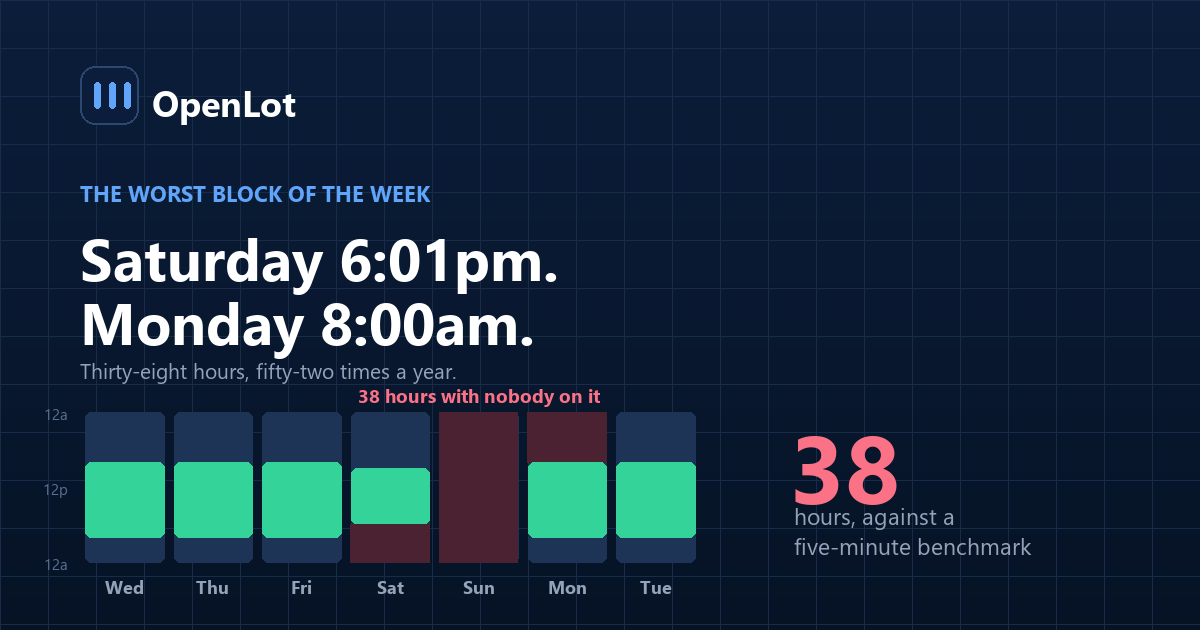
The weekend is where dealership response time goes to die. A lead submitted Saturday at 6:01pm, at a store closed Sunday, waits until Monday at 8am — 38 hours against a five-minute benchmark. It is the longest single gap in the week, and it is invisible in any blended average.
This guide covers why the weekend gap is the worst in the week, how to measure yours specifically, what weekend shopping behaviour looks like, the four ways to close it, and what to measure.
Why is the weekend gap the worst?
Because two things stack: the longest unstaffed stretch coincides with the period of highest shopping activity.
The 38-hour wait
Illustrative, on a common schedule.
A store open Saturday 9am–6pm, closed Sunday, opening Monday 8am.
Lead arrives Waits until Elapsed Sat 6:01pm Mon 8:00am 38 hours Sun 10:00am Mon 8:00am 22 hours Sun 7:00pm Mon 8:00am 13 hours Wed 8:01pm Thu 8:00am 12 hours The worst weekday gap is 12 hours. The worst weekend gap is more than three times that, and it is not an outlier — it recurs every single week, 52 times a year.
Measured against the five-minute benchmark, where a lead contacted at five minutes is roughly 21 times more likely to qualify than one contacted at thirty (Oldroyd, MIT Sloan with InsideSales), a 38-hour wait is not a degraded response. It is a different outcome entirely.
And Sunday is not a quiet day for shopping. It is a day when showrooms are closed and customers are at home with time — the exact conditions under which people browse inventory, compare three stores and submit forms.
That is the part that makes the gap expensive rather than merely long: the customer submitting at 11am Sunday is usually submitting to more than one store. The first substantive reply Monday morning is not competing with silence.
How do you measure your own weekend gap?
Three cuts, none of which appear in a standard report.
1. Volume in the window. Share of weekly leads arriving between Saturday close and Monday open. If your store is open Sunday, use your actual hours — the window is defined by your schedule, not by the calendar.
2. First-touch time for that window only. Median and worst case, measured to the first substantive message rather than to an auto-responder. Blending weekend leads into a weekly average hides the entire problem, which is the core argument of the four baseline numbers.
3. Contact rate, weekend-arriving versus weekday-arriving. This is the number that tells you what the wait costs, and it reads against the same contact-rate problem the rest of the week has. If weekend-arriving leads contact at materially lower rates, the delay is doing the damage rather than the lead quality.
One query each. None requires a vendor.
What does weekend shopping behaviour look like?
Different enough from weekday behaviour to warrant different handling.
| Weekday lead | Weekend lead | |
|---|---|---|
| Typical context | At work, between tasks | At home, with time |
| Research depth | Shallower, often a single unit | Deeper, comparing several |
| Shops multiple stores | Sometimes | Frequently |
| Wants to come in | Next weekend | Today or tomorrow |
| Response window | Hours | Minutes, realistically |
The fourth row is the one that matters. A Sunday shopper frequently wants to visit that same day or the next, and a Monday morning reply arrives after the decision window closed.
What are the four ways to close it?
1. Open Sunday. The most complete answer and the most expensive, and in some states not available. Worth evaluating honestly against the volume in your window rather than dismissing on tradition.
2. A Saturday-evening sweep. One person, one hour, Saturday 6–7pm, working only the leads that arrived that day. Cheap, partial, and it removes the worst single block — the Saturday-evening arrivals that would otherwise wait the full 38 hours.
3. Sunday on-call. A manager with the lead queue on their phone, checking a few times. Inconsistent by nature and it degrades after a couple of months, but it costs almost nothing to trial.
4. Automation across the whole window. Responds in seconds Saturday night and all Sunday, qualifies, books Monday and Tuesday appointments, escalates anything it should not answer. The trade-offs are the ones covered in after-hours lead response — it covers the window completely and it cannot hold a difficult conversation.
A reasonable sequence for most stores is 2, then 4: run the Saturday sweep for a month because it is free and it sizes the opportunity, then decide whether the remaining Sunday volume justifies covering it properly.
Where does weekend coverage go wrong?
1. Measuring Monday as the response day. A lead answered at 8:02am Monday shows as a two-minute response in a system that measures from the start of the business day. This is not rare and it makes the gap literally invisible.
2. Booking Monday appointments for Sunday shoppers. Someone ready to come in Sunday afternoon is offered Tuesday at 4pm. Offer the earliest genuinely available slot, and offer it immediately.
3. Covering Sunday and not Saturday evening. Saturday 6pm–midnight is the worst block in the week. Sunday-only coverage leaves it intact.
4. The Monday handoff. Six overnight conversations arriving at 8am with one person on duty. The weekend constraint moves to Monday morning — the same handoff failure that defeats every front-of-funnel improvement.
5. Nobody checks whether weekend appointments show. Appointments booked Sunday for Tuesday have a longer gap to attendance and need confirmation sequences accordingly.
What should you measure?
| Metric | How to compute | What it decides |
|---|---|---|
| Weekend window volume | Leads between Sat close and Mon open ÷ weekly leads | Whether this is worth solving |
| First touch, Sat evening block | Median and worst case, that block only | The number that makes the case internally |
| Contact rate, weekend vs weekday arrival | Split | What the delay actually costs |
| Monday 8–10am queue depth | Conversations awaiting a person at open | Whether coverage will convert |
| Show rate, weekend-booked | Attended ÷ set, weekend-sourced only | Whether the appointments are real |
Run the first two before any conversation about budget. A store finding 20% of weekly leads in the weekend window with a 30-hour median first touch has its business case in two numbers and one afternoon.
Frequently asked questions
How long do weekend leads actually wait at a dealership?
At a store open Saturday until 6pm, closed Sunday and reopening Monday at 8am, a lead arriving just after Saturday close waits 38 hours. Sunday morning arrivals wait around 22 hours. By comparison the worst weekday gap on the same schedule is about 12 hours, so the weekend block is roughly three times worse and recurs every week.
Do many car leads arrive on the weekend?
Enough to matter in most markets, because Sunday is when showrooms are closed and shoppers are at home with time to research and compare. The actionable number is your own: the share of weekly leads arriving between Saturday close and Monday open, pulled from CRM timestamps.
Why is a Sunday lead more urgent than a Wednesday lead?
Because weekend shoppers frequently want to visit the same day or the next, and they are usually contacting more than one store. A Monday morning reply arrives after the decision window has closed, competing not with silence but with whichever dealer answered first.
Should a dealership open on Sunday?
It is the most complete solution to the gap and the most expensive, and in several states it is not permitted. The honest way to evaluate it is against the measured volume in your weekend window rather than against tradition — and for many stores a Saturday-evening sweep plus automation covers most of the value at a fraction of the cost.
What is a Saturday-evening sweep?
One person spending an hour after Saturday close working only the leads that arrived that day. It costs almost nothing, requires no technology, and removes the worst single block in the week — the Saturday evening arrivals that would otherwise wait the full 38 hours. It is also a cheap way to size the opportunity before buying anything.
Why does weekend response time not show up in our reports?
Because many systems measure response time from the start of the next business day, so a lead answered at 8:02am Monday records as a two-minute response. Measuring from the actual lead timestamp, bucketed by arrival hour and weekday, is what makes the gap visible.
What appointment should we offer a Sunday shopper?
The earliest genuinely available slot, offered immediately rather than Monday. A customer ready to visit Sunday afternoon who is offered Tuesday at 4pm has been given a reason to keep shopping, and weekend-booked appointments with a long gap to attendance need confirmation sequences to hold.
What happens Monday morning if weekend coverage works?
A queue. Six or more engaged conversations arrive with whoever opens, and if that is one person with a full day, the weekend constraint has simply relocated to Monday at 8am. Staffing the Monday handoff is part of covering the weekend, not a separate decision.
Conclusion
- 38 hours, every week, 52 times a year. The worst weekday gap is a third of that.
- The blended average hides it completely, and many systems measure from Monday open rather than from arrival.
- Weekend shoppers want to come in now, and they are usually contacting several stores.
- Saturday evening is the worst block. Sunday-only coverage leaves it untouched.
- Run the free sweep first. One person, one hour, and it sizes the opportunity before you spend.
Last updated: