Most dealership response delay is not a staffing shortage. It is three fixable mechanics — who the lead goes to, how they find out, and what they have to write — and all three can be changed this week at no cost. What remains after that is the part that genuinely needs coverage.
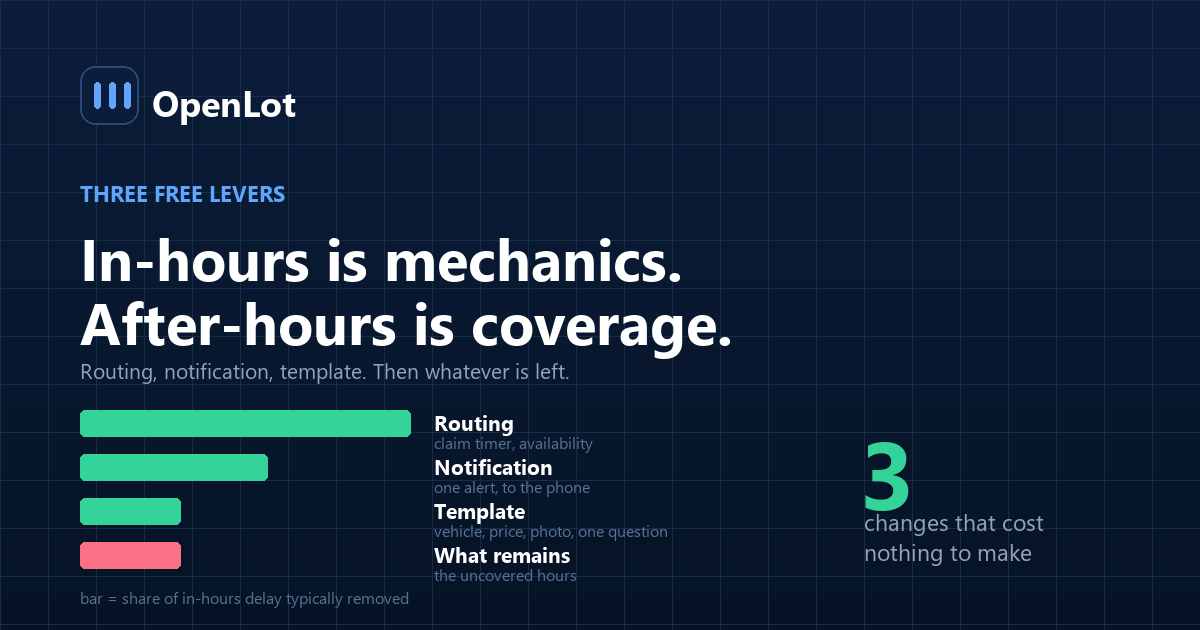
This guide covers the three changes that cost nothing, what each is worth, how to tell which one is binding at your store, what remains afterwards, and what to measure.
Why is the delay usually not a staffing problem?
Because a lead that waits 40 minutes during staffed hours was not waiting for a person to become available. It was waiting for one of three things: to reach the right person, for that person to notice, or for them to compose something.
Those are mechanics, and mechanics are cheap to fix. Adding headcount to a mechanics problem makes a slow process more expensive without making it faster, which is a reliable way to raise cost per sale without raising sales.
The honest division: in-hours delay is usually mechanics, out-of-hours delay is coverage. You cannot fix the second with the three levers below, and you should not spend on the second before fixing the first.
Lever 1 — Routing
The problem: the lead goes into a shared queue, or round-robins to whoever is next regardless of availability, or lands with a salesperson who is with a customer.
What to change:
- Route by availability, not by rotation. A rep who is in a deal should not be first in line for a web lead.
- Give every queue a named fallback that triggers on a timer. If nobody claims the lead in five minutes, it moves. Unclaimed-forever is the most common single cause of a multi-hour in-hours response.
- Route third-party marketplace leads separately. They behave differently, convert differently and frequently warrant a different first message — the distinction that makes lead attribution worth doing at all.
Worth: usually the largest of the three. A five-minute unclaimed timer alone removes most of the long tail.
Lever 2 — Notification
The problem: the lead arrives in the CRM and nobody is told, or everybody is told so often that nobody looks.
What to change:
- Push to the phone, not just to a desktop CRM inbox. The person who can answer fastest is frequently not at a desk.
- One alert per lead, with the vehicle and the source in the alert itself. If the rep has to open the CRM to find out what the lead wants, you have added a step.
- Escalate on the timer. Unclaimed at five minutes alerts the manager, not just the rep again.
- Turn off the other alerts. Notification fatigue is real, and a store where everything pings is a store where nothing does.
Worth: moderate, and it compounds with routing. Routing decides who; notification decides whether they know.
Lever 3 — The template
The problem: the rep has to compose a reply from scratch, so the reply waits for a gap in the day — and when it arrives it frequently says nothing.
This is the part most stores get wrong even when they are fast. The DAS Technology study of 1,700 U.S. dealerships found 74% of responses included no price quote, 90% sent no vehicle photos, and 26% omitted vehicle information entirely.
What to change: build a template that pre-fills the four things a first response needs —
- The vehicle, named with its specifics
- A price, or a clear reason there is not one yet
- At least one photo
- One question, not five
Pre-filled from the lead record, leaving the rep 15 seconds of personalisation rather than five minutes of composition. The speed gain is real and the content gain is larger, which is the argument made at length in where instant response stops paying.
Worth: smaller on latency than the other two, larger on outcome than both.
Which lever is binding at your store?
One query, run on 90 days of in-hours leads only. Measure three intervals per lead:
Interval If it is the largest Lead arrival → claimed by a rep Routing. Fix the queue and the unclaimed timer Claimed → first message composed Template. They are staring at a blank box Nothing is claimed for long stretches Notification. They do not know it is there Fix the binding one first. Doing all three at once is fine, but knowing which one mattered tells you whether the next problem is also mechanics.
What remains after the free fixes?
The hours nobody is working, and that is a different problem with a different budget.
If in-hours first touch drops to single-digit minutes and the blended average barely moves, the remaining delay is entirely in the uncovered window — which is the whole subject of after-hours lead response and the four ways to cover it.
That sequence matters. Fixing mechanics first means that whatever you buy for coverage is sized against the real gap rather than against a gap inflated by a broken queue.
Where does this go wrong?
1. Buying coverage before fixing mechanics. The system covers nights beautifully and the 2pm lead still waits 40 minutes.
2. A template that is a form letter. Pre-filling the four elements is not the same as sending identical text to everyone. If it reads as generic, it performs as generic.
3. An unclaimed timer with nowhere to go. The escalation has to reach a named person who is actually available, or it is a notification into a void.
4. Measuring the blended average. In-hours and out-of-hours improvements move at different rates, and a single average hides whichever one you just fixed.
5. Five questions in the first message. Each additional question lowers the reply rate. Qualification is a conversation.
What should you measure?
| Metric | How to compute | What it decides |
|---|---|---|
| Arrival → claimed | Median, in-hours leads only | Whether routing is binding |
| Claimed → first message | Median, in-hours leads only | Whether the template is binding |
| Unclaimed at 5 minutes | Share of leads | Whether notification is binding |
| First-touch, in-hours vs out | Split, never blended | What is left for coverage to solve |
| Response content score | Sample 50: price, photo, vehicle, one question | The ceiling the levers do not raise on their own |
| Reply rate to first message | Replies ÷ first messages | Whether faster is producing conversations |
Re-run two weeks after the changes. These are mechanics, so they move quickly or they did not work — unlike coverage changes, which take a full cycle to read.
Frequently asked questions
How can a dealership respond to leads faster without hiring?
Three changes, all free: route leads by availability with a timer that reassigns anything unclaimed after five minutes, push one useful alert per lead to the phone rather than to a desktop inbox, and give reps a template pre-filled with the vehicle, a price, a photo and one question. In-hours delay is usually mechanics rather than headcount.
Which fix gives the biggest improvement?
Routing, in most stores, because unclaimed leads sitting in a shared queue produce the long tail that drags the average. The way to confirm it for your store is to measure two intervals separately — lead arrival to claimed, and claimed to first message — and fix whichever is larger.
What should a lead response template contain?
The vehicle named with its specifics, a price or an explicit reason one cannot be given yet, at least one photo, and a single question. The DAS Technology study found roughly three quarters of dealer responses contained no price and nine in ten contained no photo, so the content gain from a good template usually exceeds the speed gain.
Does a faster response matter if the message says nothing?
Much less than it appears. A forty-five second reply asking only "when is a good time to call?" has produced a timestamp rather than a conversation, because the customer asked about a vehicle and received a scheduling question. Speed and substance need to be measured separately.
How many questions should the first message ask?
One. Every additional question lowers the probability of a reply, and qualification works better as a conversation that unfolds than as a form delivered up front. The remaining qualifying information can be collected once the customer has engaged.
What if response times are still slow after these changes?
Then the remaining delay is in the hours nobody is working, which is a coverage problem rather than a mechanics problem. That is a useful finding: it means any system you buy next is being sized against a real gap rather than one inflated by a broken queue.
Why measure in-hours and out-of-hours separately?
Because they have different causes and different fixes, and a blended average hides whichever one you just improved. A store that fixes routing may see its in-hours median drop from forty minutes to six while the blended figure barely moves, which looks like failure and is not.
How quickly should these changes show up in the numbers?
Within two weeks. Mechanics changes move fast or they did not work, unlike coverage changes which take a full cycle to read. Re-running the same two interval measurements a fortnight later tells you whether the fix landed or whether something else is binding.
Conclusion
- In-hours delay is mechanics, out-of-hours delay is coverage. Different problems, different budgets.
- Three free levers: routing with an unclaimed timer, one useful alert to the phone, a template that answers the question.
- Measure two intervals separately — arrival to claimed, claimed to first message — to find the binding one.
- The template earns more on content than on speed. Three quarters of fast replies carry no price.
- Fix mechanics before buying coverage, or you will size the purchase against an inflated gap.
Last updated: