Instant lead response means answering an internet lead within seconds rather than minutes. The research supporting speed is about hours versus minutes, not seconds versus minutes — and past a certain point the return on further speed collapses while the return on saying something useful does not.
This guide covers what the speed research actually measured, where the curve flattens, why most fast responses fail anyway, the trade-off between speed and substance, and what to measure.
What does the speed research actually say?
Two studies get cited constantly, and both are about hours versus minutes.
The five-minute finding. Responding within five minutes rather than thirty makes a lead 21 times more likely to qualify, and raises the odds of making contact at all by roughly 100 times — Oldroyd, MIT Sloan with InsideSales, across three years, six companies, more than 15,000 leads and over 100,000 call attempts.
The one-hour finding. Firms responding within an hour were 7 times more likely to have a meaningful conversation than those responding in the second hour, and 60 times more likely than those waiting 24 hours or more. The same audit found 23% never responded at all — Harvard Business Review, 2,241 U.S. companies.
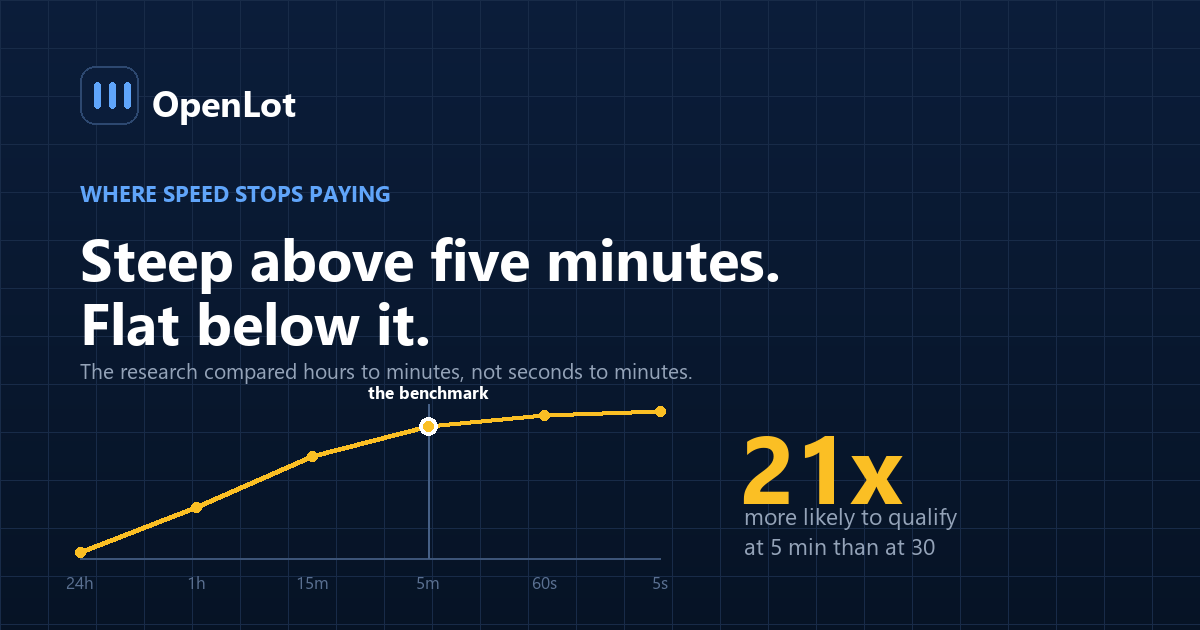
Read them carefully and the shape is clear. The enormous multiples come from closing gaps measured in hours. Neither study claims a difference between five minutes and five seconds, because neither tested it.
That matters, because the gap in most dealerships is measured in hours, and it sits where nobody is working. 19% of dealers take more than an hour to answer an internet lead — DAS Technology, 1,700 U.S. dealerships, Q3–Q4 2024, presented at NADA 2025. Those stores have enormous headroom, and it is all in the first part of the curve.
Where does the curve flatten?
The shape of the return
Illustrative, anchored on the two studies above.
Moving from To What changes 24 hours 1 hour Enormous. The lead was gone; now it is not 1 hour 15 minutes Large. Still inside the window of active shopping 15 minutes 5 minutes Meaningful. This is the documented benchmark 5 minutes 60 seconds Small, and situational 60 seconds 5 seconds Mostly a timestamp The curve is steep where the gap is hours and nearly flat below five minutes. Which means: if your uncovered hours produce nine-hour waits, every available point is in the top two rows, and arguing about seconds is optimising the part that is already solved.
There is one real exception. A customer sitting on a vehicle detail page at 11pm, actively comparing three stores, is in a different state than one who submitted a form and walked away. For that customer, seconds matter because the conversation is live. But that is a minority of leads, and it does not generalise into a case for sub-second response across the board.
Why do fast responses fail anyway?
Because speed and substance are measured separately, and most stores only measure one.
The same DAS study that produced the 19% figure also graded the content of dealer responses:
- 74% included no price quote
- 90% sent no vehicle photos
- 26% omitted vehicle information entirely
A reply in 45 seconds that says "Thanks for your interest! When is a good time to call?" has achieved a timestamp. The customer asked about a specific vehicle; the store answered about scheduling.
This is the actual ceiling on instant response, and it is why the response-time benchmarks are only half the picture. The other half is whether the message moves the conversation.
What a first response has to contain
Four things, and they are not expensive:
- The vehicle, by name and spec. Confirms you read the request.
- A price or a reason there is not one. Silence on price reads as evasion, which is how the customer already expects this to go.
- A photo or two. Nine out of ten dealers do not send one.
- One question, not five. Qualification is a conversation, not a form.
Automation is good at all four, consistently, at 2am. That is a better argument for it than raw speed.
Does automation change the trade-off?
It removes it, which is the actual case for the technology.
A person cannot be both fast and thorough at volume — they are fast when the queue is short and slow when it is long, and the quality drops exactly when the volume spikes. Software does not get busy. The same four elements go out at 2pm Tuesday and 2am Sunday.
What automation does not fix is what happens next. A 20-second response that books an appointment nobody picks up has moved the bottleneck, which is the recurring failure in AI BDC deployments and the reason front-of-funnel speed is not self-justifying.
Where does the pursuit of instant response go wrong?
1. Optimising seconds while hours go uncovered. Worse, it is usually done before the three free mechanical fixes that would have closed the in-hours delay at no cost. A store with a 19-hour Sunday wait tuning its weekday response from 90 to 30 seconds is working on the flat part of the curve.
2. Measuring to the auto-responder. An automated acknowledgement is not a response, and counting it produces a number that looks excellent and means nothing.
3. Speed with no content. Covered above. Three quarters of fast replies contain no price.
4. Five qualification questions in the first message. Each question lowers the probability of a reply. One question, then more once they engage.
5. Instant and obviously robotic. Generic, over-eager copy sent in two seconds reads as spam and gets ignored, which is worse than a thoughtful reply at minute four.
What should you measure?
| Metric | How to compute | What it catches |
|---|---|---|
| First-touch to genuine response | Lead timestamp → first message referencing the vehicle | Auto-responder inflation |
| First-touch by day-part | Bucketed by hour and weekday | Whether you are on the steep or flat part of the curve |
| Response content score | Sample 50 responses: price, photo, vehicle detail, one question | The ceiling nobody measures |
| Reply rate to first message | Customer replies ÷ first responses sent | Whether speed is producing conversations |
| Reply rate by question count | Split by how many questions the message asked | Usually one question wins |
The third row is the one almost nobody runs, and it is cheap: fifty messages, four checkboxes, one afternoon.
Frequently asked questions
How fast should a dealership respond to an internet lead?
Within five minutes is the documented benchmark, drawn from research showing a lead contacted within five minutes is roughly 21 times more likely to qualify than one contacted at thirty. Faster than five minutes produces diminishing returns in most cases, while the gap between five minutes and several hours produces nearly all of the available gain.
Is responding in seconds better than responding in minutes?
Marginally, and mostly for customers who are actively browsing at that moment. The research behind the speed case compared hours to minutes, not seconds to minutes, so a sub-minute response should be treated as a pleasant side effect of automation rather than the reason to buy it. The content of the message matters considerably more at that scale.
Why do fast lead responses still fail?
Because speed and substance are measured separately and most stores only measure speed. In the DAS Technology study, 74% of dealer responses contained no price quote, 90% included no vehicle photos and 26% omitted vehicle information entirely. A fast reply that does not address what the customer asked has produced a timestamp rather than a conversation.
What should the first response to a car lead contain?
The vehicle named with its specifics, a price or a clear reason one cannot be given yet, at least one photo, and a single question. Multiple questions in a first message reduce the chance of a reply, and qualification works better as a conversation than as a form delivered up front.
Does an auto-responder count as a lead response?
No. An automated acknowledgement that does not reference the customer, the vehicle or the question is an acknowledgement, and counting it as a first touch produces response-time figures that look excellent while the customer is still waiting. Measure to the first substantive message.
Should we automate to get instant response?
Automation is worth it for consistency and coverage rather than for raw speed. A person is fast when the queue is short and slow when it is long, with quality degrading exactly when volume spikes, while software sends the same four elements at 2pm and at 2am. The speed is a by-product; the consistency across all 168 hours is the product.
Can a response be too fast?
It can read as too automated, which is a different problem with the same symptom. Generic, over-eager copy arriving two seconds after a form submission reads as spam and gets ignored, performing worse than a specific reply at minute four. Honest disclosure plus a message that references the actual vehicle outperforms both speed alone and a failed impersonation.
Where should a store with hours-long response times start?
With the hours, not the seconds. If any day-part shows waits measured in hours, every available point of improvement sits in closing that gap, and tuning in-hours response from ninety seconds to thirty is working on the flat part of the curve. Bucket your first-touch times by hour and weekday and fix the worst bucket first.
Conclusion
- The research is about hours versus minutes. Neither cited study tested seconds against minutes.
- The curve is steep above five minutes and flat below it. Fix the hours first.
- Three quarters of fast replies contain no price, and nine in ten contain no photo. That is the real ceiling.
- Four elements make a first response work: the vehicle, a price, a photo, one question.
- Automation's case is consistency, not speed. The same message quality at 2am as at 2pm.
Last updated: