Declined work is the only list in a dealership where the customer has already been told what they need and roughly what it costs. In most stores nothing happens after the decline — not because anyone decided against it, but because working hundreds of declined recommendations a month by hand was never feasible.
This guide covers why work gets declined, how to segment the list, the timing window for each reason, what the message must contain, where follow-up goes wrong, and what to measure.
Why does work get declined?
Five reasons, and they want very different follow-up.
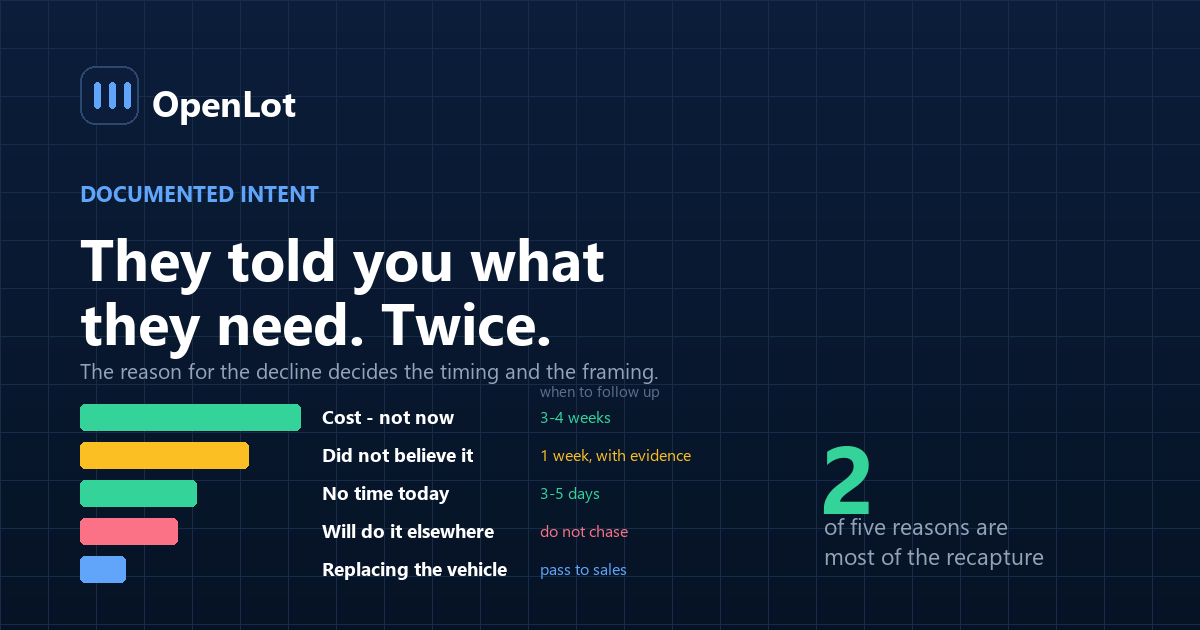
| Reason | Share of declines | Recoverable? | Right timing |
|---|---|---|---|
| Cost — not now | Largest | Yes | Next payday cycle, or next visit |
| Did not believe it was needed | Large | Sometimes | Only with evidence |
| No time today | Moderate | Yes, easily | Within days |
| Will do it elsewhere | Moderate | Rarely | Do not chase |
| Vehicle about to be replaced | Small | No | Pass to sales, carefully |
The first and third are the programme. The second can be recovered only if you can show them something — a photo of the pad, the video the technician took — which is why multi-point inspection delivery matters more than it first appears.
The fourth should be left alone. Chasing someone who already said they will use their own mechanic produces opt-outs and nothing else.
How do you segment the list?
Four filters, in order. Sending before filtering is how a good programme becomes a complaint.
1. Has it since been done? The single most important check and the one most often skipped. If the customer had the brakes done at their next visit — or you can tell from a subsequent RO — contacting them about brakes makes you look careless. This is a data quality dependency before it is an automation one.
2. Is the vehicle still theirs? Trade-ins and sales show up in your own DMS. A follow-up about a vehicle they no longer own is worse than silence.
3. Is there a current consent record? Service messaging carries the same obligations as any other outbound, with the dealership accountable regardless of vendor — the Safeguards Rule framing applies.
4. Is the recommendation still valid? A tyre recommendation from 14 months ago is now a different recommendation, and quoting the old price invites a conversation you will lose.
What survives all four is the list.
When should the follow-up go out?
Not immediately, and not a year later.
The timing windows
Illustrative, by decline reason. Measure your own response by window.
Reason First touch Second No time today 3–5 days At next reminder Cost, not now 3–4 weeks Next service due date Did not believe it With evidence, 1 week None — one attempt Safety-related (brakes, tyres, steering) Within 7 days, regardless of reason One follow-up The bottom row overrides the others. A declined safety item deserves one clear, non-commercial message quickly, framed around the condition rather than the price.
Everything else is about matching the reason. Contacting a "cost, not now" customer three days later ignores what they told you.
What must the message contain?
Four things, and the second is the one usually missing.
- The specific recommendation, in the words the advisor used, with the date it was made.
- Evidence. The photo or video from the inspection. This is the difference between a reminder and a case, especially for the "did not believe it" segment.
- A current price, or an honest statement that pricing needs reconfirming. Quoting an old number and withdrawing it is worse than not quoting.
- Two concrete times. Not a booking link alone.
What it must not contain: pressure, a countdown, or a discount framed as expiring. Declined work follow-up that reads as a sales push performs worse than one that reads as a shop keeping track.
The safety exception
Declined brakes, tyres or steering components get a different message: shorter, specific to the condition, and without a promotional frame. The purpose is to make sure the customer understood, and the commercial outcome follows from that or it does not.
Where does declined follow-up go wrong?
1. Not checking whether it was already done. The error that makes a store look careless, and it is entirely preventable.
2. Treating every decline the same. Covered above. The reason determines the timing and the framing.
3. Chasing the "I'll do it elsewhere" segment. Pure opt-out generation.
4. Quoting the old price. Parts and labour move. Reconfirm or say you will.
5. No evidence attached. For a customer who declined because they were not convinced, a message with no photo repeats the conversation that already failed.
6. Running it as a campaign rather than a process. Blasting 12 months of declines in one week burns the list and spikes opt-outs. Work it as a rolling cohort, matched to each decline's own timing window.
7. Recapturing into a full shop. If there is no capacity, the recaptured customer cannot get a convenient slot and you have spent the goodwill for nothing.
What should you measure?
| Metric | How to compute | What it tells you |
|---|---|---|
| Decline rate | Recommendations declined ÷ presented | The size of the pool |
| Decline reason capture rate | Declines with a recorded reason ÷ total | Usually low — fixing it is step one |
| Recoverable share | Survives all four filters ÷ total declines | The real list size |
| Recapture rate by reason | Booked ÷ contacted, split by decline reason | Where the programme actually works |
| Recapture rate by window | Split by days since decline | Tunes the timing |
| Opt-out rate | Opt-outs ÷ contacted | The guardrail |
| Hours recaptured | Recaptured ROs × average hours | What it is worth in capacity terms |
Row two is the prerequisite for the whole programme. If advisors are not recording why work was declined, every follow-up is sent blind, and the single highest-return change available is a required reason field at the point of decline.
Frequently asked questions
What is declined service follow-up?
It is contacting customers who were told they needed a specific repair and chose not to do it at that visit. The record sits in the DMS with the recommendation, the date and the quoted price, which makes it the only list in the dealership where intent is documented rather than inferred.
Why do most dealerships not work declined service?
Not because anyone decided against it, but because doing it by hand across hundreds of declined recommendations a month is not feasible alongside live work. It is the clearest example of a task that exists, is valuable, and simply never gets done without automation.
When should you follow up on declined work?
It depends on why it was declined. A customer who had no time that day is worth contacting within a few days; one who declined on cost is better approached after three or four weeks. Declined safety items — brakes, tyres, steering — warrant one clear message within a week regardless of the stated reason.
What should a declined work follow-up message say?
The specific recommendation in the advisor's own words with the date, the inspection photo or video as evidence, a current price or an honest note that pricing needs reconfirming, and two concrete appointment times. It should not include pressure, countdowns or expiring discounts, which make it read as a sales push rather than a shop keeping track.
How do you avoid contacting someone about work already done?
By checking subsequent repair order history for that vehicle before sending, and by confirming the vehicle is still owned by that customer. Both checks are available in your own DMS, and skipping them is the fastest way to make a well-intentioned programme look careless.
Should every declined recommendation be followed up?
No. Customers who said they would have the work done elsewhere should be left alone, and recommendations where the vehicle has since been traded are irrelevant. Filtering by what has since been done, current ownership, consent and whether the recommendation is still valid typically removes a substantial share of the raw list.
What is the prerequisite for a declined work programme?
Recording why the work was declined, at the point of decline. Most stores capture the decline but not the reason, which means every follow-up afterwards is sent blind. Adding a required reason field is usually the highest-return change available before any automation is considered.
Should the whole backlog be contacted at once?
No. Blasting twelve months of declines in a single week burns a finite list and concentrates opt-outs. Working it as a rolling cohort, with each decline contacted inside its own timing window, produces steadier recapture and preserves the list for the following quarter.
Conclusion
- The only list where intent is documented, priced, and attached to a known vehicle.
- The reason determines the timing. "No time today" and "cost, not now" are different programmes.
- Check what was already done, and whether they still own the car, before sending anything.
- Evidence is the message. For the unconvinced segment, a photo is the whole argument.
- Capture the decline reason. Without it every follow-up is blind, and that fix comes first.
Last updated: