Service department automation is usually bought as a platform and should be sequenced as a series of small projects. Three of the nine candidates return more than the other six combined, and two of the nine should not be attempted until the DMS data underneath them is trustworthy.
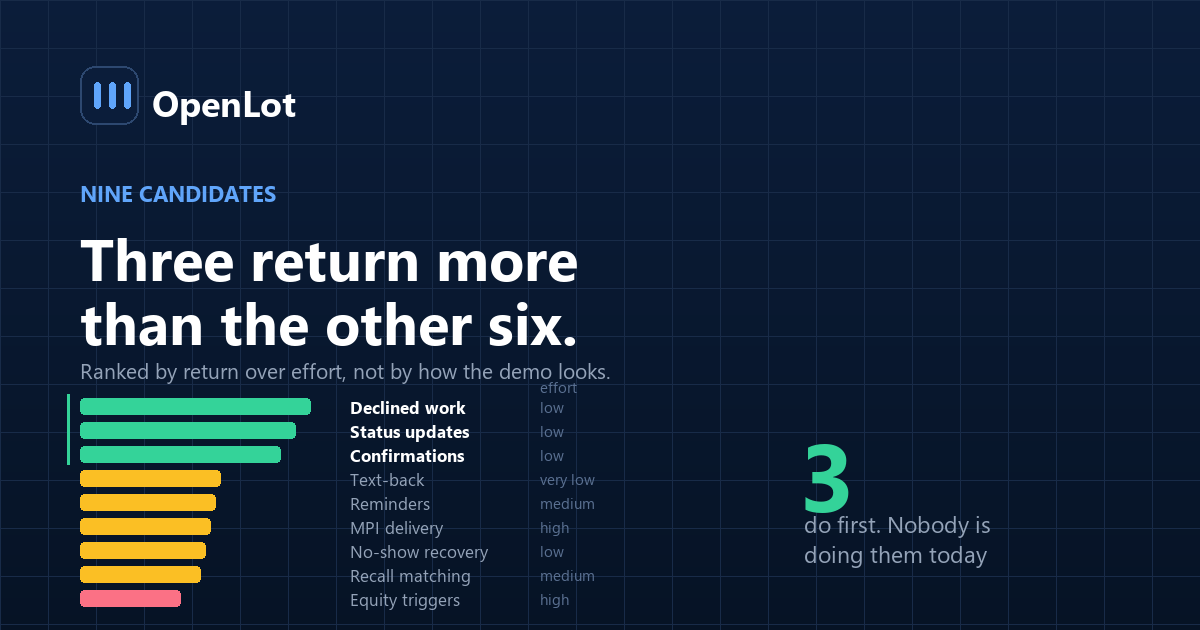
This guide covers the nine automation candidates ranked by return over effort, which three to do first, what each one requires technically, what to leave alone, and what to measure.
The nine candidates, ranked
Ranked by return divided by effort, not by how impressive the demo is.
| # | Candidate | Return | Effort | Needs DMS write? |
|---|---|---|---|---|
| 1 | Declined-work follow-up | High | Low | No — read only |
| 2 | Proactive status updates | High | Low | No |
| 3 | Appointment confirmation and reschedule | High | Low | Yes, light |
| 4 | Missed-call text-back | Medium | Very low | No |
| 5 | Maintenance reminders | Medium | Medium | No |
| 6 | No-show recovery | Medium | Low | Yes, light |
| 7 | Recall notification matching | Medium | Medium | No |
| 8 | Multi-point inspection delivery | Medium | High | Yes |
| 9 | Equity and service-to-sales triggers | Variable | High | Yes |
The top three share a property: they act on information the DMS already has, and nobody is currently acting on it. There is no process to disrupt and no judgment to replace, which is why they deploy quickly and rarely fail.
The three to do first
1. Declined-work follow-up
A customer was told they needed a repair and declined on the day. In most stores, nothing happens afterwards.
This is documented intent, attached to a known vehicle, with a known customer and a known price — and the acquisition cost was paid years ago. It is the cheapest revenue in the department and it sits untouched because working it by hand across hundreds of ROs a month is not feasible.
Needs read access to RO history and a rule for timing. Nothing more.
2. Proactive status updates
Messages at four real state changes — checked in, diagnosis complete, authorisation needed, ready for pickup — displace a large share of inbound status calls, which is the largest interruptible block in an advisor's day.
The prerequisite is DMS status discipline. If technicians do not update status reliably, automated messages will be wrong, and a wrong update generates more calls than no update.
3. Appointment confirmation and reschedule
Confirmation sequences reduce no-shows, and a reschedule that continues the thread rather than restarting the booking prevents a phone call landing in the service queue at its busiest hour.
Light DMS write access, to move an appointment. This is where the first real integration scope conversation happens — see what integration services actually contain.
What about the other six?
4. Missed-call text-back. Trivially cheap and worth doing alongside the top three. Service calls cluster into sharp peaks, so the miss rate is usually worse than on the sales side.
5. Maintenance reminders. Worth doing, with the right trigger. Blanket interval reminders to a customer who drives 4,000 miles a year read as spam — the trigger question is the subject of reminders by interval, mileage or behaviour.
6. No-show recovery. Cheap and effective, with a short window. It belongs after confirmations because confirmations reduce the volume it has to handle.
7. Recall notification matching. Useful and genuinely helpful to customers, but it depends on accurate VIN-level data and current open-recall information. The matching is the hard part, not the messaging.
8. Multi-point inspection delivery. Sending photos and video of findings materially improves approval rates. It is high effort because it depends on technicians actually capturing media consistently, which is a process change rather than a software one.
9. Equity and service-to-sales triggers. Highest variance. Done well it surfaces a genuine opportunity; done badly it is an ambush in the waiting room. Covered separately in service-to-sales conversion, and it should be last because it depends on everything above being trustworthy first.
What should not be automated?
| Leave alone | Why |
|---|---|
| Explaining why a repair is needed | This is the sale, and it is a judgment conversation |
| Responding to a declined estimate | Pushback needs a person |
| Any diagnosis from a customer description | Creates expectations the shop then has to meet |
| Repair pricing before inspection | A quote is an obligation |
| A customer who is already unhappy | Escalate immediately, every time |
The line is consistent across the department: automate what has one correct answer; leave what requires a judgment.
Where does service automation go wrong?
1. Buying the platform before sequencing the work. A nine-feature product deployed all at once has nine ways to fail simultaneously and no way to attribute which.
2. Starting at number 9. Equity mining is the most impressive demo and the most dependent on clean data. Starting there is how programmes get cancelled.
3. Automating onto unreliable DMS status. Items 2, 3, 6 and 8 all depend on the DMS reflecting reality. Audit that first.
4. Scaling demand before capacity is understood. Items 3, 4 and 5 increase bookings. If the shop is already at capacity, more bookings produce slipped promise times rather than revenue.
5. One consent model for the whole department. A maintenance reminder, a recall notice and an equity offer are different kinds of message with different consent expectations, and the dealership is accountable for all of them under the Safeguards Rule and applicable messaging rules.
6. Measuring sends instead of outcomes. Messages delivered is not a result. Recaptured declined work, reduced inbound status calls and reduced no-shows are.
What should you measure?
| Candidate | Metric | Target shape |
|---|---|---|
| Declined-work follow-up | Recapture rate on declined ROs | From near zero to anything |
| Proactive status updates | Inbound status calls per RO | Falls substantially |
| Confirmations | No-show rate | Falls |
| Missed-call text-back | Reply rate to text-back | Whether it produces conversations |
| Maintenance reminders | Response rate by trigger type | Tells you which trigger works |
| Recall matching | Match accuracy, sampled | Wrong recall notices are worse than none |
| MPI delivery | Approval rate on presented work | The reason to do it |
| Equity triggers | Opt-out rate | The guardrail — watch it closely |
Every row has a baseline that has to be captured before deployment, for the same reason it does anywhere else: without it, the result is unattributable and every seasonal swing becomes an argument.
Frequently asked questions
What should a dealership automate in the service department first?
Declined-work follow-up, proactive status updates and appointment confirmation with reschedule. All three act on information the DMS already holds that nobody is currently acting on, which means there is no existing process to disrupt and no judgment being replaced.
Why is declined work the best place to start?
Because the intent is documented, the vehicle and customer are known, the price was already quoted, and the acquisition cost was paid long ago. It sits untouched in most stores purely because working hundreds of declined recommendations a month by hand is not feasible, not because anyone decided against it.
What does service automation require from the DMS?
The top candidates need only read access to repair order history and vehicle status. Appointment changes, no-show recovery and inspection delivery need limited write access, which is where the integration scope conversation genuinely begins. Broad write access should be avoided in favour of a narrow, named permission set.
Can status updates be automated if technicians do not update the DMS?
No, and attempting it makes things worse. Automated messages derived from stale or wrong status produce more inbound calls than sending nothing, because customers stop trusting the channel. Status discipline is a prerequisite worth auditing before any customer-facing automation.
Should equity and service-to-sales triggers be automated?
Eventually, and last. They have the highest variance of the nine: done well they surface a real opportunity, done badly they read as an ambush while the customer waits for an oil change. They also depend on the data quality and consent handling built by the earlier items.
What should never be automated in service?
The explanation of why a repair is needed, the response to a declined estimate, any diagnosis from a customer description, repair pricing before inspection, and any interaction with a customer who is already unhappy. The consistent line is to automate what has one correct answer and leave what requires judgment.
Does automating service increase revenue if the shop is already full?
Not directly. Items that increase bookings produce slipped promise times rather than revenue when the shop is at capacity. In that situation the gain comes from better mix and from recaptured declined work, which adds hours without adding appointments — a smaller and different case that still needs to be made honestly.
How should the result be measured?
By outcome rather than by sends. Recaptured declined work, inbound status calls per repair order, no-show rate, approval rate on presented work and opt-out rate are the numbers that matter, each baselined before deployment so the comparison afterwards is defensible.
Conclusion
- Nine candidates, sequenced — not a platform deployed at once.
- Three return more than the other six combined: declined work, status updates, confirmations.
- They work because nobody is doing them now. No process to disrupt, no judgment to replace.
- DMS status discipline is a prerequisite for four of the nine.
- Equity triggers go last, and opt-out rate is the guardrail on them.
Last updated: