Almost every dealership sends service reminders, and almost all of them fire on a calendar interval. Interval is the weakest of the three available triggers — mileage and behaviour both carry information about whether the customer is actually due, and a reminder that arrives when they are not due teaches them to ignore the channel.
This guide covers the three trigger types, why interval underperforms, how to choose a trigger per customer, how many reminders to send, where reminder programmes fail, and what to measure.
What are the three triggers?
| Trigger | Fires when | Knows whether they are due? | Needs |
|---|---|---|---|
| Interval | A fixed period has elapsed | No | Last service date |
| Mileage | Estimated mileage crosses a threshold | Approximately | Last mileage + driving rate |
| Behaviour | Something the customer did | Directly | Visit and decline history |
Most dealership reminder programmes use the first and stop there, because it is the only one that works with the data a DMS surfaces without effort.
Why interval underperforms
Because it is a guess about mileage, and the guess is wrong for most of the distribution.
What interval gets wrong
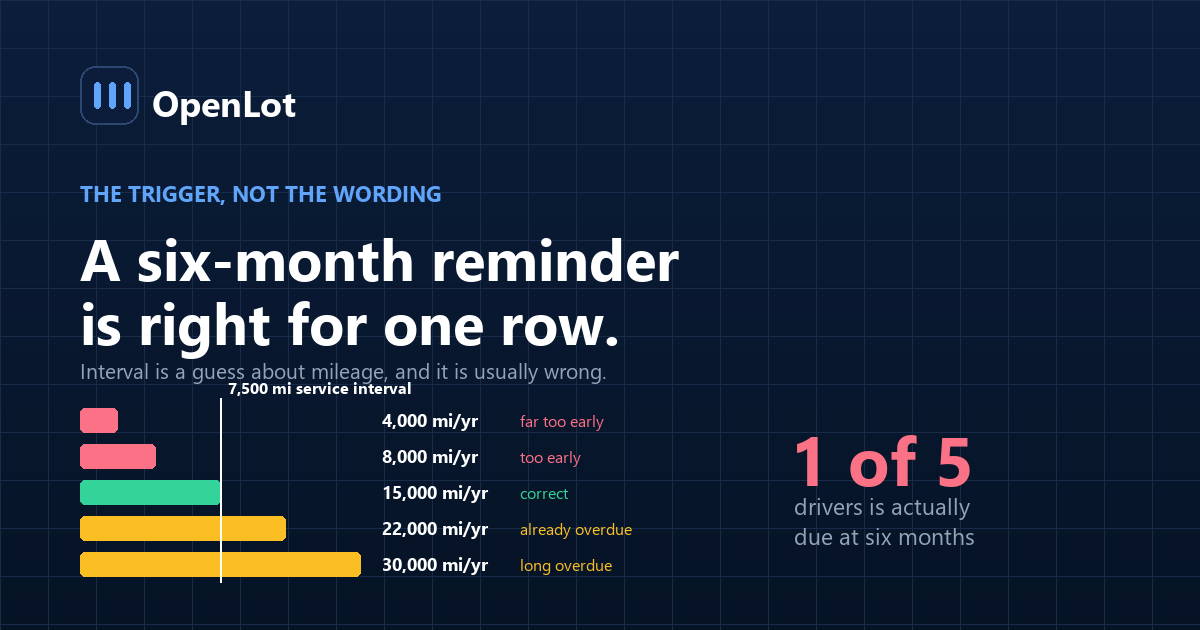
Illustrative. Assume a 7,500-mile service interval and a six-month reminder.
Annual mileage Miles at 6 months Actually due? 4,000 2,000 No — nowhere near 8,000 4,000 No 15,000 7,500 Yes 22,000 11,000 Overdue by months 30,000 15,000 Badly overdue The six-month reminder is correct for one row. For the top two it arrives early and reads as a solicitation; for the bottom two it arrives late, after the customer already went somewhere else.
The low-mileage customers are the ones who do the damage to the channel: they receive reminders they do not need, repeatedly, and learn that your messages do not apply to them.
Mileage, estimated honestly
You know the mileage at last visit and the date. The rate between the previous two visits gives you a driving rate for that specific vehicle, and projecting forward gives an estimated current mileage.
It is an estimate, and it is far better than a calendar. Two refinements matter:
- Recompute the rate at every visit. Driving habits change — a commute ends, a car becomes a second vehicle.
- Treat the estimate as a range. Fire the reminder when the lower bound of the estimate crosses the threshold, not the midpoint, or you will be early for half of them.
Behaviour, the strongest and least used
Something the customer did that tells you they are due or likely to act:
- Declined a specific repair at the last visit — the strongest signal in the department
- Missed a scheduled appointment and never rebooked
- Has an open recall on their VIN
- Stopped coming after a run of regular visits
- Bought the vehicle 11 months ago and has not been back for the first service
These are not reminders in the maintenance sense; they are follow-ups on known facts. They outperform both other categories because the customer knows the fact is true.
How do you choose a trigger per customer?
Not one programme for everyone. A simple decision order:
- Is there an open recall? Recall notification, separately and clearly — not bundled with a maintenance offer.
- Is there declined work on the last RO? Follow up on that, specifically, with the original recommendation.
- Do you have two or more visits with mileage? Use the estimated-mileage trigger.
- Only one visit on record? Interval, with a conservative assumption, until a second data point exists.
- No valid contact or consent? Nothing, until that is fixed.
Most stores can move a large share of their reminder volume out of category 4 and into 2 and 3 using data they already hold. That is the whole opportunity, and it is a data exercise rather than a messaging one.
How many reminders, and on which channel?
Fewer than most programmes send.
A workable pattern per due event: one message, one follow-up if no response, then stop. Two touches, not a sequence. Maintenance reminders are not a sales cadence — the customer either has time and intent or does not, and the third message is what generates the opt-out.
Channel follows the customer's history. If they have responded to text before, text. If they have only ever booked by phone, a text that offers a call-back works better than a booking link — and a missed call back from them lands in the service call queue at its busiest hour.
And the message has to contain the thing that makes acting easy: what is due, roughly what it costs for published maintenance, and two real times. A reminder that says "you are due for service, call us" has put the work back on the customer.
Where do reminder programmes fail?
1. One interval for every vehicle and every customer. Covered above, and it is the single largest cause of low response.
2. Reminding about work already done elsewhere. The customer had the brakes done down the road and you ask them about brakes. This is a data quality problem that makes you look careless.
3. Bundling a recall with a maintenance offer. A safety recall should be its own message. Mixing them undermines both.
4. Sending to customers with no consent record. Service reminders are outbound messaging with the same obligations as any other, and the dealership is the accountable party — see the Safeguards Rule.
5. Three or more touches per due event. The opt-out generator.
6. Reminding into a full shop. If the capacity is not there, reminders produce frustrated customers who cannot get a convenient slot.
What should you measure?
| Metric | How to compute | What it decides |
|---|---|---|
| Response rate by trigger type | Bookings ÷ reminders, split by trigger | Which triggers to expand |
| Share of volume on interval | Interval reminders ÷ total | The size of the improvement available |
| Early-reminder rate | Reminders where actual mileage was well under threshold | Why low-mileage customers tune out |
| Opt-out rate by trigger | Opt-outs ÷ reminders sent, per type | Which programme is damaging the list |
| Recapture on declined work | Bookings from declined-work follow-up | Usually the best number in the set |
| Booking-to-arrival, reminder-sourced | Attended ÷ booked | Whether reminder bookings are real |
Row one is the whole argument. Split your existing programme by trigger and the difference between categories is usually large enough to end the discussion about what to build next.
Frequently asked questions
What triggers should dealership service reminders use?
Three are available: calendar interval, estimated mileage, and behaviour such as declined work or a missed appointment. Most programmes use interval alone because it needs the least data, and it is the weakest of the three because it does not know whether the customer is actually due.
Why do interval-based service reminders underperform?
Because an interval is a guess about mileage and it is wrong for most of the customer base. A six-month reminder against a 7,500-mile interval is correct only for drivers near 15,000 miles a year; it arrives far too early for low-mileage customers, who then learn that your messages do not apply to them.
How do you estimate mileage between visits?
Use the mileage and date from the last two visits to compute a driving rate for that specific vehicle, then project forward. Recompute the rate at every visit, because habits change, and fire the reminder when the lower bound of the estimate crosses the threshold rather than the midpoint, to avoid being early half the time.
What is a behaviour-based service reminder?
A follow-up on something the customer actually did: declined a specific repair at the last visit, missed an appointment without rebooking, has an open recall, or stopped visiting after a regular pattern. These outperform maintenance reminders because the customer already knows the underlying fact is true.
How many service reminders should be sent per due event?
Two — one message and one follow-up if there is no response — then stop. Maintenance reminders are not a sales cadence, and the third touch is usually what produces the opt-out. The content matters more than the count: what is due, published pricing where it applies, and two concrete times.
Should recalls be included in maintenance reminders?
No. A safety recall deserves its own clear message rather than being bundled with a service offer, because mixing them weakens the recall notice and makes the maintenance offer look opportunistic. Recall matching also depends on accurate VIN-level data, which should be verified before sending.
What happens if we remind customers about work they already had done?
You look careless, and the customer discounts future messages. This is a data quality problem rather than a messaging one: reminders should check recent repair order history for the specific recommendation before sending, and records where the history is incomplete are better left out.
Do service reminders need consent records?
Yes. Automated service reminders are outbound messaging carrying the same consent, contact-time and opt-out obligations as any other, with the dealership accountable regardless of the vendor sending them. Customers without a valid consent record should be excluded rather than included by default.
Conclusion
- Three triggers, and most stores use only the weakest. Interval does not know whether the customer is due.
- Estimated mileage is straightforward from two visits, and far better than a calendar.
- Behaviour triggers win because the customer already knows the fact is true.
- Two touches per due event, then stop. The third generates the opt-out.
- Split your current programme by trigger and the response difference ends the debate.
Last updated: