Service advisors are the constraint in most shops long before technicians are. A large share of an advisor's day goes to status calls that carry no decision — and that is the cleanest thing to automate in the entire department, because it removes interruption rather than judgment.
This guide covers where an advisor's day actually goes, which tasks to automate and which never to, why advisors cap the shop before technicians do, where it goes wrong, and what to measure.
Where does an advisor's day go?
Not where the job description says.
The advisor's day
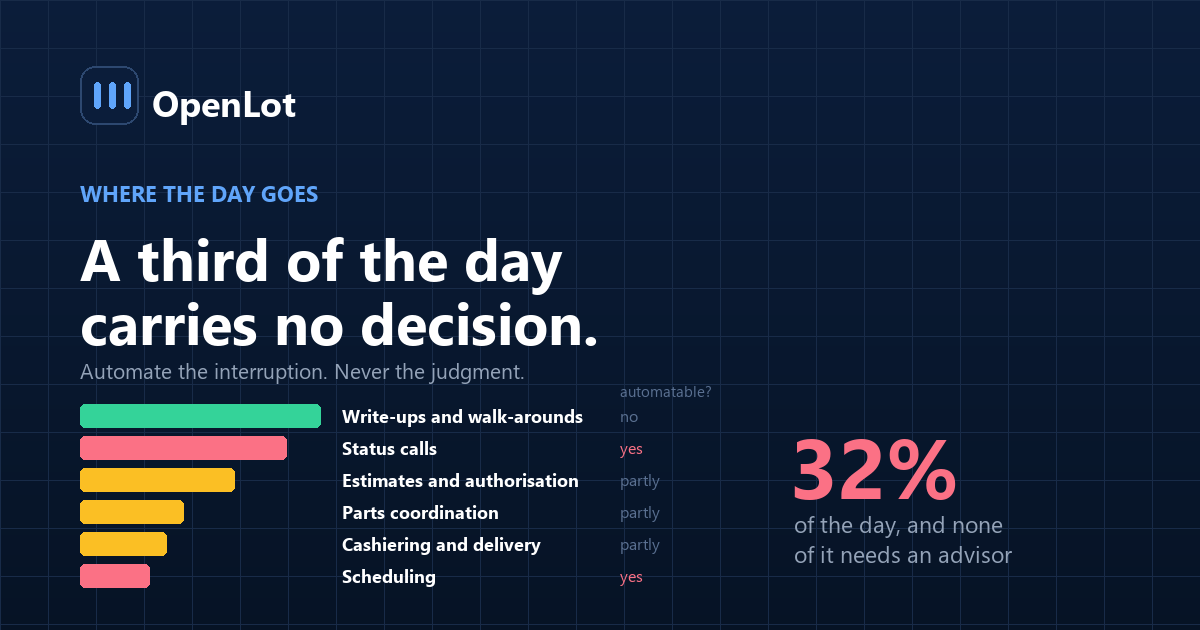
Illustrative. Sample a week of your own call logs and write-up timestamps.
Activity Share of the day Interruptible? Write-ups and walk-arounds 28% No — this is the job Status calls, inbound and outbound 24% Yes, almost entirely Estimates, authorisation calls 18% Partly — the call is, the decision is not Parts and technician coordination 12% Partly Cashiering and delivery 10% Partly Scheduling and rescheduling 8% Yes Roughly a third of the day sits in rows two and six, and almost none of it carries a decision an advisor needs to make. "Is my car ready?" has one correct answer and the advisor is not the only possible source of it.
The second row is also the one that arrives at the worst possible moment. Status calls cluster in late morning and late afternoon — exactly when write-ups and deliveries peak — so they do not merely consume time, they consume it at the point where the department is most constrained.
What should be automated?
| Task | Automate? | Why |
|---|---|---|
| "Is my car ready?" | Yes | One answer, derived from DMS status, no judgment |
| Status updates at genuine state changes | Yes | Proactive updates reduce inbound calls substantially |
| Appointment confirmation and reschedule | Yes | Covered in service scheduling |
| Declined-work follow-up | Yes | Nobody is doing it now, so there is nothing to protect |
| Maintenance reminders | Yes | With the right trigger, not blanket intervals |
| Sending an estimate for approval | Partly | The delivery is automatable, the conversation is not |
| Explaining why a repair is needed | No | Judgment, trust, and the sale itself |
| Negotiating a declined repair | No | Same |
| Handling an unhappy customer | No | Escalate immediately |
| Diagnosing from a description | No | Creates expectations the shop must then meet |
The dividing line is the same one that holds across every dealership application: automate the interruption, never the judgment. An advisor's value is in the conversation where a customer decides to spend $1,400 on a repair, and nothing about that conversation is improved by automating it.
Proactive updates beat answering faster
The counter-intuitive part: the highest-return change is not answering status calls faster. It is removing the reason for the call.
A customer who receives a message at vehicle check-in, at diagnosis complete, at authorisation needed and at ready-for-pickup does not call to ask. Four messages, each tied to a real state change in the DMS, displace a large share of inbound status volume — and inbound status volume is what makes the advisor desk feel chaotic.
Four messages at real transitions. Not four messages a day, which is noise and trains people to ignore the channel — the same trigger discipline that decides whether maintenance reminders work.
Why do advisors cap the shop before technicians do?
Because a repair order has to be written, and writing it is a serial human task.
A shop can have technician hours free and still be unable to take more work, because the front counter cannot process it. Any capacity model that counts only technicians will recommend a booking volume the advisors cannot absorb, and the symptom is a full drive with idle bays.
This is why advisor automation is a capacity intervention rather than a convenience one. Every hour recovered from status calls is an hour available for write-ups, and write-ups are the binding constraint.
It is also why automating the front of the funnel first is a mistake. More bookings against an advisor-bound shop produce a longer queue, which is the same sequencing error that defeats front-of-funnel automation on the sales side.
Where does advisor automation go wrong?
1. Automating the estimate conversation. Sending the estimate is fine. Letting a system explain why the brakes need doing, or handle the pushback, is not — and it costs the approval.
2. Status updates with no state behind them. "Your vehicle is in progress" sent on a timer rather than on an event is noise. The customer learns the messages mean nothing and starts calling again.
3. Automating without fixing the DMS status discipline. If technicians do not update status in the system, automated updates are wrong, and a wrong update generates more calls than no update at all — the same dependency that makes CRM data decay a prerequisite rather than a detail.
4. Removing the phone entirely. Some customers want to talk, and some situations need it. The goal is to displace the unnecessary calls, not to make the department unreachable.
5. Giving the recovered hours away. If the time saved is not deliberately redirected to write-ups and walk-arounds, it dissipates. The business case depends on the redirection.
6. Treating service consent as covered by sales consent. Service messaging has its own consent, contact-time and opt-out obligations, with the dealership accountable regardless of vendor — see the Safeguards Rule.
What should you measure?
| Metric | How to compute | What it proves |
|---|---|---|
| Inbound status calls per RO | Status calls ÷ ROs opened | The number proactive updates should collapse |
| Advisor hours on the phone | Call minutes ÷ advisor hours worked | Where the day goes, before and after |
| ROs written per advisor per day | The redirection metric | Whether recovered hours went anywhere |
| Hours sold ÷ hours available | Daily | Whether the advisor constraint moved |
| Status message accuracy | Messages matching real vehicle state, sampled | Catches a DMS discipline problem early |
| Approval rate on estimates | Approved ÷ presented | Must not fall — the guardrail |
The last row is the guardrail. If estimate approval rate drops after automating, something that should have stayed with the advisor did not.
Frequently asked questions
What should AI do for service advisors?
Take over the interruptions that carry no decision: answering "is my car ready", sending proactive updates at real state changes, handling appointment confirmations and reschedules, and working declined repairs nobody follows up. It should not explain why a repair is needed, negotiate a declined estimate, or handle an unhappy customer.
How much of a service advisor's day goes to status calls?
Enough to be the largest interruptible block in the day, clustered at the worst hours — late morning and late afternoon, when write-ups and deliveries peak. The way to size it for your store is to sample a week of call logs against write-up timestamps rather than relying on a general figure.
Is it better to answer status calls faster or to prevent them?
Prevent them. Four proactive messages tied to real DMS state changes — check-in, diagnosis complete, authorisation needed, ready for pickup — displace a large share of inbound status volume. Answering faster treats the symptom and still consumes advisor time at the busiest hours.
Should AI send repair estimates to customers?
It can deliver the estimate; it should not have the conversation. The explanation of why work is needed, and the response to hesitation, is where approval is won or lost, and approval rate is the metric to watch if any part of that conversation is automated.
Are advisors or technicians the real constraint in a service department?
Advisors, in most shops. A repair order has to be written by a person, so technician hours can sit available while the front counter is unable to process more work. Capacity models that count only technicians will recommend booking volumes the advisors cannot absorb.
What happens if the DMS status is not kept current?
Automated updates become wrong, and a wrong update generates more calls than no update at all. Status discipline in the DMS is a prerequisite rather than a nice-to-have, and it is worth auditing before automating anything customer-facing.
How do we know the recovered hours went anywhere?
Track repair orders written per advisor per day alongside the reduction in call time. If phone time falls and ROs written stay flat, the recovered hours dissipated into the day rather than going to write-ups, and the business case has not been realised.
Does service messaging need separate consent from sales?
Yes. Service reminders, status updates and follow-ups are outbound messaging with their own consent, contact-time and opt-out requirements, and service-side systems are frequently configured without the consent logging the sales side already has.
Conclusion
- Automate the interruption, never the judgment. Status calls yes, the estimate conversation no.
- Prevent the call rather than answering it faster. Four messages at real state changes.
- Advisors cap the shop before technicians do, which makes this a capacity intervention.
- DMS status discipline is a prerequisite. Wrong updates generate more calls than none.
- Watch estimate approval rate. If it falls, something crossed the line.
Last updated: