Service-to-sales conversion means identifying service customers whose vehicle situation has changed enough to make a trade worth discussing. The data part is easy and the timing part is where it fails — an equity conversation during a repair visit reads as an ambush, and the cost lands on service retention rather than on the sales floor.
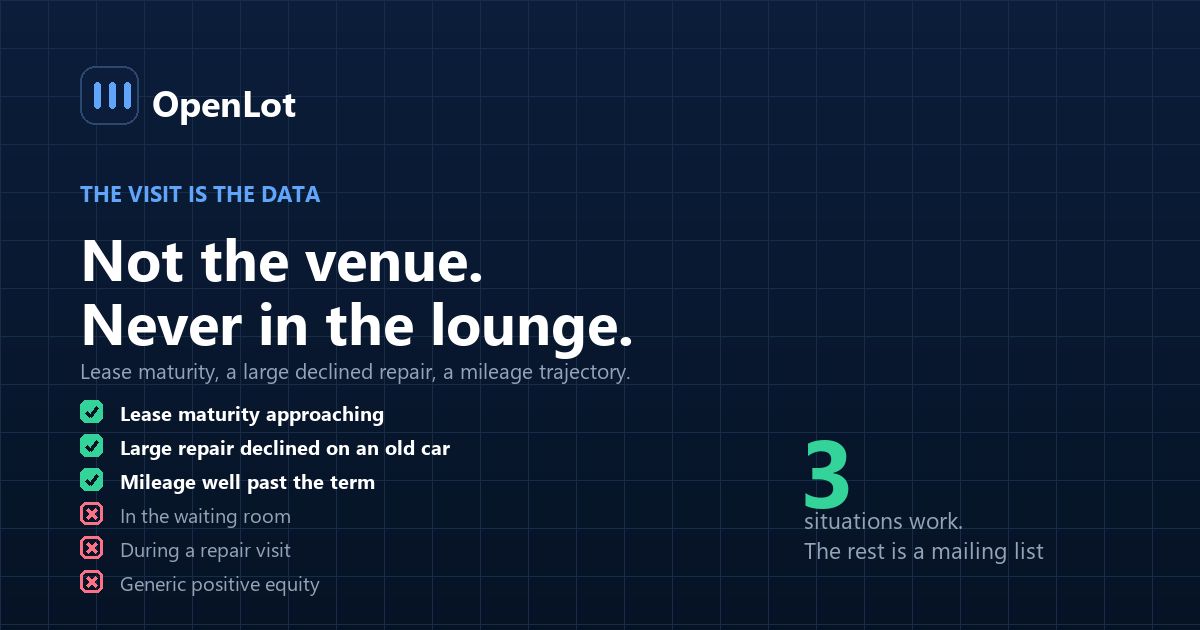
This guide covers what a genuine equity signal is, the three situations where the approach works, the three ways it backfires, what the conversation has to respect, and what to measure.
What makes an equity signal genuine?
Most equity-mining tools flag far more customers than are actually in a position to act, because they use one input where three are needed.
| Input | What a weak tool uses | What is actually needed |
|---|---|---|
| Vehicle value | A generic book value | Your own recent retail and wholesale results for that unit |
| Payoff | Estimated from original terms | Actual payoff, or a current, dated estimate |
| Payment | Assumes they want the same payment | Their current payment, and whether a comparable one is achievable |
| Situation | Not considered | Lease maturity, mileage trajectory, repair just declined |
A customer is a genuine opportunity when a comparable vehicle at a comparable payment is actually available, not when a model says their car is worth more than they owe. The second condition without the first produces a conversation that ends in disappointment, which costs the service relationship.
The three situations where it works
1. Lease maturity approaching. The strongest. The customer already knows a decision is coming, the timing is predictable, and the conversation is expected rather than imposed.
2. A large repair just declined on an older vehicle. Genuinely useful information: a customer facing a $3,200 transmission on a vehicle worth $5,000 benefits from knowing the alternative. Handled respectfully, this is a service to the customer. Handled commercially, it is predatory.
3. Mileage trajectory against the term. A customer well ahead of their lease mileage allowance, or heading toward a warranty expiry with high annual mileage, has a real reason to look.
Everything else — generic positive equity with no triggering situation — is a mailing list.
Where does it backfire?
1. In the waiting room. The most common and most damaging version. A customer sitting with a coffee waiting for an oil change, approached by a salesperson holding a printout, has been ambushed in a place they came for something else. The cost shows up as service retention, not as a lost sale, which is why it stays invisible to whoever runs the programme.
2. During a repair visit. Someone whose car is being fixed has already decided to keep it, at least for today. An equity approach at that moment reads as "we would rather sell you a car than fix this one."
3. On a vehicle you cannot replace. Telling a customer their truck is worth more than they owe, when you have nothing comparable at a comparable payment, creates a want you cannot serve — and they take it down the road. Whether you can replace it is an acquisition question, not a sales one.
The timing rule
One sentence that prevents most of the damage:
Never raise equity while the customer is in the building for service.
Make the approach separately — by message or by call, a few days after the visit, framed around their situation rather than around the fact that you noticed. The service visit provides the data. It is not the venue.
The exception is a customer who raises it themselves, which happens more often than programmes assume and is the only unambiguously good version of the conversation.
What does the conversation have to respect?
Their stated reason for being there. They came for service, and the visit sits inside the six fixed-ops stages rather than above them. The programme runs after the fact, not instead.
The decline, if there was one. If the trigger is a declined repair, the message has to acknowledge the repair honestly, including the option of doing it. A message that pretends the repair does not exist is transparently self-serving — and the declined work follow-up should still happen, separately, because many of those customers will keep the vehicle.
Consent, separately. Consent to receive service messages is not consent to receive sales offers. Treating them as one is a compliance exposure under the Safeguards Rule and applicable messaging rules, and it is also how service customers learn to opt out of everything.
The answer "no". Once. A customer who declines an equity conversation should not receive another for a long period, and the system has to record that.
Where does the automation fit?
Narrowly, and behind everything else.
What automation does well: computing the equity position across the whole service base continuously, flagging lease maturities and mileage trajectories, and queuing the opportunity with context for a person to act on at the right time.
What it must not do: make the approach itself, quote a trade value, or promise a payment. A trade number sent by your system is treated as an offer, which is the same boundary that holds everywhere else in the store.
This is why equity triggers sit last in the service automation sequence. They have the highest variance of any candidate, they depend on data quality built by the earlier items, and the downside lands on a relationship you already have rather than on one you were trying to start.
What should you measure?
| Metric | How to compute | What it tells you |
|---|---|---|
| Flagged ÷ service base | Share the tool thinks is in equity | If it is very high, the model is too loose |
| Genuine opportunity rate | Flagged customers with a comparable unit available ÷ flagged | The real list |
| Approach-to-appointment rate | Sales appointments ÷ approaches made | Whether the framing works |
| Service retention of approached customers | Return rate vs non-approached | The guardrail — watch this above all |
| Opt-out rate, service channel | Opt-outs ÷ approaches | Whether the programme is damaging the channel |
| Declined-repair completion rate | Declined repairs later completed, approached vs not | Whether you traded service revenue for a sale that did not happen |
The fourth row is the one that decides whether the programme should continue. If approached customers return for service at a lower rate than comparable non-approached ones, the programme is consuming an asset to produce a smaller one, and the arithmetic almost never favours that.
Frequently asked questions
What is service-to-sales conversion?
It is identifying service customers whose situation has changed enough that a vehicle trade is worth discussing — typically an approaching lease maturity, a large declined repair on an older vehicle, or a mileage trajectory heading past their term. The data comes from the service visit; the conversation should happen separately from it.
When is a service customer genuinely in equity?
When a comparable vehicle at a comparable payment is actually available to them, not merely when a model says their car is worth more than they owe. The second condition without the first produces a conversation that ends in disappointment and costs the service relationship.
Should you approach a customer about trading while they wait for service?
No. A customer sitting in the waiting room came for something else, and an equity approach at that moment reads as an ambush. The cost usually appears as reduced service retention rather than as a lost sale, which makes it invisible to whoever is measuring the programme.
Is it acceptable to raise a trade when a customer declines a large repair?
Yes, if handled honestly and separately. A customer facing a repair that costs most of the vehicle's value genuinely benefits from knowing the alternative. The message has to acknowledge the repair and keep it on the table, and the declined-work follow-up should continue regardless, because many of those customers will keep the vehicle.
Does consent to service messages cover sales offers?
No. These are different message types with different expectations, and treating service consent as covering sales outreach is both a compliance exposure and a reliable way to make service customers opt out of everything. Consent should be recorded and checked per message type.
What should an equity-mining system be allowed to do?
Compute positions, flag genuine triggers, and queue opportunities with context for a person to act on at an appropriate time. It should not make the approach itself, quote a trade value or promise a payment, because any number sent by the system will be treated as an offer the store has to honour.
Why should equity triggers be the last thing automated in service?
Because they have the highest variance of any service automation candidate and they depend on the data quality and consent handling built by the earlier ones. The downside also lands on a relationship you already have, rather than on a prospect you were trying to acquire, which makes the cost of getting it wrong higher.
What single metric says whether the programme should continue?
Service retention among approached customers compared with similar customers who were not approached. If approached customers come back for service less often, the programme is consuming a recurring revenue relationship to produce occasional vehicle sales, and that trade rarely works out in the store's favour.
Conclusion
- Equity alone is not a trigger. A comparable vehicle at a comparable payment has to exist.
- Three situations work: lease maturity, a large declined repair on an old vehicle, mileage trajectory.
- Never raise it while they are in the building for service. The visit is the data, not the venue.
- Consent is per message type. Service permission is not sales permission.
- Watch service retention among approached customers. It is the number that decides the programme.
Last updated: