A used car acquisition strategy is the set of rules deciding which vehicles a store buys, from where, and at what price. It is the most consequential inventory decision a dealer makes, because a unit acquired wrong cannot be fixed downstream. Repricing, merchandising and discounting can only change how expensive the mistake becomes.
This guide covers why aging is an acquisition problem, how the sourcing channels really compare, what to measure per channel, and the rules that keep a buyer honest.
Why is aging an acquisition problem?
Because the aged unit on your lot today was a decision someone made at appraisal, and every tool available afterward only manages the consequence.
The usual sequence looks like a pricing failure. A unit sits, it gets repriced, it sits more, it gets repriced again, and eventually it goes to auction at a loss. Reviewed at day 70, it reads as a pricing problem. Reviewed at day 0, it reads differently: the store bought a vehicle that its market does not absorb, or paid a number that never left room to be competitive.
Three acquisition errors account for most aged inventory:
- Wrong vehicle for the market. A model, trim or color the store's actual buyers do not shop, bought because the number looked good.
- Wrong price at acquisition. Paid to win a trade or hit a volume target, leaving no position to price into.
- Wrong condition assumption. Reconditioning came in far above estimate, and the unit is now upside down before it is even listed.
None of these are visible in a pricing report. All of them are visible in an acquisition report, which most stores do not produce.
Why the fix has to be upstream
Illustrative. Compare against your own aged list.
A unit acquired $1,500 over where the market lets you price it has two possible endings. Either it sits until it is discounted back to market — carrying holding cost the whole way — or it goes to wholesale at a loss.
Repricing did not cause that outcome and could not have prevented it. A repricing strategy determines how fast you find out, not whether the money was already lost.
This is why stores that fix pricing and leave acquisition alone see days-to-sell improve while used gross keeps sliding. They are discovering the same mistakes faster.
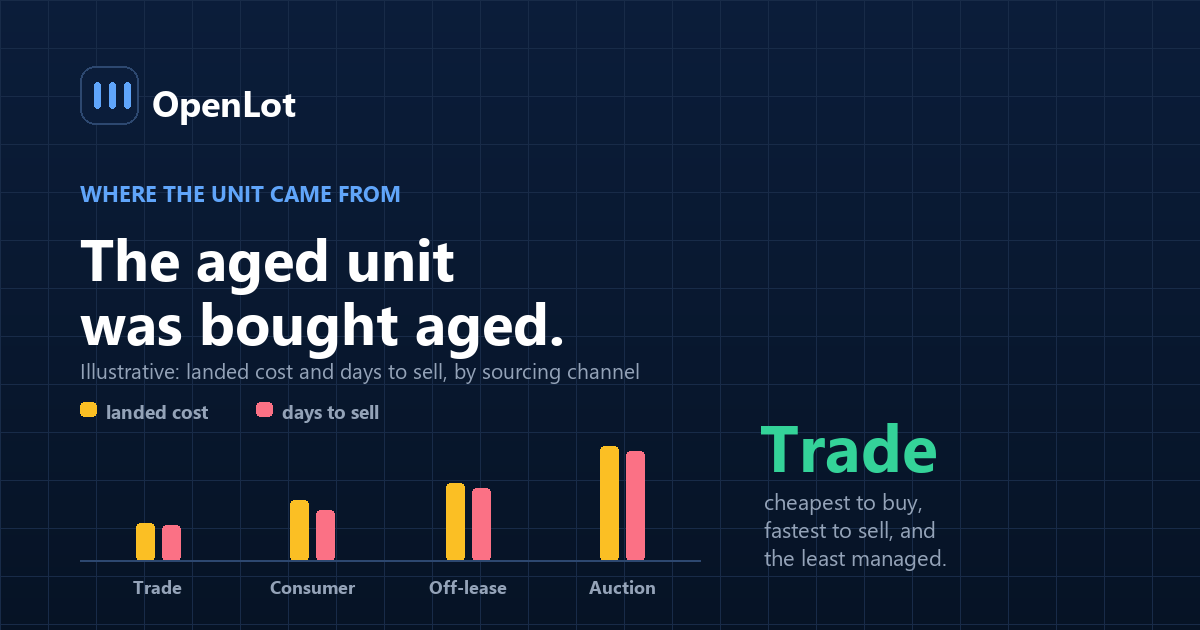
How do the sourcing channels actually compare?
Every store has all four channels available. Most run on whichever one is easiest and are surprised by the mix when they finally measure it.
| Channel | Acquisition cost | Condition risk | Typical days to sell | Volume control |
|---|---|---|---|---|
| Service-lane and customer trade | Lowest | Lowest — you have the history | Shortest | Low |
| Buy direct from consumer | Low to moderate | Moderate | Short | Moderate |
| Physical and digital auction | Highest, plus fees and transport | Highest | Longest | High |
| Off-lease and fleet | Moderate | Low to moderate | Moderate | Low |
Trade is structurally the best channel and the hardest to scale. You know the service history, there is no transport, no buy fee, and the customer is standing in front of you buying something else. The constraint is that you cannot decide to have more trades this month.
Auction is the channel you can scale, and the one that punishes weak discipline. The true landed cost includes buy fee, transport, reconditioning and the cost of the days spent getting the unit frontline-ready. A store comparing the hammer price to a trade offer is comparing two different numbers.
Buying direct from consumers sits in between and has grown for a clear reason: it competes with the instant-offer services for the same car your service lane sees, and it holds a cost advantage over auction that does not depend on winning anything.
The channel mix question
There is no correct mix, but there is a diagnostic: if auction is your largest source and your aged tail is growing, the mix is the problem, not the buyer. Scaling the channel with the highest cost and highest condition risk is how a store grows unit count and shrinks gross at the same time.
What should you measure per channel?
Most stores can report gross by unit. Very few can report gross by acquisition source, which is the report that makes the strategy manageable.
| Metric | How to compute | Why it matters |
|---|---|---|
| Landed cost | Purchase + fees + transport + actual recon | The only cost comparable across channels |
| Days to frontline | Acquisition date → listed and photographed | Dead days nobody counts against the channel |
| Days to sell | Frontline date → sold | Whether the market wants what you bought |
| Total gross by channel | Front + back, all units from that source | Which channel actually funds the store |
| Aged rate by channel | Units over 60 days ÷ units sourced there | The channel producing your problem |
Days to frontline is the most commonly ignored number in the list. An auction unit that takes eleven days to arrive, get inspected, recondition and photograph has already spent eleven days aging before any customer could have bought it. If your clock starts at frontline-ready, that time is invisible — and the channel looks better than it is.
Measure aging from acquisition, not from frontline. The unit was your money on day one.
Recon variance is a buyer metric
Reconditioning overruns are usually treated as a fixed-operations issue. For acquisition purposes they are an appraisal accuracy issue.
Track estimated recon against actual, by buyer and by channel. A buyer who is consistently 40% light on recon estimates is not having bad luck; they are systematically overpaying, and the overpayment lands in used gross weeks later where nobody connects it back.
What rules keep acquisition honest?
Five, and they are mostly about removing single-person discretion under pressure.
1. Buy to your own sales history, not to the market at large. The relevant question is what your store sold in the last 90 days at what price, in what days. A vehicle with no recent comparable sale in your store is a speculative purchase and should be treated as one.
2. Set a landed-cost ceiling before the auction, not during. The whole design of a live auction is to move your number. Writing the ceiling down beforehand, including fees, transport and estimated recon, is the only mechanism that reliably survives the room.
3. Make trade acquisition a measured activity. Appraisals per deal, offer-to-acceptance rate, and trades acquired per 100 units sold. Trade is the best channel and it is the one nobody manages, because it arrives on its own.
4. Cap speculative buys as a share of the month. Some experimentation is healthy. Ten percent is an experiment; forty percent is the aged tail forming in advance.
5. Review aged units back to their acquisition decision. Once a month, take every unit over 60 days and answer one question: what did we get wrong when we bought this? Wrong vehicle, wrong price, or wrong recon estimate. The distribution of those three answers tells you exactly which rule to tighten, and it is the only feedback loop that reaches the buyer.
That last rule is the one stores skip, and skipping it is why the same mistake recurs. Aged inventory reviews that only discuss what to do with the unit now cannot improve acquisition, because they never name the decision that created it.
Frequently asked questions
What is a used car acquisition strategy?
It is the set of rules governing which vehicles a store buys, through which channels, and at what landed cost — based on the store's own recent sales history rather than the broader market. It matters more than pricing because a vehicle acquired wrong cannot be corrected later, only discounted.
Which used car sourcing channel is most profitable?
Customer trade and service-lane acquisition, consistently: lowest cost, known history, no transport or buy fees, and the shortest days to sell. The limitation is that trade volume cannot be scaled on demand, which is why stores lean on auction and inherit its higher cost and condition risk.
Why do used cars age on the lot?
Most aged units were acquisition mistakes: the wrong vehicle for that store's market, a price that left no room to compete, or a reconditioning estimate that came in far light. Pricing determines how quickly you discover the mistake, not whether it was made.
Should aging be measured from acquisition or from frontline-ready?
From acquisition. The vehicle is the store's money from the day it is bought, and time spent in transport, inspection and recon is real aging. Measuring from frontline-ready hides the channels with the longest lead times, which are usually the ones worth scrutinizing.
How do you compare an auction unit to a trade fairly?
Compare landed cost, not purchase price: buy fee, transport, actual reconditioning and the days spent reaching frontline-ready all belong in the auction number. A hammer price compared against a trade offer is not a comparison.
How much speculative used inventory is acceptable?
Roughly a tenth of monthly acquisition, as deliberate experimentation with vehicles outside the store's proven sales history. Much beyond that and the aged tail is being created on purpose, since speculative units by definition lack a recent comparable sale to price against.
What is the most useful acquisition report?
Total gross, days to sell and aged rate broken out by acquisition channel. Most stores can report gross per unit but not gross per source, which is why an underperforming channel can run for a year without anyone identifying it.
Conclusion
- Aging is usually an acquisition outcome, not a pricing failure. Pricing sets the speed of discovery.
- Trade is the best channel and the least managed, because it arrives without anyone working for it.
- Auction is scalable and unforgiving. Compare landed cost, never hammer price.
- Measure aging from acquisition. Days to frontline are real days, and hiding them flatters the slowest channels.
- Recon variance is an appraisal metric. Track estimate against actual by buyer.
- Review aged units back to the buy decision. Without that loop, the same mistake repeats monthly.
Take every unit currently over 60 days and label each one: wrong vehicle, wrong price, or wrong recon estimate. Whichever label dominates is the acquisition rule to fix first — and it will do more for used gross than any amount of repricing.
Last updated: