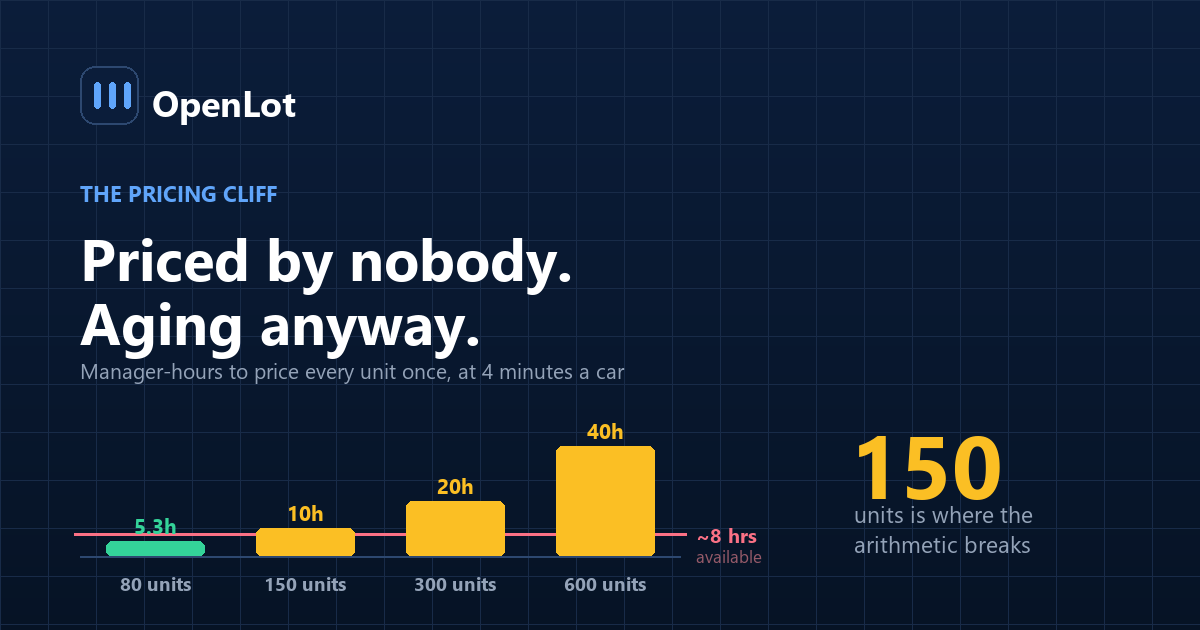
A used car repricing strategy is the cadence and the rules by which a store revisits the asking price of every unit in stock. Most dealers have the cadence written down and do not execute it, for a reason that has nothing to do with discipline: the arithmetic stops working somewhere around 150 units. Past that point, pricing every car on schedule costs more manager hours than the store has.
This guide covers how often to reprice, what a usable pricing rule contains, where manual repricing breaks, who should own the decision, and how to tell whether any of it is working.
What is used car repricing, and how often should it happen?
Repricing is revisiting the asking price of a unit already in stock, against the market as it stands today rather than the market on the day you acquired it.
The market moves underneath you whether or not you look. Comparable units sell, new ones list, a competitor two miles away drops $700, and the price that was competitive on day 3 is invisible on day 21.
A workable baseline cadence:
| Days in stock | Review frequency | What you are reacting to |
|---|---|---|
| 0–14 | Once, around day 10 | Whether the initial price drew traffic at all |
| 15–30 | Weekly | Market drift and competitive set changes |
| 31–60 | Twice weekly | Declining relevance in search ranking |
| 60+ | Every listing refresh | The exit decision, not the price |
Notice the cadence tightens as the unit ages. That is the opposite of what happens in most stores, where fresh units get attention because they are interesting and aged units get avoided because the conversation is unpleasant.
Repricing is not discounting
A price change can go up. A unit acquired below market, or one whose competitive set has thinned out because three comparable cars sold, is underpriced — and repricing rules that only move one direction leave that money on the table permanently.
Framing the activity as "discounting" is why it gets resisted. It is not a concession. It is keeping the number current.
Why does manual repricing stop working?
Because it is a per-unit task in a store whose unit count grows, executed by a person whose hours do not.
The manager-hours arithmetic
Illustrative. Substitute your own unit count and your own honest minutes-per-car.
To make a real price decision on one unit, a used car manager has to pull the current market set, check where the unit ranks, look at how many days it has been listed, check recent price changes, and decide. Call it 4 minutes per car, which is fast.
Units in stock Minutes to touch every car once Hours 80 320 5.3 150 600 10 300 1,200 20 600 2,400 40 At 80 units, a weekly pass is a morning. At 300, it is half the week — and that is one pass, not the twice-weekly cadence the aged band actually needs.
Run your own number: units in stock × your minutes per car ÷ 60. Compare it to the hours your used car manager actually has after appraisals, wholesale, desking and everything else. The gap is the share of your inventory that is being priced by nobody.
The failure is not that managers reprice badly. It is that they reprice selectively — the units they remember, the ones a salesperson complained about, the ones at the top of the list. The rest hold a price nobody has looked at in five weeks.
And the units that get forgotten are disproportionately the ones that need it, because an aged unit generates no conversation to remind anyone it exists. That is the mechanism behind the cost of aged inventory: it is not that stores decide to hold cars too long, it is that nobody made a decision at all.
What should a repricing rule actually contain?
A rule that can run without a human in the loop needs four parts. Missing any one of them produces a rule you cannot trust and will end up overriding constantly.
1. A market reference. What the price is measured against — comparable units within a radius, adjusted for mileage, trim and condition. "Below book" is not a market reference, because the buyer is not shopping book.
2. A target position. Where in that set you intend to sit, expressed as a rank or a percentage of market average. This is a merchandising decision and it should be deliberate, not an accident of what you paid.
3. Aging bands with different targets. The whole point. A day-10 unit and a day-70 unit should not be aiming at the same position in the market.
4. Guardrails. A floor, a maximum single-step change, and an exclusion list. Without a maximum step, one bad comparable set produces a $3,000 overnight drop that you cannot walk back without looking erratic to anyone watching the listing.
| Rule component | Weak version | Usable version |
|---|---|---|
| Market reference | "Below book" | Comparable set within 100 miles, mileage-adjusted |
| Target position | "Competitive" | Top 5 of the comparable set |
| Aging | One target for all units | Position tightens at 15, 30 and 45 days |
| Guardrail | None | Floor at cost + pack; max change $500/step |
| Exclusions | None | Specialty, recent arrivals, units in recon |
Who should own the price decision?
Someone specific, with the authority to be wrong occasionally.
The common failure is a price decision that requires two people to agree — the used car manager proposes, the GM approves — with no standing meeting. That structure does not slow pricing down. It stops it, because the proposal queues behind everything else the GM is doing and expires quietly.
A structure that survives contact with a busy week:
- Rules are set by the GM and the used car manager together, quarterly, in writing
- Rule execution needs no approval. If the price change falls inside the guardrails, it happens
- Exceptions escalate, not the routine. A change outside the floor or bigger than the max step is the only thing that needs a second signature
- The aged list is reviewed on a fixed day, with the exit decision explicitly on the table
The point of writing the rules down is not documentation. It is converting a hundred individual approvals a week into one approval a quarter.
What breaks when you automate pricing badly?
Automation moves the failure rather than removing it, and these are the failure modes worth designing against:
Bad comparable sets. Thin markets, rare trims and high-mileage units produce comparable sets of two or three cars, where one outlier drags the target price meaningfully. Rules need a minimum-comparables threshold that falls back to human review.
Recon-blind pricing. A unit that is not yet frontline-ready gets repriced as though it were available, accumulating days and price drops while it sits in the shop. Exclude anything not photographed and listed.
Price-change whiplash. Frequent small changes in both directions read as instability to a shopper tracking the car, and to the marketplace ranking algorithms. Set a minimum interval between changes.
Feed lag. The price changes in your tool and reaches the marketplaces eighteen hours later, so the shopper sees a stale number and the phone conversation starts with a correction. This is a plumbing problem, not a pricing one — and it is the same class of problem as everything else in DMS and CRM integration.
Nobody reads the output. The system generates a daily action list and it goes to an inbox nobody opens. Automated pricing still needs a human reviewing exceptions, and that has to be someone's named job.
How do you measure whether repricing is working?
Four numbers, tracked monthly. None of them is gross per unit on its own, because gross per unit falls in a store that is turning faster and that is not automatically a problem.
| Metric | How to compute | What good looks like |
|---|---|---|
| Price coverage | Units with a price decision in the last 14 days ÷ total units | Above 90% |
| Days to first price change | Median days from listing to first repricing | Under 14 |
| Aged share | Units over 60 days ÷ total units | Falling, and below 15% |
| Total gross | Front + back gross across all used units sold | Rising, even if per-unit falls |
Price coverage is the one that diagnoses the problem in this article. If it sits at 40%, no pricing strategy is being executed regardless of what the policy document says — and you will not learn that from any report that only looks at the units that sold.
Watch total gross against per-unit gross together. Faster turn usually trades per-unit gross for volume and for a lower cost per sale. If total gross is rising while per-unit falls, the strategy is working and the per-unit number is the wrong alarm to react to.
Frequently asked questions
How often should a dealership reprice used cars?
Tighten the cadence as the unit ages: one review around day 10, weekly from day 15 to 30, twice weekly from 31 to 60, and at every listing refresh past 60 days. Most stores do the opposite, giving fresh units attention and leaving aged units untouched for weeks.
At what inventory size does manual repricing stop working?
Around 150 units for most stores. At four minutes per car, 150 units is ten hours to touch every unit once — and the aged band needs more than one pass a week. Past that point managers begin pricing selectively, and the units that get skipped are disproportionately the ones that need the decision.
What should a used car repricing rule include?
Four parts: a market reference based on comparable units rather than book value, a deliberate target position within that set, different targets by aging band, and guardrails consisting of a price floor, a maximum single-step change and an exclusion list for recon and specialty units.
Does repricing always mean lowering the price?
No. A unit acquired below market, or one whose comparable set has thinned because similar cars sold, may be underpriced. Rules that only move one direction permanently forfeit that margin. Repricing means keeping the number current, in both directions.
Who should approve used car price changes?
Set the rules jointly at the GM and used car manager level on a quarterly cadence, then let changes inside the guardrails execute without individual approval. Only exceptions — below the floor, or larger than the maximum step — should require a second signature. Requiring approval per change stops pricing rather than slowing it.
Will faster repricing hurt my gross per unit?
Usually per-unit gross falls and total gross rises, because the units that would have aged into a deeper discount or a wholesale loss sell earlier instead. Judge the strategy on total gross and aged share together, not on per-unit gross alone.
What is the most useful metric for repricing?
Price coverage: the share of units that received a price decision in the last 14 days. It measures whether the strategy is being executed at all, which is the actual failure in most stores. Reports based only on units that sold cannot reveal it.
Conclusion
- Repricing breaks on arithmetic, not discipline. At 300 units, one pass is twenty hours of manager time.
- The cadence should tighten with age. Most stores do the reverse and leave aged units untouched.
- Skipped units are not random. Aged cars generate no conversation, so nothing reminds anyone they exist.
- Rules need guardrails, or one thin comparable set produces a price move you have to walk back.
- Rules replace approvals. A hundred approvals a week becomes one approval a quarter.
- Measure price coverage. If under half your inventory was priced this month, you do not have a pricing problem, you have an execution problem.
Export your inventory list with the date of the last price change on each unit. The share with no change in 30 days is the part of your lot that is being priced by nobody.
Last updated: