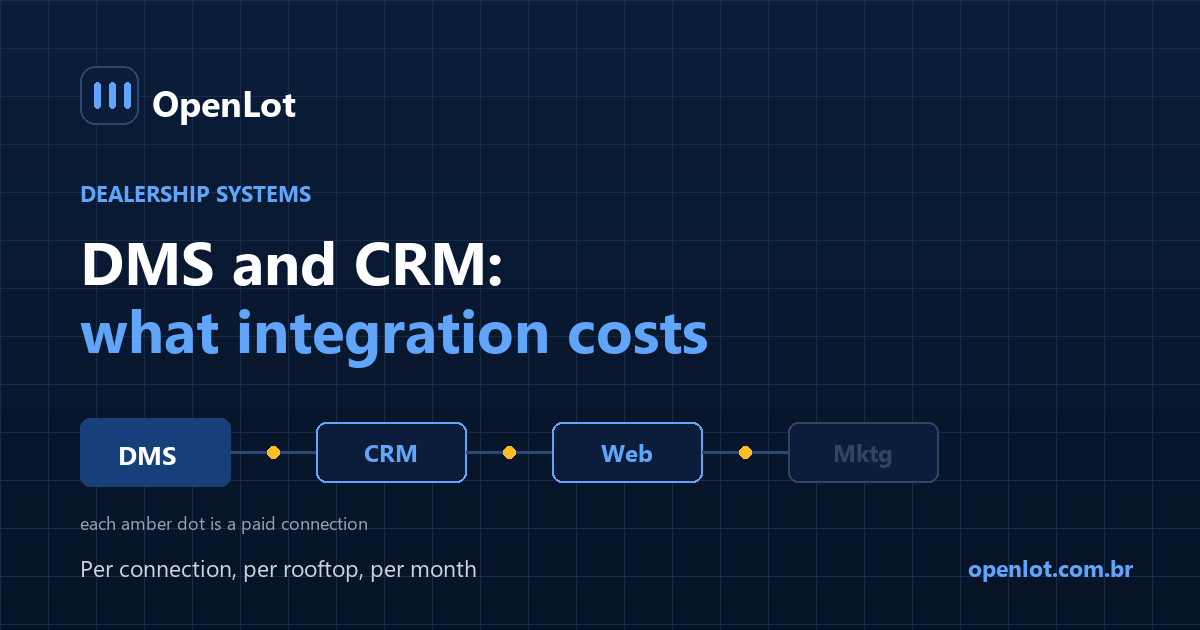
Dealership DMS and CRM integration is the process of moving data — inventory, customers, deals, repair orders — between your Dealer Management System and the other tools that need it. The obstacle is rarely technical. It is commercial: most DMS vendors charge per integration, per month, per rooftop, and dealers report paying anywhere from $175 to $700 for a single connection.
This guide covers what you are actually being charged for, the routes available to get your data out, and the questions that separate a real integration from a nightly spreadsheet.
Why does DMS integration cost so much?
Because DMS vendors control the access point, and access is sold separately from the DMS itself.
When you buy a third-party tool — a CRM, an inventory manager, a service scheduler — that tool needs to read from and write to your DMS. The DMS vendor sits between them and charges for the privilege. That charge is typically billed monthly, per integration, per rooftop, and it is separate from both your DMS subscription and what you pay the third-party vendor.
Dealers in community forums consistently report a range of $175 to $700+ per month for a single third-party connection, with specific cases running higher. Upfront implementation fees for deeper accounting-level integrations have been reported in the tens of thousands.
This has been contested in court. In In Re: Dealer Management Systems Antitrust Litigation, dealerships alleged that CDK Global and Reynolds and Reynolds conspired to inflate prices for DMS services and data integration services.
- Reynolds settled for $29.5 million, approved in 2019
- CDK settled for $100 million — preliminary approval August 2024, final approval February 2025
The CDK class covered roughly 12,000 to 17,000 dealer rooftops for the period from 2013 onward. Settlements resolve claims without an admission of liability, so read them as a signal about the market's pricing dynamics rather than a finding of fact.
The practical takeaway for a dealer principal: integration pricing is a negotiated commercial term, not a fixed technical cost. Treat it that way.
What are the ways to get data out of a DMS?
Four routes, in descending order of reliability:
| Route | How it works | Reliability | Typical cost |
|---|---|---|---|
| Certified vendor program | Vendor is approved by the DMS; uses an official API | Highest — supported, documented | Monthly fee per integration |
| Direct dealer API access | You license API access in your own name | High, but you own the integration work | Monthly fee, sometimes lower |
| Scheduled file export | DMS drops CSV/fixed-width files nightly to SFTP | Medium — batch only, breaks silently | Low or included |
| Screen scraping | Software logs in as a user and reads screens | Lowest — breaks on every UI change | Cheapest, and it shows |
Two names worth knowing: CDK routes third-party access through Fortellis and DMS Data Connect; Reynolds uses its Certified Interface program. Tekion and Dealertrack have their own equivalents. The specific program matters less than the question of whether your vendor is inside it or working around it.
Why nightly file exports are not integration
A nightly file is a snapshot. It tells you what was true at 2 AM.
That is fine for reporting. It is useless for anything a customer experiences in real time — confirming a vehicle is still available, checking whether a deal was already written, knowing that the lead calling now already has an appointment. A scheduled export cannot answer "is this car still here?" at 9 PM on a Saturday, which is precisely when it matters.
If a vendor describes their DMS connection and the word "nightly" appears, you are buying reporting, not integration.
What should a dealer actually ask before signing?
Most integration disappointments trace back to a question nobody asked during the sales process.
- Is this read-only or read-write? Writing back to the DMS is a materially different permission and usually a different price.
- Real-time or batch? If batch, how often, and what happens between runs?
- Who pays the DMS integration fee — you or me? Get this in writing. It is the single most common surprise line item.
- Is the fee per rooftop or per group? For multi-store groups this is the difference between a rounding error and a budget item.
- Which specific data objects? "DMS integration" is not a scope. Inventory, customers, deals, ROs and parts are separate permissions.
- What happens when the integration breaks? Who is alerted, how fast, and does anyone notice before a customer does?
- What happens to my data if I leave? Export format, timeline, and whether your historical records come with you.
The duplicate-connection audit
Before negotiating a better rate, check whether you are paying for the same data twice. A pattern we see repeatedly:
- The CRM pulls inventory from the DMS — one paid integration
- The website provider pulls inventory from the DMS — a second paid integration
- The marketing vendor pulls inventory from the website provider — but also has its own DMS feed, unused, still billed
List every vendor touching the DMS, what each one reads, and what each one costs. Stores running six to ten vendors commonly find at least one connection that is redundant, unused, or left over from a tool they stopped using. That audit costs nothing and often pays for itself immediately.
How many integrations does a typical store actually need?
Fewer than most have. The question is not how many tools you run — it is how many of them need a direct line to the DMS.
A common arrangement that reduces the count: one integration feeds a central store of dealership data, and the other tools read from that instead of each buying their own DMS connection. Whether that is worth doing depends on how many vendors you run and what each connection costs.
| Store profile | Typical direct DMS connections | Realistic target |
|---|---|---|
| Single rooftop, basic stack | 3–5 | 2–3 |
| Single rooftop, full stack | 6–10 | 3–4 |
| Multi-store group | 10+ per rooftop | Consolidated at group level |
The savings are real but secondary. The primary gain is that one definition of a vehicle, a customer and a deal exists across your tools, instead of five tools each holding a slightly different version.
Does switching DMS solve the integration problem?
Rarely, and the switching cost is severe.
A DMS migration touches accounting, payroll, service, parts and every integration you run. It consumes months of management attention and reliably produces a period of degraded operations. Newer platforms market more open data access, and some genuinely deliver it — but "more open" is not the same as "free," and you will be renegotiating every downstream vendor contract anyway.
The honest sequence:
- Audit what you pay today, per connection, per rooftop
- Cancel the redundant and unused ones
- Negotiate the remainder — integration fees are commercial terms, and dealers who ask often pay less
- Consolidate so fewer tools need direct DMS access
- Only then evaluate whether the DMS itself is the constraint
Most stores find enough in steps one through four that step five becomes optional.
Frequently asked questions
How much does DMS integration cost per month?
Dealers commonly report $175 to $700 per month for a single third-party connection, per rooftop, though specific cases run higher and deeper accounting integrations can carry five-figure setup fees. The fee is separate from your DMS subscription and from what you pay the third-party vendor.
Can I access my own dealership data without paying an integration fee?
Sometimes, through scheduled file exports that are included in many DMS contracts. Those give you batch snapshots, not real-time access. Real-time API access almost always carries a fee, whether the vendor pays it or you do.
Who owns dealership data, the dealer or the DMS vendor?
The dealer owns the underlying business data. What the DMS vendor controls is the access mechanism — the API, the certification program and the terms of use. That distinction is why fees persist even though the data is yours.
Is screen scraping a legitimate way to integrate with a DMS?
It works until it does not. Screen scraping breaks on interface changes, often violates DMS terms of service, and typically requires storing a set of login credentials — which creates a security exposure you then have to account for under the FTC Safeguards Rule.
Do I need real-time DMS integration, or is nightly enough?
Nightly is adequate for reporting and analysis. It is not adequate for anything a customer experiences live — confirming availability, avoiding a double-sold unit, or answering an after-hours inquiry with accurate inventory.
Will switching to a newer DMS make integration cheaper?
Possibly, but a DMS migration is one of the most disruptive projects a dealership can undertake. Audit, cancel and negotiate your existing connections first; most stores recover meaningful cost without touching the DMS.
What does "certified integration" actually mean?
That the DMS vendor has approved the third party and granted official API access. It is more reliable and better supported than unofficial methods, and it is also the route that carries the monthly fee.
Conclusion
- Integration cost is commercial, not technical. The data movement is trivial; the access price is a negotiated term.
- The pricing has been litigated. Two major DMS vendors settled antitrust claims over data integration pricing — $29.5M and $100M.
- Nightly files are reporting, not integration. If a customer-facing answer depends on it, batch will not carry it.
- Audit before you negotiate. Redundant and unused connections are common in stores running six or more vendors.
- Switching DMS is the last lever, not the first. Most of the recoverable cost sits in connections you already have.
Start with the list: every vendor touching your DMS, what it reads, and what it costs per month. That single spreadsheet usually answers the question.
Last updated: