A follow-up cadence is the schedule of attempts made on a lead that has not replied — how many, how far apart, on which channel. Below is a complete eight-touch template, with the reasoning for each interval, the stop conditions, and the method for tuning it against your own reply data rather than ours.
This guide covers the shape of a working cadence, a complete eight-touch template, why each interval is what it is, the stop conditions, how to tune it to your own data, and where cadences go wrong.
What shape does a working cadence have?
Three principles, before any specific schedule.
Front-loaded. More than half the attempts belong in the first 72 hours, because that is when the customer is actively shopping. A cadence that spreads eight touches evenly across three weeks is mostly contacting people who already bought elsewhere — assuming it gets that far, which most written cadences do not.
Channel-rotating. Eight messages on one channel is a mailing list. Rotation matters more than wording: a customer who ignores email may answer a text, and the second channel is frequently where contact is actually made.
Decelerating. Intervals widen as the sequence runs. Daily at first, then every few days, then weekly. A customer who has not replied by day 9 is on a longer timeline, not a shorter one, and pressing harder works against you.
The eight-touch template
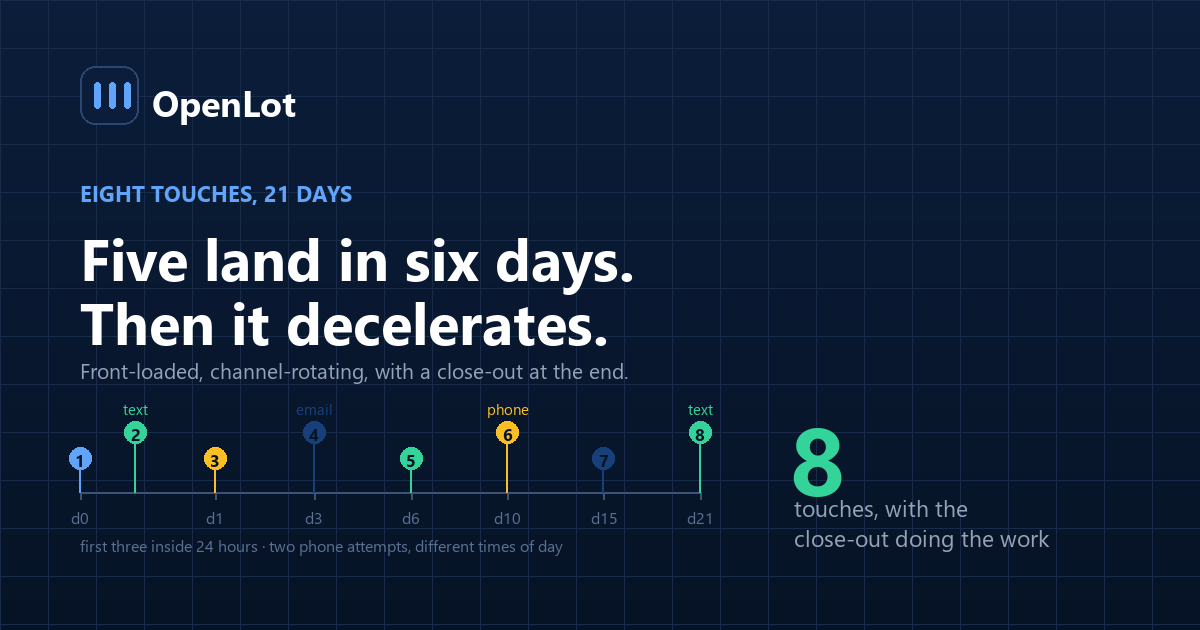
Eight touches, 21 days
Starting point, not gospel. Tune against your own reply data using the method below.
# When Channel Content 1 Immediately Same channel as the lead Vehicle named, price or reason, photo, one question 2 +4 hours Text Short. "Did the pricing on the [vehicle] make sense?" 3 +1 day Phone A real attempt, with a voicemail that says something 4 +3 days New information: a comparable unit, or a change in status 5 +6 days Text A single direct question — "still looking, or did you find one?" 6 +10 days Phone Second genuine call attempt, different time of day 7 +15 days Value, not pursuit: something useful about the segment 8 +21 days Text The close-out. "Should I keep you on the list or close this out?" Five of eight land inside the first six days. Touch 3 is the first phone attempt and touch 6 the second, at a different time of day, because the same time twice reaches the same voicemail twice.
Why these intervals
Touch 2 at four hours catches the customer still in the session. It is the highest-yield attempt after the first and the most commonly missing one.
Touch 3 by phone on day 1 exists because phone is where qualification actually happens, and a call attempt that leaves a specific voicemail outperforms one that leaves nothing — the point behind why leads never answer the phone.
The gap between 3 and 4 is deliberate. Three touches in 24 hours is attentive; four is pressure.
Touch 8 as an explicit close-out performs disproportionately well. Asking permission to stop produces replies from people who had simply not got around to answering, and it generates a clean, honest stop for everyone else.
What are the stop conditions?
More important than the send schedule. Every one of these halts the sequence immediately:
- The customer replied — any reply, on any channel
- The customer bought, here or anywhere you can detect it
- The customer opted out, on any channel, including verbally on a call
- A person marked the lead dead
- A duplicate record was merged
- The vehicle of interest sold and no substitute was offered
The first and third are the ones that fail in practice. A reply arriving on a different channel than the one that sent the message frequently does not stop the sequence, and a verbal opt-out on a phone call almost never does unless someone logs it. Both are visible to the customer and both are expensive.
Automated outbound at this volume carries consent and contact-time obligations the dealership owns regardless of vendor — the same accountability covered in the Safeguards Rule guide.
How do you tune it to your own data?
The template above is a starting point. Your store's curve is different, and finding it takes one query.
Step 1 — Reply rate by attempt position. For each attempt number, replies received ÷ attempts sent. You are looking for where the curve flattens.
Step 2 — Reply rate by channel, within position. Touch 5 by text and touch 5 by email are different experiments. Run both for a month.
Step 3 — Opt-out rate by attempt position. The crossover point where opt-outs per attempt exceed replies per attempt is the end of your cadence, regardless of what any template says.
Step 4 — Reply rate by time of day. Phone attempts especially. Most stores call during their own convenient hours, which are the customer's working hours.
Four queries, all available from CRM activity data, all worth more than any template including this one. The baselines they depend on are the same four numbers in the AI lead response baseline.
Where do cadences go wrong?
1. Evenly spaced. Eight touches at 3-day intervals ignores that intent decays fastest in the first 48 hours.
2. One channel. The second channel is where contact is frequently made, and rotation costs nothing to implement.
3. Every call at the same time of day. Two attempts at 2pm reach the same unavailable person twice.
4. Running past the flattening point. Once reply rate per attempt flattens, additional touches mostly generate opt-outs, and opt-outs are permanent.
5. Treating aged leads with the active cadence. A 90-day-old lead needs a different sequence, not touch 9 of this one.
6. No close-out message. Ending silently wastes the single best-performing touch in the sequence.
What should you measure?
| Metric | How to compute | What it decides |
|---|---|---|
| Reply rate by attempt position | Replies ÷ attempts, per position | Cadence length |
| Reply rate by channel within position | Split each position by channel | Channel assignment per touch |
| Opt-out rate by position | Opt-outs ÷ attempts, per position | Where to stop, definitively |
| Phone reply rate by hour | Connects ÷ attempts, bucketed | When to place calls |
| Stop-condition failures | Sequences continuing after a stop event | Should be zero |
| Close-out reply rate | Replies to touch 8 ÷ touch 8 sent | Usually higher than touches 5–7 |
Review quarterly. Reply behaviour by channel shifts faster than most operational numbers, and a cadence tuned two years ago is tuned for a different customer.
Frequently asked questions
How many follow-up attempts should a car dealership make on a lead?
Around eight over three weeks is a reasonable starting point, with more than half landing in the first 72 hours. The right number for your store is wherever reply rate per attempt flattens and opt-out rate per attempt begins to exceed it, which is a measurement rather than a rule of thumb.
What should the intervals between follow-up attempts be?
Front-loaded and decelerating: immediate, four hours, one day, three days, six days, ten days, fifteen days, twenty-one days. Intent decays fastest in the first two days, so evenly spaced attempts spend most of the sequence contacting people who have already bought elsewhere.
Which channels should a follow-up cadence use?
All three, rotating. Email, text and phone have different reply characteristics, and the second channel is frequently where contact is actually made. A sequence that uses one channel eight times is a mailing list, and rotation costs nothing to implement.
When should a follow-up sequence stop?
Immediately on any of: a reply on any channel, a purchase, an opt-out including a verbal one on a call, a lead marked dead by a person, a duplicate merge, or the vehicle selling with no substitute offered. Cross-channel replies and verbal opt-outs are the two that most often fail to halt a sequence, and both are visible to the customer.
Does a final close-out message work?
Yes, and it typically outperforms the three touches before it. Asking whether to keep someone on the list or close them out produces replies from people who simply had not got around to answering, and it creates a clean stop for everyone else rather than trailing off silently.
Should aged leads use the same cadence?
No. A lead that has been quiet for 90 days needs a different sequence with different framing and a much lighter touch, not attempt nine of the active cadence. Treating aged records with an active-shopper cadence is a reliable way to generate opt-outs on a list you already paid for.
How often should the cadence be reviewed?
Quarterly. Reply behaviour by channel shifts faster than most operational metrics, and a cadence tuned two years ago was tuned against different customer habits. The four queries needed for a review — reply rate by position, by channel, by hour, and opt-out rate by position — can all be run from CRM activity data.
Will a longer cadence annoy customers?
Past the point where opt-out rate per attempt exceeds reply rate per attempt, yes, and opt-outs are permanent in a way that an unanswered message is not. That crossover is specific to each store, which is why cadence length should be set by measurement rather than copied from a template.
Conclusion
- Front-loaded, channel-rotating, decelerating. Five of eight touches inside six days.
- Two phone attempts at different times of day. The same hour twice reaches the same voicemail twice.
- Stop conditions beat send conditions, and cross-channel replies plus verbal opt-outs are where they fail.
- Tune with four queries: reply rate by position, by channel, by hour, and opt-out rate by position.
- Keep the close-out message. It usually outperforms the three touches before it.
Last updated: