Automated lead follow-up is software executing a contact cadence without a person remembering to. The problem it solves is not a bad script — it is attempts two through eight never happening. A cadence that is written down and not executed is worth exactly nothing, and execution collapses under volume.
This guide covers why follow-up collapses, what the collapse costs, what automation fixes and what it does not, where automated cadences go wrong, and what to measure.
Why does follow-up collapse after attempt one?
Not because anyone is lazy. Because attempt one is triggered by an event and attempts two through eight are triggered by memory.
A lead arrives, a notification fires, someone responds. That is a system. Three days later, nothing fires, nothing notifies, and whether the second attempt happens depends on a person remembering, under load, alongside everything else.
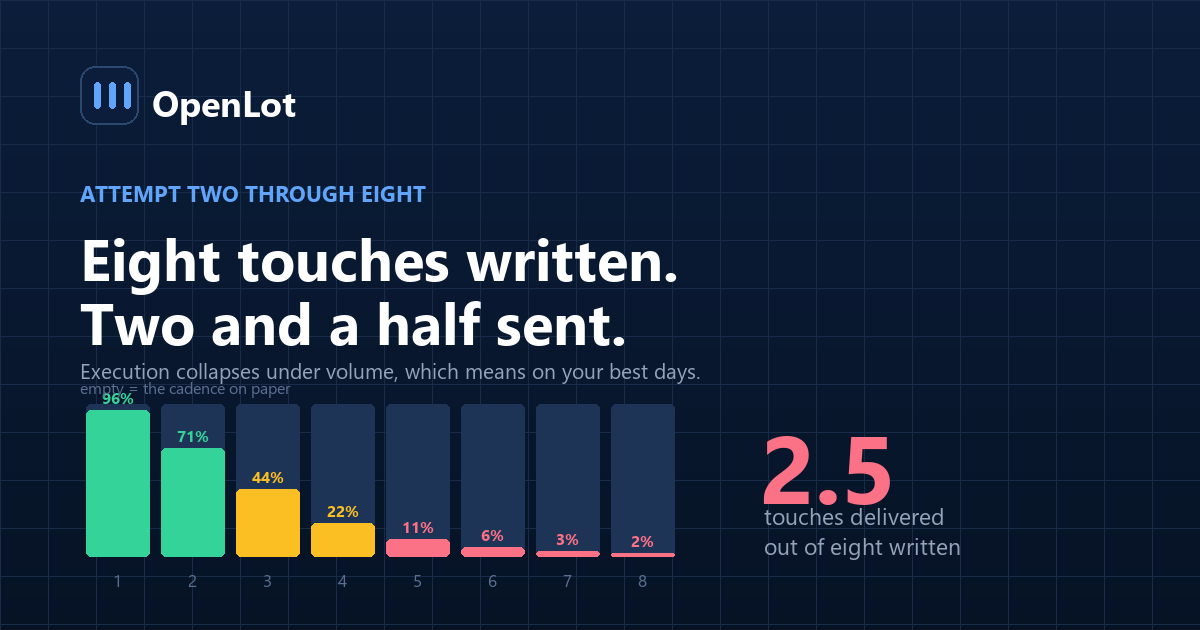
So the execution rate decays, and it decays fastest exactly when volume is highest — which means it fails hardest on your best lead days.
The decay
Illustrative. Count your own from CRM activity.
A store with a documented eight-touch cadence over 21 days:
Attempt Cadence says Actually happens 1 Day 0 96% 2 Day 1 71% 3 Day 3 44% 4 Day 6 22% 5 Day 9 11% 6 Day 13 6% 7 Day 17 3% 8 Day 21 2% The written cadence is eight touches. The delivered cadence is roughly two and a half.
Run this on your own activity log — attempts per lead, not activities per rep. The gap between the two columns is the entire opportunity, and it costs nothing to measure.
What does the gap cost?
The leads lost to it are not the ones that were never going to buy. They are disproportionately the ones with a longer timeline — the customer who was six weeks out, got one reply, heard nothing again, and bought somewhere that kept in touch.
This compounds with the contact-rate problem. Most leads do not answer the first attempt at all, which is why contact rate sits where it does; a cadence truncated at attempt two or three never reaches the people who were always going to need four.
It also quietly inflates cost per sale. You paid for the lead once, worked it a quarter of the way, and the unworked portion is pure waste on the same invoice — the mechanism behind spending more and selling the same.
What does automation actually fix?
Execution, and nothing else. That is the honest claim and it is enough.
| What it fixes | What it does not |
|---|---|
| Attempt 2 through 8 happening at all | Making any one message more persuasive |
| Consistency on high-volume days | Knowing when a lead is genuinely dead |
| Channel rotation without a person tracking it | Reading an ambiguous reply correctly |
| Complete activity logging | Negotiating, quoting or committing |
| Stopping on opt-out, reliably | Recovering a customer who is annoyed |
Software does not get busy. That is the whole advantage and it has nothing to do with the system being clever.
The corollary matters: if your cadence is bad, automating it produces bad follow-up at scale. Automation is a multiplier on whatever is written, which is why the cadence design question — how many touches, how far apart, on which channel — is worth settling before anything is switched on.
Where do automated cadences go wrong?
1. Automating a cadence nobody reviewed. The sequence that existed on paper was written years ago, by someone who left, for a market that moved. Read it before you multiply it.
2. Every touch on the same channel. Eight emails is not a cadence, it is a mailing list. Channel rotation is most of what makes a sequence work.
3. No stop condition. A sequence that keeps running after the customer replied, bought, or asked to be left alone does active damage. The stop conditions are more important than the send conditions.
4. Running it against dirty data. A CRM with duplicates contacts the same human from three threads simultaneously, which turns an internal data problem into something the customer experiences — see CRM data decay.
5. Consent treated as a setting. Automated outbound at volume carries consent, contact-time and opt-out obligations, and the dealership is the accountable party regardless of vendor — the Safeguards Rule framing applies here too.
6. Nobody watches the replies. The cadence produces engaged conversations at 9pm and they queue until someone notices. The bottleneck moves, as it does in every after-hours coverage design that stops at the front of the funnel.
What should you measure?
| Metric | How to compute | What it catches |
|---|---|---|
| Attempts per lead | Genuine outbound attempts ÷ leads, by attempt number | The decay curve above |
| Attempt-to-reply rate, by attempt number | Replies ÷ attempts, per position in the sequence | Where the sequence stops earning |
| Contact rate, before and after | Two-way conversations ÷ leads | The number automation should move |
| Opt-out rate | Opt-outs ÷ leads in sequence | Whether the cadence is too aggressive |
| Stop-condition failures | Sequences continuing after reply or sale | The damage metric — should be zero |
| Reply pickup time | Reply received → human response | Whether the extra conversations convert |
The second row is the one that tells you how long the cadence should be, and it is specific to your store. Most sequences have a point where the reply rate per attempt flattens, and running past it buys opt-outs rather than conversations.
The fifth row should be zero and frequently is not. A sequence still messaging a customer who bought last week is the fastest way to lose the next deal.
Frequently asked questions
Why does dealership lead follow-up stop after a few attempts?
Because the first attempt is triggered by an event and the rest are triggered by memory. A lead arriving fires a notification; day three fires nothing. Execution therefore depends on a person remembering under load, and it decays fastest on high-volume days, which are also the days with the most leads to lose.
How many follow-up attempts should a dealership make?
Enough that the reply rate per attempt has clearly flattened, which is a number specific to your store rather than an industry constant. Measure replies by attempt position: most sequences show a point past which additional touches generate opt-outs rather than conversations, and that point is where the cadence should end.
Does automating follow-up make the messages more effective?
No. Automation fixes execution, not persuasion. The gain comes entirely from attempts two through eight actually happening, consistently, including on days when the team is swamped. If the written cadence is poor, automating it produces poor follow-up at larger scale.
Should every follow-up touch use the same channel?
No. Eight emails is a mailing list rather than a cadence, and channel rotation across email, text and phone is a large part of what makes a sequence reach anyone. Each channel has different reply characteristics and different consent requirements, which should be reflected in the sequence design.
What stop conditions does an automated cadence need?
At minimum: the customer replied, the customer bought, the customer opted out, the lead was marked dead by a person, and a duplicate record was merged. Stop conditions matter more than send conditions, because a sequence that keeps messaging someone who already replied or purchased causes damage rather than merely wasting a send.
Will automated follow-up increase opt-outs?
It can, if the cadence is longer or more aggressive than what the store was actually delivering before. That is worth measuring deliberately: track opt-out rate against attempt position, and shorten the sequence where opt-outs begin to outpace replies. The written cadence being executed fully is a real change in customer experience, not just in internal metrics.
What happens if our CRM data is poor?
Automation amplifies it. Duplicate records mean the same person is contacted from several sequences at once, which is visible to the customer in a way that internal reporting problems are not. Measuring duplicate rate and cleaning before deployment is cheaper than discovering it through complaints.
Who handles the replies an automated cadence generates?
Someone has to, with an expected response time, or the system makes things worse. A cadence that produces engaged conversations at 9pm which then sit in a queue until the next afternoon has converted a slow first response into a fast first response followed by silence, which sets and then breaks an expectation.
Conclusion
- The written cadence and the delivered cadence are different documents. Measure attempts per lead by attempt number.
- Execution collapses under volume, which means it fails worst on your best days.
- Automation fixes execution only. That is enough, and claiming more is not credible.
- Stop conditions matter more than send conditions. A sequence running after a sale costs the next one.
- Find where reply rate per attempt flattens. Past that point, extra touches buy opt-outs.
Last updated: