An AI appointment setter books test drives and sales appointments without a person running each conversation. Booking count is the easiest metric in the category to inflate and the least informative — the number that settles whether it worked is how many of those people walked in.
This guide covers why booking count misleads, the four conditions that make a booking real, what an AI setter does well and badly, where deployments fail, and what to measure.
Why is booking count the wrong number?
Because booking is the only stage in the funnel where both parties can agree to something neither intends to do.
A customer who says "sure, Saturday works" to end a conversation has produced a booking. A system optimised for bookings will collect a great many of those, and the dashboard will look excellent for about three weeks.
How a booking lift becomes a loss
Illustrative. Substitute your own four rates.
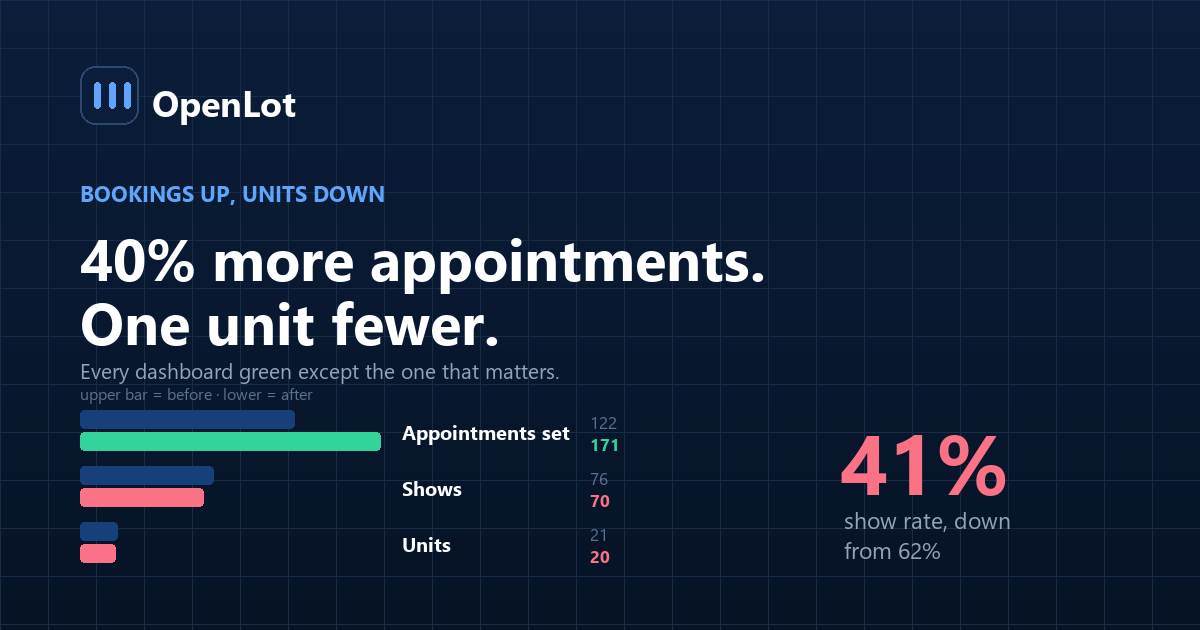
Before After Contacts 320 320 Appointments set 122 171 (+40%) Show rate 62% 41% Shows 76 70 Close rate 28% 28% Units 21 20 Bookings up 40%, units down. Every dashboard in this scenario is green except the one that matters, and the sales floor has absorbed 49 extra appointments of preparation for nothing.
This is not a hypothetical failure mode — it is the default outcome of optimising the wrong stage, and it is why show rate belongs next to booking count in every report.
What makes a booking real?
Four conditions. A booking missing any of them should be treated as a lead with a date attached rather than as an appointment.
1. A specific time, agreed. Not "sometime Saturday." A time, confirmed back, that the customer repeated or selected.
2. A specific vehicle, in stock. An appointment to see a unit that sold yesterday produces a worse experience than no appointment. The system has to check inventory at booking time, not at reminder time.
3. A named person expecting them. Appointments assigned to "the sales team" are assigned to nobody. Someone has to own the arrival.
4. A confirmation the customer responded to. A confirmation that was sent is not a confirmation that was received. The reply is the signal.
The fourth is the cheapest to add and the most predictive. A customer who confirms is materially more likely to arrive than one who was merely messaged, which means a confirmation sequence is a filter as much as a reminder.
What does an AI setter do well, and badly?
| AI setter | Human setter | |
|---|---|---|
| Availability, any hour | Complete | Staffed hours only |
| Consistency at volume | Unchanged | Degrades when busiest |
| Checking inventory before offering | Automatic, if integrated | Frequently skipped |
| Running the confirmation sequence | Every time | When remembered |
| Reading hesitation in a reply | Poor | Strong |
| Handling "what's my payment?" | Must escalate | Handles it |
| Rebuilding a broken appointment | Mechanical | Strong |
The honest division is the same one that holds everywhere in the store: the system is better at the mechanics and worse at the judgment. An AI setter that stays in the mechanics — offer, confirm, remind, rebook — is a strong product. One that negotiates is a liability, for reasons covered in where agent autonomy should end.
Where the real gain is
Not in booking more of the leads a person would have booked. In booking the ones nobody reached: the 9pm enquiry, the Sunday browser, the lead that went quiet on attempt three. The gain is concentrated in the hours nobody covers, and a vendor case that spreads it evenly across the week is describing a different store than yours.
Where do deployments fail?
1. Optimised for bookings. The whole subject of this article, and the default unless show rate is in the target.
2. Booking against a calendar rather than against people. If every appointment lands on the same two salespeople, or on a day nobody is scheduled, the shows arrive to nobody.
3. No inventory check. Booking a customer to see a sold unit is a worse outcome than not booking them.
4. Confirmation sent, never read. One-way confirmations without a reply mechanism provide no filter and no early warning — the design covered in confirmation sequences.
5. Over-qualifying before booking. Every question asked before the time is agreed lowers the chance of agreeing to a time. Qualify after.
6. Nobody owns the arrival. This is the handoff problem that defeats front-of-funnel improvements everywhere.
What should you measure?
| Metric | How to compute | What it decides |
|---|---|---|
| Appointments set | Set ÷ contacts | The number vendors report |
| Confirmation reply rate | Replied ÷ confirmations sent | The best early predictor of attendance |
| Show rate | Attended ÷ set | The guardrail |
| Show rate by set hour | Split by when the appointment was booked | Whether late-night bookings are real |
| Appointment-to-sold | Sold ÷ shown | Whether the shows are qualified |
| Shows per week | Absolute, against baseline | The only number the owner cares about |
Report rows one and three together, always, in the same view. Separating them is how the failure above survives for a quarter.
Row four deserves its own look. Appointments set at 11pm by an automated system are the ones most likely to be soft, and they are also the ones the system exists to produce — so the honest question is whether their show rate is acceptable, not whether it matches a weekday-afternoon booking made by a person.
Frequently asked questions
What is an AI appointment setter for a car dealership?
It is software that works internet leads through to a booked sales appointment or test drive — offering times, confirming, reminding and rebooking — without a person running each conversation. The useful scope is mechanical: it should not quote prices, negotiate terms or handle an unhappy customer.
Why is booking count a misleading metric?
Because a booking requires only agreement, not intent, and a customer saying "Saturday works" to end a conversation produces one. A system optimised for bookings collects many of those, which is how a 40% booking increase can coincide with a small decrease in units sold once show rate falls.
What makes an appointment real rather than nominal?
Four things: a specific time the customer selected or repeated back, a specific vehicle confirmed to be in stock, a named person expecting them, and a confirmation the customer actually replied to. The reply is the cheapest to add and the most predictive of attendance.
Should the setter qualify the customer before booking?
Minimally. Every question asked before a time is agreed lowers the chance of agreeing to one, so the working order is to secure the appointment first and qualify afterwards. The exception is vehicle availability, which has to be checked before offering, because booking against sold inventory is worse than not booking.
Do appointments booked late at night actually show up?
Often at a lower rate than weekday appointments set by a person, and that is not automatically a failure. Those are customers nobody was reaching at all, so the right question is whether their show rate is acceptable in absolute terms rather than whether it matches the best-case comparison.
What should an AI setter never do?
Quote a price or a payment, give a trade value, promise a specific vehicle it cannot verify, or try to recover a customer who is annoyed. Each of these creates either a commitment the store must honour or a conversation that needs judgment, and both cost more than the convenience of an immediate answer.
How do we stop appointments landing on nobody?
By assigning each appointment to a named person with capacity at that time, and by checking the sales schedule before offering slots. Appointments assigned to the team as a whole are assigned to nobody, and the customer experiences that as being unexpected on arrival.
What is the single number to report?
Shows per week, with show rate alongside booking count. Booking count on its own is the metric that lets a deployment look successful while the pipeline degrades, and the two should never appear in a report without each other.
Conclusion
- Booking is the one stage where both sides can agree to something neither intends.
- A 40% booking lift can produce fewer units, and every dashboard will stay green.
- Four conditions make a booking real: a chosen time, a verified vehicle, a named owner, a replied confirmation.
- The gain is concentrated in uncovered hours, not spread evenly across the week.
- Report bookings and show rate together, always, or the failure survives a quarter.
Last updated: