An AI agent for a car dealer is software that takes actions rather than only producing text — sending, booking, updating, following up. The design decision that matters is how far it goes before asking a person, and for almost every dealership job the answer should stop at level three of five.
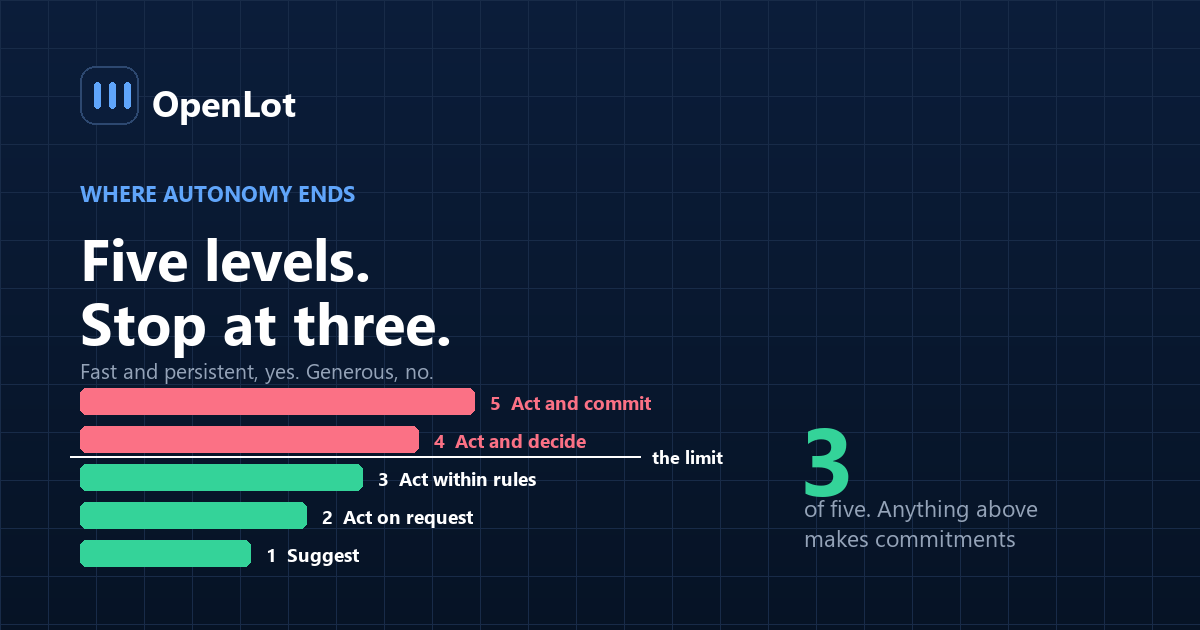
This guide covers the five levels of agent autonomy, where each dealership job belongs on that scale, why level four is where trouble starts, how the limit is enforced technically, and what to measure.
What makes something an agent rather than an assistant?
An assistant produces output a person then acts on. An agent acts.
That is the whole distinction, and it is where the risk changes character. A system that drafts a reply for a BDC rep to send has a human checkpoint by construction. A system that sends the reply has removed the checkpoint, and everything the system does is now something your store did.
Most dealership AI sits somewhere between those two, usually without anyone having decided where. The purpose of the ladder below is to make that an explicit choice.
What are the five levels of autonomy?
| Level | What it does | Human role | Typical dealership use |
|---|---|---|---|
| 1 — Suggest | Drafts; a person sends | Approves every action | Reply suggestions in the CRM |
| 2 — Act on request | Executes when a person triggers it | Initiates each time | "Send the follow-up sequence to this lead" |
| 3 — Act within rules | Acts on its own, inside an enumerated boundary | Sets rules, reviews exceptions | After-hours lead response, appointment booking |
| 4 — Act and decide | Chooses the approach, not just the execution | Reviews outcomes after the fact | Rare, and usually sold as level 3 |
| 5 — Act and commit | Makes binding commitments on the store's behalf | Finds out afterwards | Should not exist in retail automotive |
Level 3 is the working level, and the one that produces nearly all the measurable value: responding instantly at 11pm, running a follow-up cadence to completion, booking against real calendar availability. All of it inside rules a person wrote and can test — which is also the argument for one agent per job, since a rule set only stays testable while it stays short.
Why level four is where it goes wrong
The jump from three to four looks small and is not. At level three, an agent executes a decision that was already made when someone wrote the rules. At level four, the agent makes the decision.
In practice that means it chooses what to offer, how to respond to an objection, or whether a situation warrants an exception — and those choices create expectations in the customer's mind that your store then has to honour or walk back. That is the same boundary identified in the AI BDC failure modes: systems that engage on price, trade or terms generate commitments the store has to unwind.
Level four is not a capability problem. It is an accountability problem, and no model improvement fixes it.
Where does each dealership job belong?
| Job | Right level | Why |
|---|---|---|
| First response to an internet lead | 3 | High value, rules are enumerable, nothing is promised |
| Follow-up cadence | 3 | Persistence is the entire benefit; the content is pre-written |
| Appointment booking | 3 | Against real availability, with no salesperson or unit promised |
| Service scheduling | 3 | Bounded by bay and technician capacity |
| Reactivation of aged leads | 3, with consent gate | Rules are simple; the consent check is the hard part |
| Pricing or payment questions | 1 | Suggest only. A quote is a commitment |
| Trade valuation to a customer | 1 | The number will be treated as an offer |
| Handling a complaint | 1 | Judgment, and the cost of getting it wrong is reputational |
| Negotiation of any kind | — | Not an agent job at any level |
The pattern is consistent: agents are allowed to be fast and persistent; they are not allowed to be generous. Anything that could later be read as an offer belongs at level one.
The commitment test
A single question that settles almost every scoping argument:
If the customer screenshots this message and brings it to the store, does the store have to honour it?
If yes, the action belongs at level one — drafted, reviewed, sent by a person. If no, level three is safe.
Run it against the actual message templates, not against the category. "We have several options in that range" passes. "We can do $420 a month on that" does not, and neither does "that trade is worth around $14,000" or "yes, we still have it" when the system cannot verify stock.
How is the limit actually enforced?
Not by instruction. Instructions are advisory; the system will occasionally do something else, and "we told it not to" is not a control.
Four mechanisms, in order of reliability:
1. Capability limits. If the agent has no ability to send a price, it cannot. Remove the tool rather than forbidding its use — this is the only mechanism that holds under every condition.
2. Hard escalation triggers. A matched pattern stops the agent and routes to a person, evaluated before the response is generated rather than after. Payment, financing, trade, payoff, legal, complaint, and anything containing a dollar amount from the customer.
3. Output validation. The response is checked before it goes out — no currency figures, no availability claims, no named commitments. Cheap to build and catches what the trigger list missed.
4. Audit log. Every action, with its trigger and its context, retained. This is both the compliance requirement under the Safeguards Rule and the only way to find out what level your system is actually operating at as opposed to the level it was specified at.
The first two are design-time controls and the second two are run-time ones. Systems that rely only on prompts have none of the four.
Where do agent deployments fail?
1. Sold as level 3, behaves as level 4. The most common gap, and it is usually not deception — the boundary was never specified, so the system does whatever the model finds reasonable.
2. The escalation list was written once. Customers phrase things in ways nobody anticipated. The trigger list needs review against real transcripts in the first weeks, which is why pilot threads get read individually.
3. Autonomy is raised quietly. A setting is changed, a new capability is enabled, and nobody re-examined the limit. Autonomy level belongs in change control.
4. The audit log exists but nobody reads it. A log that is never sampled is storage, not a control.
5. Level 3 was correct and the handoff was unstaffed. The agent does its job, escalates properly, and the thread waits six hours. The limit was right; the capacity behind it was not.
What should you measure?
| Metric | How to compute | What it catches |
|---|---|---|
| Escalation accuracy | Triggers that fired ÷ triggers that should have | Whether the boundary holds in practice |
| Commitment-test violations | Sampled outbound messages that fail the test | Level drift, before a customer finds it |
| Handoff pickup time | Escalation → first human reply | Whether level 3 can produce value at all |
| Actions per escalation | Agent actions ÷ escalations | A rising ratio means the boundary is eroding |
Sample outbound messages weekly against the commitment test. Fifty messages, read by a person. It is the cheapest control in the list and the one that catches drift first.
Frequently asked questions
What is an AI agent for car dealers?
It is software that takes actions on the dealership's behalf — sending messages, booking appointments, updating records, running follow-up sequences — rather than only drafting text for a person to use. The distinction matters because an agent has removed the human checkpoint, which means everything it does is something the store did.
How much autonomy should a dealership AI agent have?
For nearly every job, level three on a five-level scale: acting independently inside an enumerated set of rules, escalating on defined triggers. That covers after-hours lead response, follow-up cadence, appointment booking and service scheduling. Pricing, trade values, complaints and anything resembling negotiation belong at level one, where a person reviews and sends.
What is the test for whether an action is safe to automate?
Ask whether the store would have to honour the message if the customer screenshotted it and brought it in. If yes, it is a commitment and belongs under human review. If no, an agent can send it. Run the test against actual message templates rather than against job categories, because the risk lives in specific phrasing.
Can an AI agent quote prices or trade values?
It should not. A figure sent by your system will be treated as an offer regardless of any disclaimer attached, and walking it back costs more than the speed gained. Price, payment, trade value and payoff questions should trigger a hard escalation to a person, evaluated before a response is generated.
How do you stop an agent from exceeding its scope?
Four mechanisms, in order of reliability: remove the capability entirely so the action is impossible, add hard escalation triggers evaluated before generation, validate outgoing messages against rules such as no currency figures or availability claims, and keep an audit log that is actually sampled. Instructions alone are advisory and do not constitute a control.
What is the difference between an AI agent and a chatbot?
A chatbot answers; an agent acts. A chatbot that explains your hours has no ability to change anything, while an agent books the appointment, logs the activity and runs the follow-up. The risk profile, the required controls and the compliance obligations are all different, even when the conversational layer looks identical.
Should autonomy level be in change control?
Yes. The most common way a deployment drifts is that a setting is changed or a capability is enabled without anyone revisiting the limit that was agreed at specification. Treating the autonomy level as a controlled configuration item, with a named approver, prevents the quiet escalation that is otherwise discovered from a customer complaint.
What happens if we set the level correctly but nobody answers escalations?
Then the limit was right and the deployment still fails. An agent that escalates properly into a queue nobody works has moved the bottleneck rather than closed it, and the customer experiences a fast first response followed by silence — which is worse than a slow response, because expectations were set.
Conclusion
- An agent acts, an assistant drafts. Everything an agent does is something your store did.
- Level three is the working level, and it produces nearly all the measurable value.
- The commitment test settles most arguments: if the store would have to honour it, a person sends it.
- Enforce with capability limits, not instructions. Remove the tool rather than forbidding its use.
- Autonomy belongs in change control, and outbound messages should be sampled weekly against the test.
Last updated: