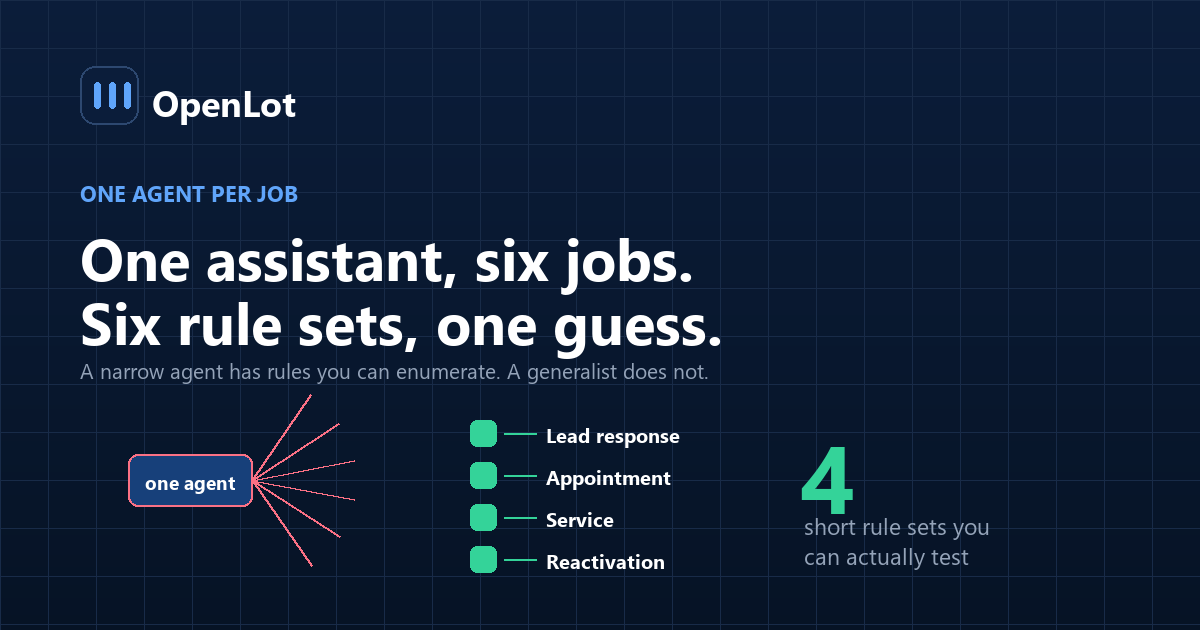
Multi-agent AI means running several narrowly scoped systems, each owning one job, instead of one assistant asked to handle everything. The reason is testability, not sophistication. A narrow agent has rules you can enumerate and verify; a generalist has behaviour you can only hope about.
This guide covers why a single generalist assistant degrades, how to split work into agents, what a handoff between them has to carry, where multi-agent systems fail, and when one agent is the right answer.
Why does one generalist assistant degrade?
Not because the model is weak. Because the rules become untestable.
Every job a dealership automates carries its own escalation boundary. Lead response must never quote a payment. Service scheduling must never book past bay capacity. A reactivation agent must respect opt-outs recorded two years ago. Each of those is a short, enumerable list of conditions.
Ask one system to do all three and the rule set is no longer a list — it is the intersection of three lists, conditional on which job the system thinks it is currently doing. That inference is the failure point. The model is not wrong about the rules; it is wrong about which situation it is in.
This is why the symptom of an over-scoped assistant is never "it gave a bad answer." It is "it gave a service answer to a sales question," which is much harder to catch in testing and much more expensive in front of a customer.
The scope test
For any system you are about to deploy, try to write down every condition on which it must stop and hand to a person. If that list is twelve items, you have an agent operating at a defensible autonomy level. If you cannot finish the list, you have a product that will surprise you.
How do you split the work?
By job, which usually means by the escalation boundary rather than by the department on the org chart.
| Agent | Owns | Must never |
|---|---|---|
| Lead response | First touch, qualification, follow-up cadence | Quote price, payment, trade value or availability it cannot verify |
| Appointment | Booking against real calendar availability, confirmations | Promise a specific salesperson or a vehicle not in stock |
| Service | Scheduling against bay and technician capacity, reminders | Diagnose, quote repair cost, or book past capacity |
| Reactivation | Working aged and closed-lost records | Contact anyone without a current consent record |
Four agents, four short rule sets, four things you can test independently. Add a fifth job later and you add a fifth rule set rather than renegotiating the other four.
Two design rules make this hold up:
Agents do not share a scope boundary. If two agents could both plausibly handle the same message, you have ambiguity at runtime, which is the generalist problem reintroduced. One owner per message type.
Routing is a separate, dumb decision. Which agent gets a given message should be decided by explicit rules on source, channel and intent — not by asking a model to choose. Routing by inference is where multi-agent systems quietly become generalists again.
What does a handoff have to carry?
Most multi-agent failures are handoff failures, and they are all the same failure: context did not travel.
| Carried | Why |
|---|---|
| Full conversation history | The customer should never repeat themselves. They will not; they will leave |
| Identity, deduplicated | The same human across channels and threads — see data decay |
| Consent state | Which channels are permitted, recorded, and when |
| What was already promised | An appointment time offered, a vehicle named, a callback committed |
| Why the handoff happened | The trigger, so the receiving agent or person does not re-ask |
The last row is the one that gets dropped. A handoff that arrives without its reason forces the person picking it up to reconstruct the thread, which is exactly the latency the system was bought to remove.
Where handoffs actually break
Four points, in the order they cost you.
- Agent to agent. Context truncated between systems — the customer repeats themselves.
- Agent to human. The conversation lands in a queue with no reason attached and sits.
- Channel to channel. Web chat to SMS to phone, each starting cold because identity was not resolved.
- Shift to shift. The overnight thread has no summary, so the morning person starts from scratch.
Only the first is a technology problem. The other three are process problems that technology exposes, and the second one determines whether any of this produces revenue — an engaged conversation left in a queue is the bottleneck moving, not closing.
Where do multi-agent systems fail?
1. Routing by inference. Letting a model decide which agent handles a message reintroduces the ambiguity the architecture exists to remove. Route on source, channel and explicit intent signals.
2. Overlapping scopes. Two agents that can both handle a service question will handle it differently on different days, and the inconsistency is unattributable.
3. Too many agents. Splitting a job that has one escalation boundary into three agents adds handoffs without adding testability. Handoffs are the expensive part; do not manufacture them.
4. No shared identity layer. Without deduplicated identity underneath, agents contact the same person from different threads, which is the customer-visible version of a CRM data problem.
5. The human queue was never sized. Four agents escalating into a handoff point staffed for one agent's volume produces a faster front end and a longer wait. The constraint moved, it did not close.
When is one agent the right answer?
Frequently, and more often than the architecture discussion suggests.
If your store has one job to automate — after-hours lead response, say — then one agent is the correct design and a multi-agent platform is complexity you are paying for without using. Multi-agent earns its cost when the second and third jobs arrive and you want to add them without renegotiating the rules of the first.
The practical sequence is: deploy one agent, prove it, add the second as a separate agent with its own rule set, and build the handoff between them deliberately. Starting with four is how projects fail in week three of implementation.
What should you measure?
| Metric | How to compute | What it catches |
|---|---|---|
| Misroute rate | Messages handled by the wrong agent ÷ total | Routing by inference, or overlapping scopes |
| Repeat rate | Conversations where the customer restates information | Context not travelling across handoffs |
| Handoff pickup time | Escalation → first human reply | Whether the queue is sized for the volume |
| Escalation accuracy, per agent | Triggers that fired correctly ÷ should have fired | Whether each rule set is actually testable |
Measure escalation accuracy per agent, not in aggregate. Aggregate numbers hide the one agent whose boundary is wrong, which is the whole thing you built this architecture to be able to see.
Frequently asked questions
What is multi-agent AI for dealerships?
It is running several narrowly scoped automated systems — lead response, appointment setting, service scheduling, reactivation — each owning one job with its own escalation rules, rather than one assistant handling everything. The benefit is testability: a narrow agent has a rule set you can enumerate and verify, while a generalist has behaviour that can only be sampled.
Is multi-agent AI better than a single assistant?
It is better once there is more than one job to automate. For a single job, one agent is the correct design and multi-agent architecture is unused complexity. The advantage appears when you want to add a second capability without renegotiating the rules governing the first.
How should messages be routed between agents?
By explicit rules on source, channel and intent signals, not by asking a model to decide. Routing by inference reintroduces exactly the ambiguity that splitting the system was meant to eliminate, and misroutes are hard to detect because the response is usually plausible, just from the wrong rule set.
What has to be included in a handoff between agents?
Full conversation history, deduplicated customer identity, current consent state, anything already promised such as an appointment time or a named vehicle, and the reason the handoff occurred. The reason is the item most often dropped, and its absence forces whoever picks up the thread to reconstruct it, which reintroduces the delay the system was bought to remove.
How many agents should a dealership run?
As many as it has distinct escalation boundaries, which for most stores is between one and four. Splitting a single job across multiple agents adds handoffs without adding testability, and handoffs are the expensive and failure-prone part of the architecture.
What is the most common multi-agent failure?
Context not surviving the handoff, in one of four places: agent to agent, agent to human, channel to channel, or shift to shift. Only the first is a technology problem. The other three are process gaps that the technology makes visible, and the agent-to-human one determines whether the system produces revenue at all.
Does multi-agent AI need a shared customer record?
Yes. Without a deduplicated identity layer underneath, separate agents will contact the same person from different threads, turning an internal data quality problem into something customers experience directly. Identity resolution is a prerequisite rather than a feature of the agent layer.
Can we start with one agent and add more later?
That is the recommended sequence. Deploy one agent against one job, prove it against a baseline, then add the second as a separate system with its own rule set and build the handoff deliberately. Starting with four simultaneously is a common way for deployments to fail during the pilot.
Conclusion
- The reason to split is testability, not sophistication. A rule set you can enumerate is a rule set you can verify.
- Split by escalation boundary, not by org chart. One owner per message type, no overlapping scopes.
- Route explicitly. Routing by inference turns a multi-agent system back into a generalist.
- Handoffs are where it breaks, and three of the four break points are process rather than technology.
- One job means one agent. Add the second as a separate agent when the second job actually arrives.
Last updated: