Every improvement at the front of the funnel ends at the same place: a person in your showroom meeting a customer they were not briefed on. The handoff is where the value of everything upstream is either collected or discarded, and it is the least designed moment in the whole process.
This guide covers the four places context is lost, what the salesperson actually needs, why the arrival moment decides the visit, where handoffs fail, and what to measure.
Where does the context go?
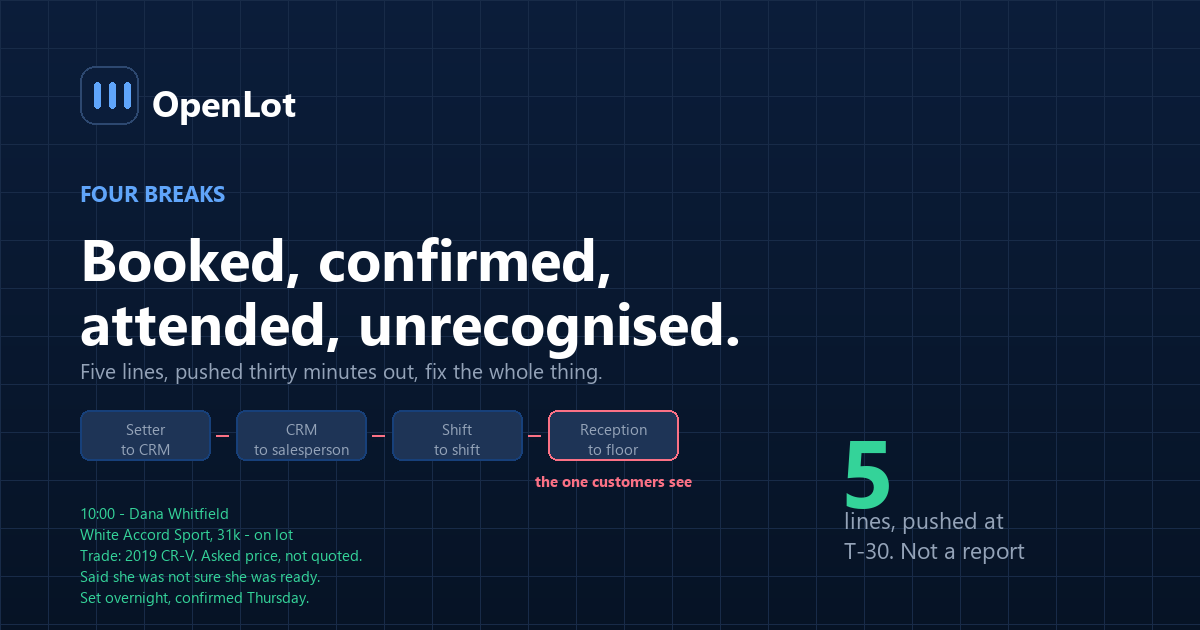
Four breaks, in sequence. Each one is small and they compound.
| # | Break | What is lost |
|---|---|---|
| 1 | Setter to CRM | The nuance: hesitation, what they actually asked about, the second vehicle they mentioned |
| 2 | CRM to assigned salesperson | Whether anyone read it |
| 3 | Shift to shift | A 7pm booking for a 10am appointment, two different people |
| 4 | Reception to the floor | The greeting happens before anyone checks the system |
Break 4 is the one customers experience most directly. They walk in, say "I have an appointment with Marcus", and the person at the door does not know who they are. Everything upstream — the instant response, the confirmation sequence, the two-option booking — is invisible from where the customer is standing.
What does the salesperson actually need?
Five facts, available before the greeting, not in a CRM record they will open afterwards.
- Name and what they are here to see, specifically — the unit, not the segment.
- What they already told you. Trade, timing, who is coming with them.
- What they asked that was not answered. Usually price. The salesperson should know it is coming.
- How they were set. Overnight by an automated assistant, or by a person who spoke to them — these are different customers arriving.
- Any hesitation expressed. "Not sure I'm ready" from two days ago is the single most useful thing the salesperson could know.
Point 5 is almost never transferred, and it is the one that changes how the first two minutes go.
The briefing has to be push, not pull
A CRM record is a pull mechanism: it works only if someone opens it. At 10am on a Saturday nobody opens it.
The version that works is a push: a short summary that arrives where the salesperson already looks — their phone — at a time they can act on it, typically 30 minutes before the appointment. Five lines. Not a report.
Five lines, pushed at T–30
10:00 — Dana Whitfield
White Accord Sport, 31k (stock #4412, on lot)
Trade: 2019 CR-V, ~70k. Asked about payment — not quoted.
Said she "wasn't sure she was ready" on Tuesday.
Set overnight by the assistant, confirmed Thursday.
That is the entire briefing. It takes fifteen seconds to read and it changes the greeting from "how can I help you?" to "Dana — the Accord's out front, I've got the keys."
The difference between those two openings is the whole argument for designing the handoff.
Why does the arrival moment decide the visit?
Because it sets whether the customer has to start over.
A customer who repeats information they already provided concludes, correctly, that the store does not keep track. That conclusion then colours everything else in the visit — the trade appraisal, the numbers, the follow-up — because it is evidence about how the business operates.
That is the same leak as spending more and selling the same: the cost was already incurred upstream. It also wastes the most valuable minutes available. The first five minutes of an appointment are the ones where the customer is most engaged, and spending them re-collecting known facts converts enthusiasm into administration.
This is the same bottleneck that defeats every front-of-funnel improvement: an appointment setter that books more feeds a greeting that absorbs none of it, and the net gain approaches zero.
Where do handoffs fail?
1. Assigned to "the team". Covered in booking against real availability — nobody is expecting them.
2. The briefing is a CRM link. Pull, not push. It does not get opened.
3. Reception is outside the system. The first person the customer meets has no visibility, which is the most visible failure and usually the easiest to fix — and it compounds the phone-handling problem at the same desk.
4. Nuance never captured. Hesitation and unanswered questions live in the message thread and never reach a field anyone reads.
5. Shift change with no summary. The person who set the appointment is gone and left nothing behind.
6. Overnight appointments arriving cold. The highest-value thing an automated setter produces is a conversation that already happened. Discarding it is the most expensive handoff failure of all.
What should you measure?
| Metric | How to compute | What it catches |
|---|---|---|
| Briefed-before-greeting rate | Appointments where the rep saw a summary first ÷ total | The headline number |
| Repeat rate | Appointments where the customer restated known information | Sampled by asking reps, honestly |
| Time to greeting | Arrival to first contact | The reception gap |
| Unassigned on arrival | Appointments with no named rep at the door | Should be zero |
| Appointment-to-sold, briefed vs not | Split | The business case |
| Show-to-test-drive rate | Drove ÷ showed | Whether the greeting converted |
The fifth row is the one that funds fixing this. If briefed appointments close at a materially better rate than unbriefed ones — and they generally do — the handoff is the cheapest improvement available, because it requires no new customers and no new software.
Frequently asked questions
What is the appointment handoff at a dealership?
It is the transfer of everything known about a customer from whoever set the appointment to whoever greets them. It covers four breaks — setter to CRM, CRM to salesperson, shift to shift, and reception to the floor — and each one loses detail that the customer then has to supply again.
What does a salesperson need to know before greeting an appointment?
Five things: the customer's name and the specific vehicle, what they have already said about trade and timing, what they asked that was not answered, how the appointment was set, and any hesitation they expressed. The last is the most useful and the least often transferred.
Why does a CRM record not solve the handoff problem?
Because it is a pull mechanism that only works if someone opens it, and on a busy Saturday nobody does. The version that works pushes a short summary to where the salesperson already looks, roughly half an hour before the appointment, in a form that takes fifteen seconds to read.
What happens when a customer repeats information they already gave?
They conclude the store does not keep track, and that conclusion colours the rest of the visit including the trade appraisal and the numbers. It also consumes the first five minutes, which are the most engaged minutes of the appointment, on administration rather than on the vehicle.
Why do overnight appointments suffer most?
Because the conversation that produced them happened while nobody was working, which makes it the richest context in the store and the easiest to discard. An automated assistant that qualified a customer at 11pm has produced exactly the briefing a salesperson needs, and it is usually lost by morning.
Should reception have access to the appointment list?
Yes, and it is one of the cheapest fixes available. The first person the customer meets is the one who sets the tone, and a greeting that recognises an expected visitor costs nothing beyond giving reception visibility into the day's bookings.
How do we know if the handoff is costing us?
Split appointment-to-sold rate by whether the salesperson was briefed before the greeting. Briefed appointments generally close at a meaningfully better rate, and the gap is the value being discarded — available without buying anything or generating a single additional lead.
What should the briefing look like?
Five lines, pushed to the phone about thirty minutes before the appointment: name and time, the specific vehicle and its stock status, what the customer already told you, what they asked that went unanswered, and how the appointment was set. Anything longer does not get read.
Conclusion
- Four breaks, and they compound. The one customers see is reception.
- Push the briefing, do not store it. A CRM record is a pull mechanism and it stays closed.
- Five lines, thirty minutes before. Name, vehicle, what they said, what they asked, how it was set.
- Hesitation is the most valuable field and almost nobody transfers it.
- Split close rate by briefed versus not. That gap is the cheapest improvement in the store.
Last updated: