A confirmation sequence is three messages, and the design question is whether they announce or ask. Announcing produces a reminder; asking produces information — and a customer who tells you 48 hours out that the time no longer works has handed back a slot you can still sell.
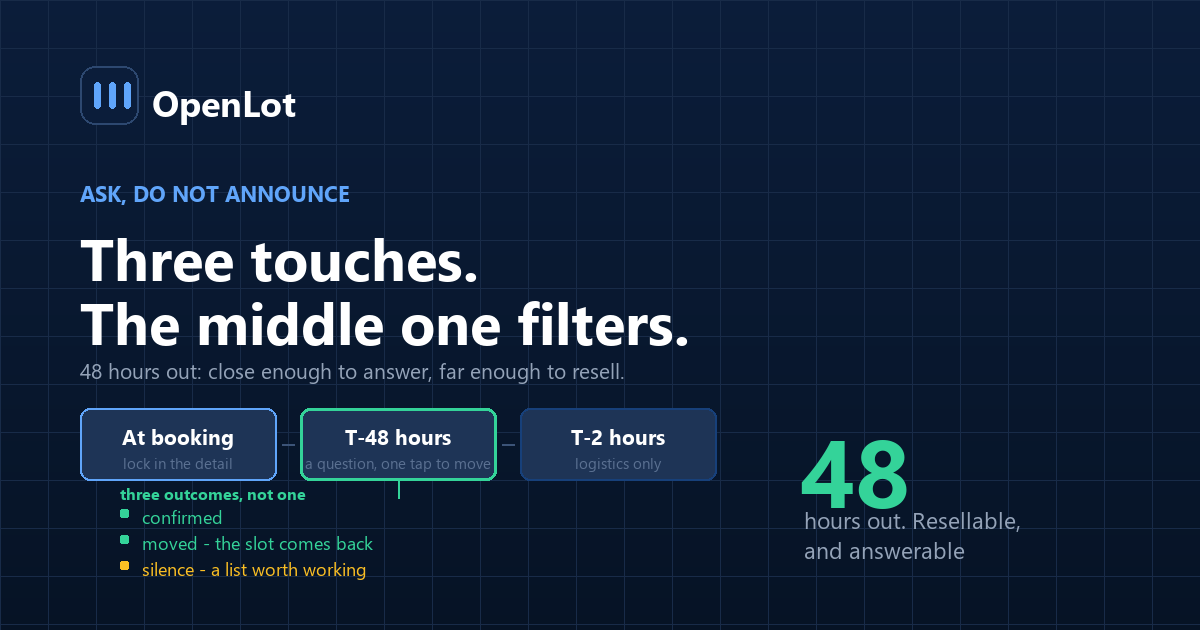
This guide covers the three-touch sequence, why asking beats announcing, what each message should contain, how to handle non-responders, where sequences fail, and what to measure.
The three-touch sequence
| When | Purpose | Shape |
|---|---|---|
| Immediately | Lock in the detail while they are engaged | Confirm vehicle, time, person, what to bring |
| T–48 hours | The filter. Surface problems while the slot is resellable | A question requiring a reply, with a one-tap reschedule |
| T–2 hours | Practical | Address, parking, who to ask for |
Three messages. Not five, and not one.
The middle touch does nearly all of the work, and the timing is operational rather than psychological: 48 hours is far enough out that a freed slot can still be sold, and close enough that the customer knows their week. Confirming a week ahead asks a question the customer cannot answer; confirming the morning of surfaces a problem too late to resell.
Why asking beats announcing
"Your appointment is Thursday at 6pm with Marcus" is a notification. It is polite, it is accurate, and it surfaces nothing.
"Still good for Thursday at 6? Reply 1 to confirm or 2 and I'll move it" is a question. It produces three outcomes instead of one:
- Confirmed — the strongest predictor of attendance there is, per no-show rate by segment.
- Moved — the slot comes back while it can still be filled.
- Silence — which is itself information, and the basis of a working list.
The announcing version produces only "sent", which tells you nothing about any of those three.
Make the reschedule easier than the no-show
This is the principle the whole sequence rests on. A customer whose plans changed will take the path of least effort. If moving the appointment requires a phone call during business hours, not showing up is easier — so the store receives a no-show instead of a reschedule, and loses a sellable slot as well as the visit.
Two taps. Always.
What should each message contain?
Touch 1 — immediately: - The vehicle, named specifically - The time, and the person who will meet them - What to bring (licence, and insurance where your process needs it) - A one-tap change option
Touch 2 — T–48: - A question, with a numbered or one-word reply - Nothing else. This message should be short enough to read on a lock screen.
Touch 3 — T–2: - Address, where to park, who to ask for - No question. This one is logistics.
A common error is making touch 3 another confirmation request. By then the answer changes nothing operationally, and a third ask reads as nagging.
How do you handle non-responders?
The non-responder list is the point of the whole sequence, and most stores do nothing with it.
A customer who did not reply at T–48 is materially more likely to miss. That is a prediction you can act on:
- Call them. A short human call at T–24 to a non-responder is high-value and low-volume — it is a small list.
- Offer an easier alternative. "If Thursday got tight, I have Saturday at 10."
- If still nothing at T–2, keep the appointment but do not hold the vehicle out of inventory for them, and do not let a salesperson block their afternoon around it.
The third item is the operational point: a confirmation sequence does not just reduce no-shows, it tells you which appointments to plan around.
Where do confirmation sequences fail?
1. Announcing instead of asking. The whole subject.
2. Too many touches. Five confirmations for one appointment reads as desperation and generates opt-outs — the same ceiling that governs any follow-up cadence.
3. Confirming a week out. The customer cannot answer honestly that far ahead, so the reply means nothing.
4. A reschedule path that requires a call. Converts reschedules into no-shows.
5. Non-responders ignored. The list is the most actionable output and it usually goes unused.
6. No inventory recheck. If the vehicle sold since booking, the confirmation is the moment to say so and offer an alternative — not the arrival. Covered in booking against real availability.
7. Consent and timing handled loosely. Confirmation messages are outbound messaging with contact-time and opt-out obligations, and the dealership is accountable regardless of vendor — the Safeguards Rule framing applies here as everywhere.
What should you measure?
| Metric | How to compute | What it decides |
|---|---|---|
| Confirmation reply rate | Replied ÷ sent at T–48 | The health of the sequence |
| Reschedule rate at T–48 | Moved ÷ confirmations | The number that proves it is working |
| Show rate, responders vs non | Split | The size of the predictive gap |
| No-show rate, before and after | Against baseline | The headline |
| Slot resale rate | Freed slots refilled ÷ freed | Whether the early warning is being used |
| Opt-out rate | Opt-outs ÷ appointments in sequence | The guardrail on touch count |
Row two is the one people miss. A rising reschedule rate looks like a problem and is the programme succeeding — each reschedule is a no-show that did not happen and a slot that came back in time to sell.
Frequently asked questions
How many confirmation messages should a dealership send?
Three: one immediately at booking, one around 48 hours before that asks whether the time still works, and a short practical one a couple of hours ahead. Five messages for one appointment reads as desperation and generates opt-outs without improving attendance.
When is the best time to send an appointment confirmation?
Around 48 hours before. That is far enough ahead that a freed slot can still be sold to someone else, and close enough that the customer actually knows their week. Confirming a week out asks a question the customer cannot answer honestly.
Should a confirmation ask a question or just state the appointment?
Ask. A statement produces only a sent message, while a question produces three useful outcomes: a confirmation, a reschedule that returns a sellable slot, or silence that identifies a likely no-show. The information is the point.
Why does an easy reschedule option reduce no-shows?
Because a customer whose plans changed takes the path of least effort. If moving the appointment requires a phone call during business hours, simply not showing up is easier, so the store gets a no-show instead of a reschedule and loses the chance to resell the slot. Two taps changes which option is easier.
What should be done with customers who do not reply?
Treat them as a working list rather than ignoring them. A short human call at around 24 hours out to a small list of non-responders is high value, and if there is still no response, the appointment should be kept but not planned around — no vehicle held, no afternoon blocked.
Is a rising reschedule rate a bad sign?
No, it is usually the programme working. Each reschedule is a no-show that did not happen and a slot returned early enough to sell to someone else. The metric to watch alongside it is whether those freed slots are actually being refilled.
Should the final reminder ask for confirmation again?
No. Two hours before the appointment, the answer no longer changes anything operationally, and a third request reads as nagging. That message should carry logistics only — address, parking, who to ask for.
Do confirmation messages carry compliance obligations?
Yes. They are outbound messaging subject to consent, contact-time and opt-out requirements, with the dealership accountable regardless of which system sends them. Confirmation flows are frequently set up without the consent logging applied to marketing messages, which is worth checking.
Conclusion
- Three touches: lock in, ask, logistics. The middle one does the work.
- 48 hours out — resellable, and close enough for the customer to answer honestly.
- Make rescheduling easier than not showing up. Two taps, never a phone call.
- The non-responder list is the most actionable output, and almost nobody uses it.
- A rising reschedule rate is success, provided the freed slots are being refilled.
Last updated: