Self-serve calendar links work beautifully in industries where the buyer knows what they are booking. A car shopper does not. They know a vehicle caught their attention, they are unsure whether they are ready, and a grid of empty time slots asks them to resolve all of that alone.
This guide covers why calendar links underperform in car retail, what conversational setting does differently, where a link is still the right tool, how to combine them, and what to measure.
What does a calendar link ask the customer to do?
More than it appears.
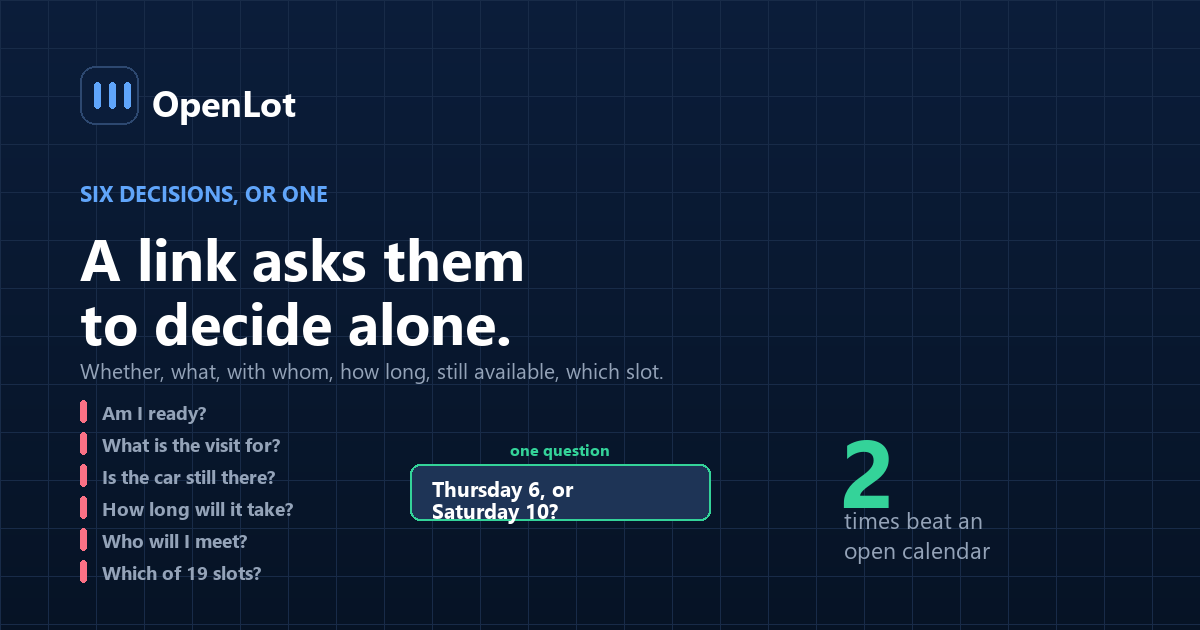
A link to an availability grid asks the customer to decide, alone and without help: whether they are ready to come in, what the visit is for, how long it will take, who they will see, whether the vehicle is still available, and which of nineteen identical-looking slots to pick.
In a context where the buyer already knows all of that — a demo with a software vendor, a consultation they requested — none of this is friction. In car retail, every item on that list is genuinely uncertain to the customer, and the link hands all of it back to them at the moment they were closest to committing.
What each side has to supply
The customer must decide Calendar link Conversational setter Whether they are ready Alone Surfaced and addressed What the visit is for Alone Named for them Whether the car is still there Cannot know Checked before offering How long it takes Guess Stated Who they will meet Unknown Named Which slot 19 options Two options Six decisions versus one. And the one that remains is a choice between two concrete times, which is a question people answer easily.
What does conversational setting do differently?
Four things, and none of them is sophistication.
It offers two times, not a calendar. "I can do Thursday at 6pm or Saturday at 10am — which is easier?" converts dramatically better than an open grid, because it is a question rather than a task.
It checks the vehicle first. Booking against inventory the store no longer has is worse than not booking, and a link cannot check.
It names a person. "Marcus will have it pulled up front" changes the appointment from an errand into an arrangement.
It handles the hesitation. A customer who replies "I'm not sure I'm ready to come in yet" has given useful information. A link receives that reply as silence.
That fourth point is most of the gap. A link produces a binary outcome — booked or nothing — while a conversation produces a third outcome, which is a customer who tells you what is actually in the way.
When is a calendar link the right tool?
It is not always wrong, and three cases favour it.
Rescheduling a confirmed appointment. The customer already knows what the visit is and who they are seeing. The only open question is time, which is exactly what a link is good at.
Service, for known maintenance. An oil change has a known purpose and duration. Even here the step count matters — see why service booking gets abandoned — but the customer at least knows what they are booking.
A customer who asks for one. Some people prefer self-serve, and the correct response to "just send me a link" is to send a link.
The pattern: a link works when the only unknown is when. It fails when whether, what and with whom are also open.
How should they be combined?
Conversation first, link as a fallback within the conversation.
- The setter offers two concrete times.
- If neither works, offer two more.
- If the customer wants to browse, send the link — inside the same thread, after the context has been established.
- Whatever is booked, run the confirmation sequence on it, because a self-served booking carries less commitment and needs more confirmation rather than less.
The sequencing matters. A link offered first is a link that does the whole job badly. A link offered third, after two attempts and with the vehicle and person already named, is a convenience rather than an abdication.
Where does this go wrong?
1. The link in the first message. Fastest way to convert a warm thread into no reply.
2. Nineteen slots. Choice paralysis is real and it is worse when every option looks identical. Expose a few.
3. No inventory check behind the link. The customer books to see a car that sold on Tuesday — the first of the four availability checks, and the only one whose failure happens in person. It is the same class of error as CRM data decay: the system is confident about something it never verified.
4. No person assigned. A self-served booking frequently lands with nobody, which is the handoff failure with an extra step.
5. Treating link bookings as equivalent. They show at different rates and should be tracked separately, for the reason covered in show rate being the only number.
6. Removing the conversation entirely. A store that replaces setting with self-serve has not saved labour — it has moved the work to the customer and lost the third outcome, the hesitation it could have addressed.
What should you measure?
| Metric | How to compute | What it tells you |
|---|---|---|
| Link open rate | Opened ÷ sent | Whether the link is even being considered |
| Link book rate | Booked ÷ opened | The real conversion of self-serve |
| Conversational book rate | Booked ÷ conversations where a time was offered | The comparison that matters |
| Show rate by booking method | Attended ÷ set, split | Usually the decisive difference |
| Slots offered per booking | Average options presented | Two beats nineteen, measurably |
| Hesitation replies | Replies expressing uncertainty ÷ offers | The outcome a link cannot produce |
Row four is where most stores find the answer. If link bookings show at a materially lower rate, the apparent efficiency of self-serve was borrowed from attendance.
Frequently asked questions
Why do calendar links underperform in car sales?
Because they ask the customer to resolve six uncertainties alone — whether they are ready, what the visit is for, whether the vehicle is still available, how long it takes, who they will meet, and which slot — at the moment they were closest to committing. In contexts where the buyer already knows all of that, links work well.
How many appointment times should be offered at once?
Two. A choice between two concrete times is a question people answer quickly, while a grid of many identical-looking slots is a task they postpone. If neither works, offering two more performs better than opening the full calendar.
Is a calendar link ever the right tool for a dealership?
Yes, in three cases: rescheduling an appointment the customer already understands, booking known maintenance in service, and whenever a customer explicitly asks for a link. The pattern is that links work when the only open question is when, and fail when whether, what and with whom are also open.
What does a conversational setter do that a link cannot?
It checks inventory before offering a time, names the person who will meet the customer, and — most importantly — handles hesitation. A customer who says they are not sure they are ready has given useful information, which a link receives as silence.
Should the booking link be sent in the first message?
No. A link in the first message converts a warm conversation into no reply more often than it produces a booking. If a link is used at all, it belongs later in the thread, after a time has been offered and the vehicle and person have been named.
Do self-served bookings show up at the same rate?
Usually at a lower rate, because less commitment was required to make them. They should be tracked as a separate booking source with their own show rate, and they generally warrant a stronger confirmation sequence rather than a weaker one.
Does replacing setters with self-serve save money?
It moves the work to the customer rather than removing it, and it discards the most useful outcome of a conversation — the customer who explains what is actually in the way. The saving usually reappears as a lower show rate, which is a worse trade than it looks on a staffing spreadsheet.
What is the biggest fixable mistake with calendar links?
Exposing too many slots. Choice paralysis is measurable, and reducing a long availability grid to a handful of options typically improves completion more than any change to the link itself or the message around it.
Conclusion
- A link asks the customer to resolve six uncertainties alone. A conversation resolves five of them.
- Two times beat nineteen, because a choice is easier than a task.
- Links win when only "when" is open: reschedules, known maintenance, and on request.
- Conversation first, link third, inside the same thread and after the context exists.
- Track show rate by booking method. Self-serve efficiency is frequently borrowed from attendance.
Last updated: