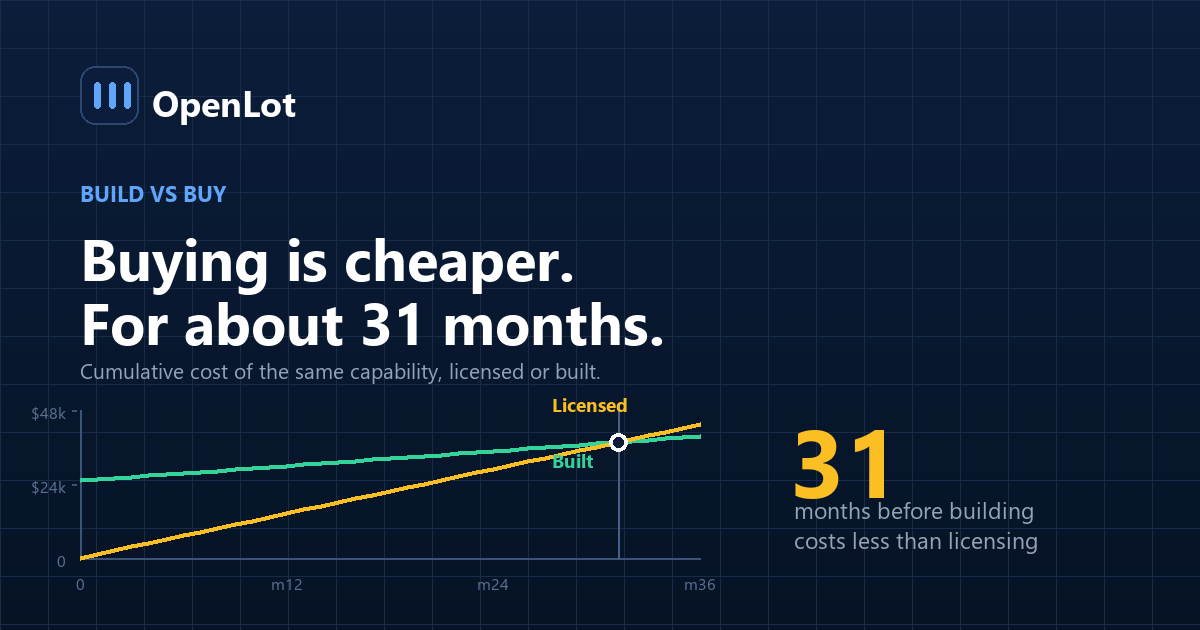
Custom AI automotive solutions are systems built around one dealership's processes, data and integrations rather than licensed as a finished product. For most stores, buying is the right answer. Custom earns its cost only when something about the operation is genuinely not standard — and the arithmetic below puts the crossover around month 31.
This guide covers what custom AI means in a dealership context, the five conditions that justify it, what it costs against a subscription over 36 months, where custom projects reliably fail, and what a serious engagement has to deliver.
What are custom AI automotive solutions?
Custom AI is software built for the way one store actually works, rather than configured inside a product built for the average store.
The useful way to see it is as a spectrum, not a binary. Almost nobody builds a model from scratch, and almost nobody uses a platform exactly as shipped. Every dealership sits somewhere between:
- Configuration — a licensed platform, set up with your hours, your sources, your templates. Days of work. No code.
- Integration — a licensed platform plus connective work so it reads and writes against your DMS and CRM correctly. Weeks of work. Some code, mostly at the edges.
- Custom build — software written around your process, owned by you, running against your data. Months of work.
The question is never "custom or not." It is how far right on that spectrum your specific problem forces you, and whether the problem is worth the trip.
Three things sold as custom that are not
A different prompt is not custom software. Tuning the wording an assistant uses is configuration with a premium attached. Valuable, often necessary, not a build.
A branded wrapper is not custom. The same multi-tenant platform every other dealer on the vendor's roster runs, with your logo on it, is still the same platform. The test is simple: ask whether the behavior you are paying for can be turned on for another customer tomorrow.
An integration is not the whole project. Connecting a product to your DMS and CRM is work, and real work, but it is plumbing for someone else's software. It does not make the software yours, and it does not travel with you if you switch vendors.
The distinction matters because stores pay custom prices for the first three, conclude that custom "did not work," and never evaluate the one case where it would have.
When does off-the-shelf actually stop working?
Five conditions. If none of them describes your store, buy the platform and stop reading — that is the honest answer and it is the answer most of the time.
1. Your process is genuinely non-standard, and the difference is the business. Not "we do it our way" — every store says that. Something structural: a buy-here-pay-here collections flow, a wholesale operation that drives acquisition, a consignment model. Platforms encode the mainstream retail process. If yours is deliberately not that, configuration fights you forever.
2. The systems you need to connect have no product between them. Every vendor integrates with the top three CRMs. If your stack includes something regional, legacy, or home-grown, you are not buying an integration — nobody built one. That gap is where custom starts being cheaper than waiting.
3. You need to own the data layer. A group consolidating reporting across rooftops eventually needs one model of a customer, a deal and a unit that does not live inside a vendor's database on a vendor's schema. That is an asset, and it is not rentable.
4. Per-seat or per-rooftop pricing has stopped scaling with the value. This is the most common honest trigger. A model priced per user punishes you exactly when adoption succeeds. At some rooftop count, the subscription stops tracking what you get out of it — see the broader pattern in rising cost per sale.
5. You cannot accept the vendor as a single point of failure. If a capability becomes load-bearing for the store, the vendor's outage is your outage and the vendor's roadmap is your roadmap. That is a continuity question before it is a technology one.
One condition is usually not enough. Two or more, and the conversation is worth having.
What does custom cost against a subscription?
The 36-month arithmetic
Illustrative. Substitute your own quotes — the shape matters more than these numbers.
A licensed platform covering lead response and appointment setting across a small group: $1,200 per month, all in.
The same capability built: $25,000 once, plus $400 per month to host, monitor and maintain it.
Month Licensed Built 12 $14,400 $29,800 24 $28,800 $34,600 31 $37,200 $37,400 36 $43,200 $39,400 The lines cross at month 31. Before that, licensing is cheaper. After that, building is — and the gap keeps widening, because one line has a slope of $1,200 and the other has a slope of $400.
Run your own quotes through it. If your planning horizon is shorter than the crossover, the decision is already made.
Two things follow from this, and they point in opposite directions.
The first is that buying wins on any short horizon. A store that needs the capability working this quarter, or that is not sure the capability is the right one, should license it. Custom cannot compete with a subscription you can cancel.
The second is that the crossover is a cliff, not a slope. Past it, the subscription keeps charging full price for software that has not changed, while the build is down to maintenance. Three years is not a long time in a dealership group.
What the model leaves out
Honest version: the build line above is optimistic in one direction and pessimistic in another. The version with the mess put back in — the six costs that never appear on a quote — moves the crossover in both directions depending on your store.
Optimistic, because $25,000 assumes a scoped problem and a clean data source. A build that discovers mid-project that the CRM is full of duplicate records spends its budget on cleanup instead of capability.
Pessimistic, because the subscription line assumes the price never moves. Per-seat pricing on a growing group does not hold flat for three years, and the renewal is where the vendor's leverage is highest.
Where do custom AI projects fail?
Any firm that will not tell you this is selling badly. Five failure modes, in the order they bite:
1. The scope was a wish, not a specification. "AI for the dealership" is not a project. "Respond to internet leads from these four sources within 60 seconds, qualify against these five fields, book against this calendar, escalate on these twelve triggers" is. Projects die in the gap between those two sentences, and the gap is always discovered after the money is committed.
2. It was built on data nobody validated first. This is the same failure that sinks platform deployments, and custom makes it worse rather than better, because there is no vendor support queue to blame. Clean the database before you automate against it, not after.
3. Nobody owns it after handover. The build ships, the people who wrote it leave, and eighteen months later a DMS version bump breaks something nobody in the building can read. A custom system without a named owner and a maintenance budget is a liability with a launch party.
4. It was built to replace judgment instead of labor. The scope that works is narrow and boring: latency, coverage, persistence, logging. The scope that fails is the one where the software negotiates, quotes or decides. Same boundary as any AI BDC deployment — custom does not move it.
5. Compliance was treated as a delivery detail. Automated outbound, customer data in a model's context window, and records retention are all your obligations under the Safeguards Rule, whoever wrote the code. Building it yourself removes the vendor, not the duty. Specify the audit trail in the statement of work or you will pay to add it later.
What should a custom engagement deliver?
A serious engagement produces artifacts you can hold, at every stage, before the last payment. If a proposal does not name these, it is selling hours — the full version is the seven-clause scope of work.
| Phase | Deliverable | How you know it is real |
|---|---|---|
| Discovery | Written process map and the integration inventory | It names your systems and versions, not generic ones |
| Specification | Scope document with escalation rules and failure behavior | You can predict what the system does on a bad input |
| Pilot | Running against one lead source or one rooftop | Measured against a baseline taken before it was switched on — see the 30-day plan |
| Hardening | Monitoring, alerting, logging, consent and retention records | You can answer an audit without calling the vendor |
| Handover | Source code, credentials, runbook, named owner | It survives the firm that built it disappearing |
The handover row is the one that gets dropped, and it is the one you are actually paying for. Custom software you cannot operate, read or move is a subscription with extra steps and worse terms.
What should you measure?
Three numbers before the project starts, or you will never know what it did.
| Metric | How to compute | What it decides |
|---|---|---|
| Fully loaded cost of the current path | Licenses + integration fees + the hours staff spend compensating for the gap | Whether the crossover math is even close |
| The one operational number the build is meant to move | Pick one — first-touch time, appointment show rate, days to front line | Whether the pilot succeeded, in a way nobody can argue with |
| Time to recover from the build breaking | Who gets paged, what the runbook says, how long a rollback takes | Whether you have an asset or an exposure |
If you cannot state the second one as a single number with a baseline, the project is not ready to be scoped, let alone bought.
Frequently asked questions
What are custom AI automotive solutions?
They are AI systems built around a specific dealership's processes, data and integrations rather than licensed as a finished multi-tenant product. In practice most engagements sit between full configuration of a platform and a ground-up build, and the right position on that spectrum depends on how far your operation sits from the mainstream retail process the platforms are designed for.
Is custom AI worth it for a single-rooftop dealership?
Usually not. The fixed cost of a build is the same whether it serves one store or ten, so the payback period stretches badly at low volume. The exceptions are a genuinely non-standard business model, such as buy-here-pay-here, or a stack whose systems no vendor has integrated with. Otherwise, license a platform.
How much does a custom AI project cost for a car dealership?
Scoped projects generally start in the low five figures and run into six for anything touching multiple systems and multiple rooftops, plus an ongoing maintenance cost in the hundreds per month. The number that matters is not the quote but the crossover against what you would otherwise license: on a $1,200 per month subscription against a $25,000 build with $400 per month upkeep, building becomes cheaper around month 31.
How long does a custom AI build take?
A narrowly scoped build against systems with real APIs is typically weeks, not quarters. Anything that requires reverse-engineering a legacy DMS, cleaning a customer database, or integrating a system nobody has touched before is longer, and the uncertainty lives almost entirely in the data rather than in the model.
Should we build or buy AI for our dealership?
Buy, unless at least two of these apply: your process is structurally non-standard, the systems you need connected have no product between them, you need to own the data layer, per-seat pricing has stopped tracking the value, or you cannot accept the vendor as a single point of failure. One condition alone rarely justifies the cost.
Who owns the code in a custom AI engagement?
You should, and it should be written into the agreement before work starts, along with credentials, infrastructure access, a runbook and a named internal owner. An engagement that ends with the firm holding the keys is a subscription with worse terms, because you now have switching costs and no product roadmap.
Does building our own AI make us responsible for compliance?
Yes, and more directly than before. Under the FTC Safeguards Rule the dealership is the accountable party regardless of who wrote the software, and building removes the vendor without removing the obligation. Consent records, opt-out handling, data retention and access logging have to be specified in the scope document rather than added after launch.
What happens if the firm that built our system disappears?
That depends entirely on whether the handover was real. With source code in your repository, infrastructure in your accounts, a current runbook and a named owner, another developer can pick it up. Without those, the system is unmaintainable the day the original team stops answering email, which is why handover belongs in the contract rather than in the final invoice.
Conclusion
- Most dealerships should buy. Custom is the right answer in a narrow set of conditions, and a firm that recommends it to everyone is not evaluating, it is selling.
- The decision is a crossover, not a preference. On typical numbers it falls around month 31. If your horizon is shorter than that, license.
- One condition is not enough. Non-standard process, missing integrations, data ownership, broken pricing scale, concentration risk — two or more make the conversation worth having.
- Scope is where projects die, not technology. A specification that names systems, fields, escalation triggers and failure behavior is the whole difference between a build and a write-off.
- Handover is the asset. Code, credentials, runbook and a named owner. Without them you bought a subscription with switching costs attached.
Last updated: