The build-vs-buy decision for dealership AI is usually made by comparing two quotes, and both quotes are wrong — not dishonest, just incomplete. Six cost components live outside the number on the proposal, and in a typical first year they are larger than the quote itself.
This guide covers the six costs that never appear on a quote, how to assemble a 36-month model you can defend, what moves the crossover in each direction, and where the exercise goes wrong.
Why is the quote never the cost?
Because a quote prices the thing being sold, and the thing being sold is a fraction of what has to happen for the capability to work in your store.
A licence quote prices access to software. A build quote prices the work of writing it. Neither prices the hours your people spend making the surrounding operation compatible with either one, and those hours are real money whether or not anyone invoices for them.
This is not a vendor problem. It is a scoping problem, and it cuts both ways: the same six components inflate the build column too.
The crossover model in the custom AI guide uses clean numbers on purpose, to make the shape visible. This article is the version with the mess put back in.
What are the six costs the quote leaves out?
1. Integration. Connecting anything to a DMS or CRM is quoted separately, quoted late, or not quoted at all. The cost and structure of that work is its own project with its own vendor relationships, and it recurs per rooftop rather than once. It is also the component that grows fastest, because connection count rises faster than system count.
2. Data remediation. Nothing automated works well against a database full of duplicates, dead numbers and records with no consent flag. The decay is continuous, so this is not a one-time line either — it is cleanup plus an ongoing hygiene process someone has to own.
3. Internal hours. Discovery meetings, testing, writing the escalation rules, reviewing transcripts for the first month. These never appear anywhere because they are salaried people doing work they were already being paid for. That does not make the hours free; it makes them invisible, which is worse.
4. Training and process change. A system that routes leads differently changes what the sales floor does. The cost is a few weeks of reduced throughput while people adapt, and it is incurred every time the process changes again.
5. Price escalation. Per-seat and per-rooftop pricing does not hold flat. Renewal is where the vendor has the most leverage and you have the least, because by then the capability is load-bearing. Model an annual increase; if it does not happen, you were pleasantly wrong.
6. Switching cost. The price of being wrong. Migrating off a platform means exporting data in whatever shape it comes out, rebuilding integrations, and retraining. This cost is zero until the day it is enormous, which is exactly why it gets left out.
The first-year arithmetic
Illustrative. Substitute your own quotes and your own honest hour counts.
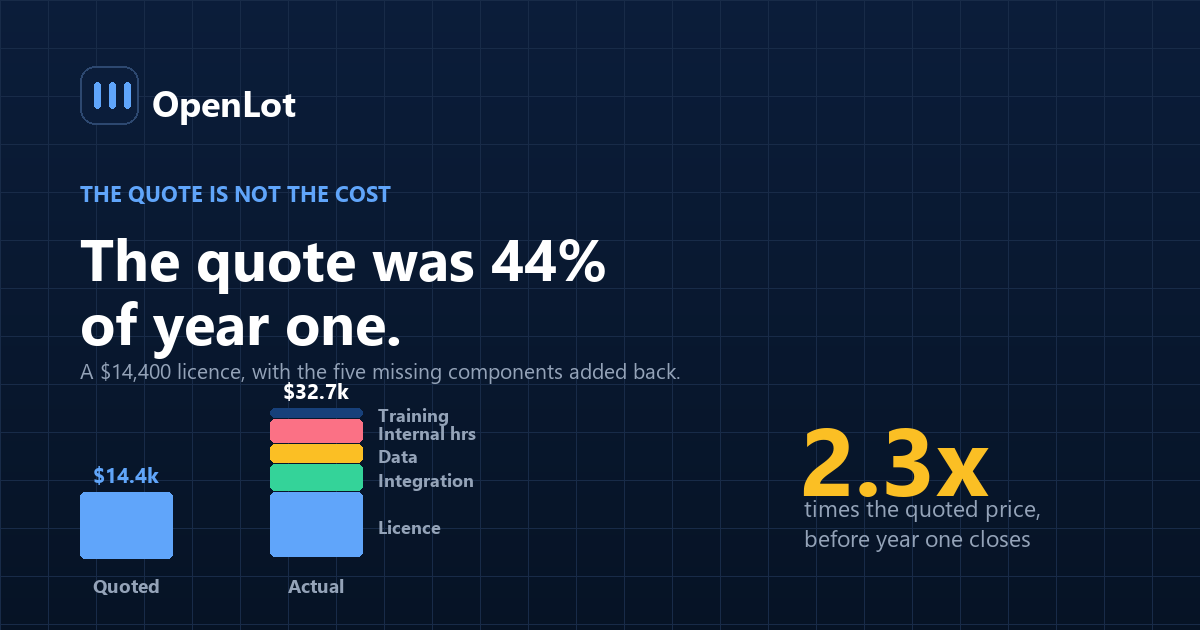
A platform quoted at $1,200 per month — $14,400 for the year. What the year actually costs:
Component Year 1 Licence, as quoted $14,400 Integration setup and per-rooftop fees $6,000 Data remediation before go-live $4,500 Internal hours (120 hrs at $45 fully loaded) $5,400 Training and throughput dip $2,400 True first-year cost $32,700 The quote was 44% of the cost. Not because anyone lied — because the quote priced the software and the other $18,300 priced the deployment.
Run the same six lines against the build column before you compare them. A build that skips integration and data work is not cheaper, it is unfinished.
Does this change the build-vs-buy answer?
Sometimes, and not always in the direction people expect.
Four of the six components — integration, data remediation, internal hours, training — are incurred either way. They are not arguments for building. They are arguments for budgeting honestly, and they mostly cancel out of the comparison.
Two of them do not cancel:
| Component | Licensed | Built |
|---|---|---|
| Integration | Per rooftop, often recurring, re-done on vendor change | Once, and you own it |
| Data remediation | Required either way | Required either way |
| Internal hours | Lower during build, higher during evaluation | Higher during build, lower after |
| Training | Same | Same |
| Price escalation | Compounds annually on the largest line | Maintenance only, flat or near it |
| Switching cost | Large, and grows with adoption | Mostly absent — you hold the code |
Price escalation is the one that quietly dominates a long horizon. A 7% annual increase on a $1,200 monthly licence turns a $43,200 three-year subscription into roughly $46,300, and the fourth year is worse. The build column has no equivalent line.
Switching cost is the one that dominates the risk calculation rather than the arithmetic. It is not a number you pay; it is a number that determines how much leverage you have at every renewal.
What moves the crossover earlier
- More rooftops. The build cost is roughly fixed. Licence cost is not.
- Steep renewal escalation, or a pricing model tied to a metric that grows.
- Integration work that recurs — per rooftop, per system, per vendor change.
- A long planning horizon. Groups that think in five years cross; stores that think in quarters do not.
What moves it later, or off the table
- Uncertainty about the capability itself. If you are not sure this is the right problem to solve, buy. Optionality is worth more than the crossover.
- No internal owner. A build with nobody to maintain it is a liability on a delay fuse.
- A healthy vendor market for your exact stack. If three products already integrate with your systems, the integration argument evaporates.
- Short horizon. Anything under two years, buy.
Where does the build-vs-buy exercise go wrong?
1. Comparing a quote to a quote. The entire point of the six components is that the comparable unit is total cost of the capability over a horizon, not price of the artifact. Most decisions are made on the artifact.
2. Pricing the build and not the maintenance. Software does not hold still. DMS versions move, APIs deprecate, requirements change. A build quoted without an ongoing line is quoted wrong, and the number is usually 1 to 2 percent of the build cost per month.
3. Counting internal hours at zero. The most common error and the largest. If your GM spends 40 hours on this, that is 40 hours not spent on the store, and the comparison that ignores it will favour whichever option consumed more of them.
4. Modelling one year. One year is shorter than every crossover. A one-year model always says buy, which means it is not a model, it is a formality.
5. Letting the vendor build the model. Including us. Ask for the spreadsheet, change the inputs yourself, and see whether the conclusion survives. A model that only works with the seller's numbers is a sales aid.
What should you measure before deciding?
| Metric | How to compute | What it decides |
|---|---|---|
| Fully loaded hourly rate | Salary + burden ÷ worked hours, per role involved | Whether internal hours are a rounding error or the biggest line |
| Integration count | Number of system pairs that must exchange data, per rooftop | Whether integration is a line item or the whole project |
| Planning horizon | How many years leadership actually commits to | Whether a crossover past month 30 is even relevant |
| Current vendor concentration | Share of daily operations dependent on one vendor | Whether switching cost is a risk or an abstraction |
If the horizon is shorter than the crossover, the arithmetic is decided before you start. That is a useful thing to find out in an afternoon rather than in month nine of a build.
Frequently asked questions
Should a dealership build or buy AI?
Buy, in most cases. Building earns its cost when the planning horizon runs past the crossover — typically somewhere between month 24 and month 36 on realistic numbers — and when at least two structural conditions apply, such as non-standard process, missing integrations, data ownership needs, pricing that no longer scales with value, or unacceptable vendor concentration.
What is a realistic total cost for dealership AI in year one?
Expect the true first-year cost to run roughly two to two and a half times the quoted licence once integration, data remediation, internal hours and training are added. On a $14,400 annual licence, a $30,000 to $35,000 first year is a reasonable planning figure, and the ratio improves sharply in year two because most of the extra components are one-time.
Do the hidden costs apply to building as well?
Yes, and that is the point. Integration, data remediation, internal hours and training are incurred whichever path you take, so they mostly cancel out of the comparison. Only price escalation and switching cost differ structurally between the two columns, and both favour building on a long horizon.
How do I account for internal staff time in the model?
Use a fully loaded hourly rate — salary plus payroll burden, divided by actual worked hours — and count the hours honestly, including meetings, testing and the first month of reviewing output. For a typical deployment this lands between 100 and 200 hours across the GM, the BDC manager and whoever owns the CRM.
What maintenance cost should I budget for a custom build?
Between 1 and 2 percent of the build cost per month covers hosting, monitoring, dependency updates and the periodic breakage caused by upstream system changes. On a $25,000 build, that is $250 to $500 monthly, and a proposal with no maintenance line is incomplete rather than cheap.
How much should I assume for annual price increases?
Model something between 5 and 10 percent annually unless your contract caps it, and read the renewal terms before signing rather than at renewal. Pricing tied to seats, rooftops or lead volume escalates on its own even without a rate increase, which is a separate line to model.
Is switching cost worth modelling if we have no plans to switch?
Yes, because switching cost is what sets your negotiating position at every renewal, whether or not you ever exercise it. A capability you cannot move is priced by the vendor accordingly, and the cost shows up as price escalation rather than as a migration invoice.
Who should own the build-vs-buy model inside the dealership?
Whoever will be accountable for the outcome, usually the GM or the group operations lead — not the vendor and not IT alone. The model needs someone who can supply honest hour counts, state the planning horizon, and change inputs without needing permission from the party selling one of the two options.
Conclusion
- The quote prices the artifact, not the capability. On typical numbers it covers under half of the first year.
- Four of the six hidden costs are incurred either way. They change your budget, not your decision.
- Two of them do change the decision: price escalation compounds on the licence column, and switching cost sets your leverage at every renewal.
- One year is not a model. Every crossover sits past month 24, so a one-year comparison always says buy by construction.
- Build the model yourself, with your fully loaded rates and your horizon. If the conclusion only holds with the seller's inputs, it is not a conclusion.
Last updated: