Used car operations have a sharper AI case than franchise sales departments, because the decisions are faster and the margin lives in inventory. Five use cases return more than they cost, three of them act on the lot rather than on the lead, and the ranking between them changes with the size of your inventory rather than your preference.
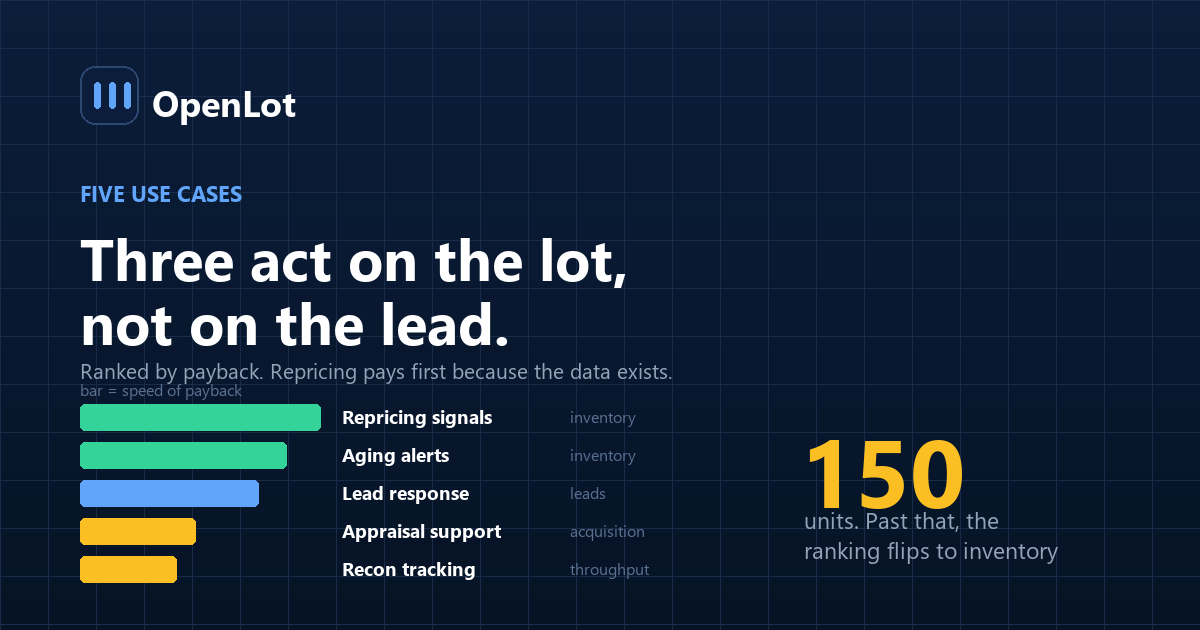
This guide covers the five use cases ranked by payback, what each needs from your data, how the ranking changes with lot size, where each fails, and what to measure.
The five, ranked by payback
| # | Use case | Acts on | Payback | Needs |
|---|---|---|---|---|
| 1 | Repricing signals | Inventory | Fastest | A feed and 90 days of sales |
| 2 | Aging alerts | Inventory | Fast | Days-in-stock, accurate |
| 3 | Lead response and follow-up | Leads | Fast | Clean CRM, lead timestamps |
| 4 | Appraisal support | Acquisition | Medium | Your own retail results |
| 5 | Recon tracking | Throughput | Medium | Stage timestamps you probably do not have |
The ordering is by payback rather than by importance. Acquisition quality matters more than repricing in the long run, and repricing pays first because the units are already on the lot and the data already exists.
1. Repricing signals
The unit is already bought. The only remaining lever is the price, and the arithmetic of doing it manually breaks down somewhere around 150 units — the model set out in why manual repricing stops working.
What it does well: flags units whose market position has moved, ranks them by urgency, and surfaces the ones nobody has touched in three weeks.
What it does not do: decide. A price change is a judgment about this unit, this market and this month, and the system's job is to put the right twenty cars in front of the manager rather than to set the number.
Payback: fast, because it acts on inventory you already own and it needs nothing you do not already have.
2. Aging alerts
Aging is a problem of attention, not of information. Every store knows that a 70-day unit is a problem; few have a mechanism that makes someone look at it on day 31.
What it does well: converts a report nobody opens into an alert someone acts on, with the ladder of interventions described in the 45-day line.
What it does not do: fix a unit that was bought wrong. Aging frequently starts at acquisition, which is why acquisition strategy sits upstream of everything here.
3. Lead response and follow-up
The same case as anywhere: cover the hours nobody works, and execute attempts two through eight.
For an independent used car operation this is usually the highest-volume leak, and it is the one most visible to customers. The ranking against inventory work depends on your own measurements rather than on a rule — the three measurements decide it.
4. Appraisal support
A model trained on market data, corrected by your own retail results, gives an appraiser a starting number and a confidence range.
What it does well: consistency across appraisers, and a defensible starting point.
What it does not do: see the car. Condition, history and the specific thing wrong with this unit are not in the data, which is the subject of appraisal blind spots.
5. Recon tracking
The least glamorous and frequently the largest hidden cost. Every day a unit spends in recon is a day of holding cost with no exposure, and most stores cannot say where the time goes.
Payback: medium, and it is gated by whether anyone records stage timestamps — the constraint explored in days to front line.
How lot size changes the ranking
Illustrative. The crossovers are approximate and your own numbers should move them.
Units in stock First Second Under 60 Lead response Aging alerts 60–150 Aging alerts Repricing 150–400 Repricing Recon tracking 400+ Repricing Appraisal support The pattern: at small volumes the leak is leads, because inventory is manageable by hand. Past roughly 150 units the manual arithmetic fails and inventory work overtakes everything else.
Where does each one fail?
Repricing: when the signals are treated as instructions. A system that automatically changes prices without a manager in the loop will make confident mistakes at scale.
Aging alerts: when they fire into no process. An alert on day 31 that nobody is accountable for is a notification, not a mechanism.
Lead response: when the handoff is unstaffed. Covered everywhere, and it remains the most common reason good deployments show nothing.
Appraisal: when the number is treated as the answer rather than the starting point, which trains appraisers to stop looking.
Recon: when the data is entered retroactively. Stage timestamps recorded at the end of the week are fiction.
What does each one need from your data?
| Use case | Minimum data | Usually missing |
|---|---|---|
| Repricing | Inventory feed, 90 days of sold units | Nothing — this is why it pays first |
| Aging | Accurate days-in-stock from acquisition date | Date is often the front-line date, not the purchase date |
| Lead response | Lead timestamps, deduplicated contacts | Deduplication |
| Appraisal | Your own retail and wholesale results | Wholesale outcomes are rarely recorded against the appraisal |
| Recon | Stage-level timestamps | All of it |
The second row matters more than it looks. If days-in-stock starts counting when a unit hits the front line rather than when you bought it, every aging number understates by however long recon took — which is exactly the time you are trying to measure.
What should you measure?
| Metric | How to compute | Which use case it proves |
|---|---|---|
| Average days to sale | Sold date − acquisition date | Repricing and aging, together |
| Units over 45 days | Count, weekly | Aging alerts |
| Price changes per unit per month | From the feed | Whether repricing signals are being acted on |
| First-touch time by day-part | Bucketed | Lead response |
| Appraisal variance | Appraised vs eventual retail or wholesale result | Appraisal support |
| Days to front line | Acquisition to retail-ready | Recon |
Row one is the summary number for the whole operation, and it is the one to watch across all five. Everything on this list that works shows up there eventually.
Frequently asked questions
What AI use cases actually pay off for a used car dealer?
Five: repricing signals, aging alerts, lead response and follow-up, appraisal support and recon tracking. The first two act on inventory you already own using data you already have, which is why they pay back fastest, while appraisal and recon take longer because they depend on data most stores do not currently capture.
Which one should a used car dealer do first?
It depends on lot size. Under about 60 units the biggest leak is usually leads, because inventory is still manageable by hand. Past roughly 150 units the manual repricing arithmetic fails and inventory work overtakes everything else. Measuring first-touch time, missed calls and aged units decides it properly.
Should AI set used car prices automatically?
No. The useful output is a ranked list of units whose market position has moved, put in front of a manager. Automatic price changes make confident mistakes at scale, because a price is a judgment about a specific unit in a specific market this month.
Why do aging alerts fail at some stores?
Because they fire into no process. An alert on day 31 that nobody is accountable for is a notification rather than a mechanism, and it joins the reports nobody opens. The alert needs a named owner and a defined action at each aging band.
Does AI appraisal replace an appraiser?
No. A model gives a consistent starting number with a confidence range, which is genuinely useful across multiple appraisers. It cannot see the car — condition, history and the specific problem with this unit are not in the data — so treating the number as an answer rather than a starting point degrades appraisals over time.
Why is recon tracking hard to implement?
Because it needs stage-level timestamps that most stores do not record, and retroactive entry produces fiction. Until someone captures when a unit entered and left each stage in something close to real time, there is nothing to analyse.
What is the most common data problem in used car AI?
Days-in-stock measured from the front-line date rather than the acquisition date. It understates aging by exactly the duration of recon, which is the period most worth measuring, and it makes every downstream aging and pricing decision optimistic.
What single metric covers the whole operation?
Average days to sale, measured from acquisition rather than from front line. Every use case on this list that works eventually shows up in that number, which makes it the right summary to track while individual initiatives are evaluated separately.
Conclusion
- Five use cases pay. Three act on inventory, and those are where the margin is.
- Repricing pays first because the units are owned and the data exists.
- The ranking flips around 150 units, when manual pricing arithmetic stops working.
- Days-in-stock from acquisition, not front line. Otherwise aging understates by the length of recon.
- Average days to sale is the summary number. Everything that works shows up there.
Last updated: