At a 50-car lot there is budget for one tool at a time, which makes order the whole decision. Three measurements, each taking under an hour, tell you which one — and buying against the largest measured leak is the difference between a tool that pays for itself and one that gets cancelled in month four.
This guide covers the three measurements, the decision tree they feed, what to buy second and third, where sequencing goes wrong, and what to measure afterwards.
The three measurements
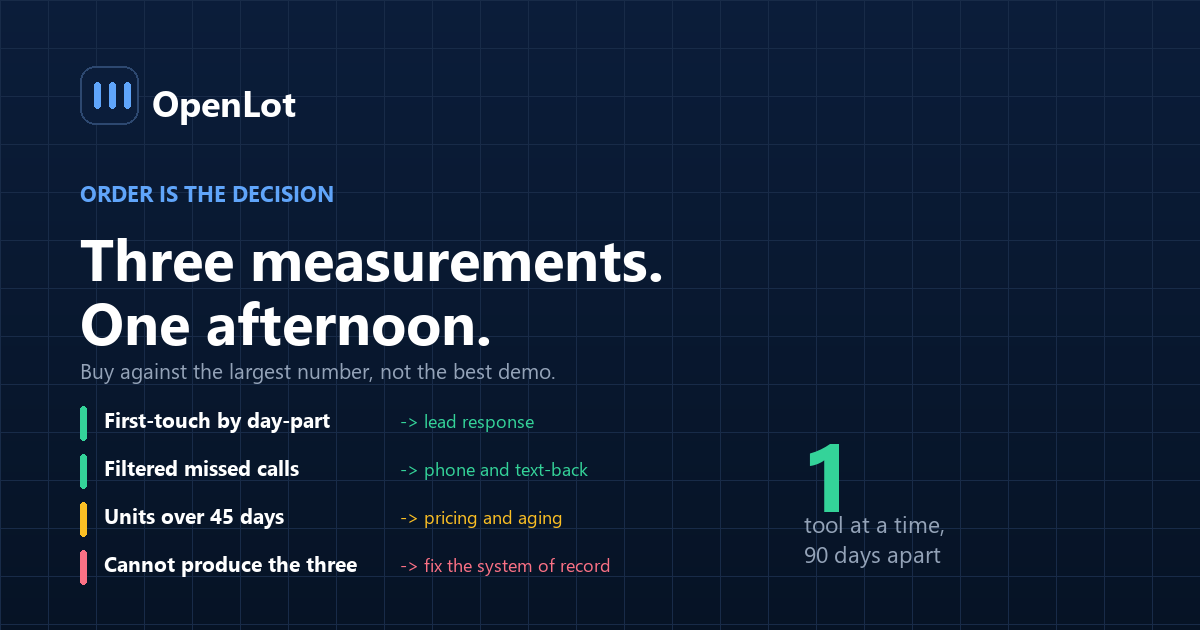
None requires a vendor, and together they take an afternoon.
1. First-touch time by day-part. Export 90 days of leads with their timestamps and your first outbound message. Bucket by hour and weekday. You are looking for the worst bucket, not the average — the method in the four baseline numbers.
2. Missed calls, filtered. Pull the phone system report. Remove vendors, robocalls and wrong numbers. What remains, split by hour, is the phone leak.
3. Units over 45 days, and what they cost to hold. Count them. Multiply by your own daily holding cost. That is the inventory leak, and it compounds the way turn rate describes.
Write all three down. The largest one is your first purchase.
The decision tree
If the largest number is Buy first Because Hours-long response outside staffed hours Lead response Nothing else is reachable until the lead is Calls unanswered at peak or after close Phone and text-back Highest intent channel, cheapest fix Aged units and stale pricing Pricing and aging signals The margin is already on the lot You cannot produce the three numbers Fix the system of record The most common outcome, and it is not AI The last row catches more small stores than the other three combined. A store that cannot export lead timestamps has a CRM problem, and automation on top of that amplifies rather than fixes it.
Why does the order matter so much?
Because at this size you get one shot at credibility.
A 50-car lot that buys lead response when its actual leak is missed phone calls will see no change, conclude that AI does not work for stores like theirs, and not try again for two years. The tool was fine. The sequence was wrong.
Order also matters mechanically: each tool makes the next one more valuable.
- Lead response is worth more once the CRM is clean, because duplicates stop multiplying contacts.
- Phone text-back is worth more once someone is watching replies, which lead response forces you to arrange.
- Pricing signals are worth more once the units are actually being merchandised and responded on.
What comes second and third?
Once the largest leak is addressed and measured:
Second: whichever of the remaining two is now largest. Re-measure rather than assuming. The first tool frequently changes the shape of the second number — closing the after-hours gap, for instance, usually reduces missed calls as well, because some of those callers were people whose web enquiry went unanswered.
Third: the remaining one.
Fourth, and only then: consolidation. Once three tools are running, integration burden becomes real, and that is the point at which a platform starts to make sense — the trade-off set out in the independent's stack, and the reason maintenance burden belongs in the comparison.
What about everything else?
Marketing automation, merchandising tools, chat widgets, reputation management and equity mining are all legitimate products that belong after the four steps above. They are amplifiers: they make an operation that works work harder, and they make an operation with a hole in it leak faster.
Where does sequencing go wrong?
1. Buying the best demo. The most impressive product is not the one addressing your largest leak.
2. Buying a platform first. It covers four leaks adequately at the price of addressing none of them well, and at a small store it also means paying for group features.
3. Not re-measuring between purchases. The second decision should be made on new numbers, not on the original ranking.
4. Buying two at once. Attribution becomes impossible, and at this budget attribution is what justifies the third purchase.
5. Starting with equity mining or marketing. Amplifiers before the basics, which is how a store ends up driving more traffic into an unanswered phone.
6. Skipping the CRM finding. If the three measurements cannot be produced, that is the answer, and it is unwelcome enough that stores frequently buy something else instead.
What should you measure after each purchase?
One number per tool, chosen before buying, measured against the baseline you already captured.
| Tool | The one number |
|---|---|
| Lead response | First-touch time in the worst bucket |
| Phone and text-back | Filtered missed calls, and text-back reply rate |
| Pricing and aging | Units over 45 days, and average days to sale |
| CRM clean-up | Duplicate contact rate |
Give each one 90 days before judging. Thirty days is seasonality in retail automotive, and a tool cancelled at day 45 has been judged on noise.
If the number moved, buy the next one. If it did not, find out whether the tool failed or whether the handoff behind it did — a faster first response that nobody follows up produces no change in anything downstream, and that is a staffing finding rather than a software one.
Frequently asked questions
What AI tool should a small used car dealer buy first?
Whichever addresses the largest of three measured leaks: first-touch time in your worst day-part bucket, filtered missed calls, and units over 45 days in stock with their holding cost. All three can be measured in an afternoon without a vendor, and the largest number is the first purchase.
Why does the order of purchases matter?
Because a small store gets one shot at credibility. Buying lead response when the real leak is missed phone calls produces no visible change, and the conclusion drawn is usually that AI does not work for stores of that size rather than that the sequence was wrong.
What if I cannot produce the three measurements?
Then the first project is the system of record rather than any AI tool. A store that cannot export lead timestamps or filter its phone report has a data problem, and automation layered on top of it multiplies contacts to duplicate records rather than fixing anything.
Should a small store buy a platform instead of individual tools?
Not first. A platform covers several leaks adequately rather than addressing the largest one well, and at a single rooftop it also means paying for group features. Consolidation makes sense once three tools are running and integration burden has become the binding constraint.
Can I buy two tools at the same time?
You can, and you will lose the ability to attribute the result. At this budget, attribution is what justifies the next purchase, so one at a time with 90 days between is the sequence that keeps the programme funded.
How long before judging whether a tool worked?
Ninety days, measured against a baseline captured before installation. Thirty days is indistinguishable from seasonality in retail automotive, and tools cancelled in the second month are frequently being judged on noise rather than on effect.
Where do marketing and merchandising tools fit?
After the basics. They are amplifiers — they make a working operation work harder and make a leaking one leak faster. Driving more traffic into an unanswered phone or an unworked lead queue produces cost rather than units.
What if the number does not move after a purchase?
Check whether the tool failed or the handoff behind it did. A faster first response that nobody follows up produces no downstream change, and that is a staffing finding rather than a software one. The distinction decides whether to replace the tool or to staff the queue.
Conclusion
- Three measurements, one afternoon. First-touch by day-part, filtered missed calls, aged units.
- Buy against the largest number, not the best demo.
- Re-measure between purchases. The first tool changes the shape of the second number.
- One at a time, 90 days apart, or attribution disappears and the programme loses funding.
- If you cannot produce the three numbers, that is the finding, and it is not a tool.
Last updated: