Software at a small dealership does not usually fail loudly. It stops being maintained, then stops being accurate, then stops being used — and the whole sequence takes about a quarter. The question to ask before buying is not what the tool does, but what it needs from you every week.
This guide covers the maintenance cost nobody quotes, how tools decay without an owner, the six questions that reveal the burden, what self-sustaining looks like, and what to measure.
The cost nobody quotes
Every tool asks for something ongoing. The quote covers the licence; the burden is separate and it is paid in hours the store does not have.
| Burden | What it looks like | Typical weekly cost |
|---|---|---|
| Configuration drift | Rules, templates and routing that need updating as things change | 15–60 min |
| Data hygiene | Merging duplicates, fixing bad records | 30–90 min |
| Reviewing output | Reading what the system sent | 30 min–3 hrs |
| Integration babysitting | Noticing that a connection stopped | 0 min, until it is hours |
| Vendor management | Support tickets, renewals, training new staff | Variable |
At a group, these land on someone whose job includes them. At a 50-car lot there is no such person, so they land on the GM, who has six other things, and then they do not happen.
How does a tool decay without an owner?
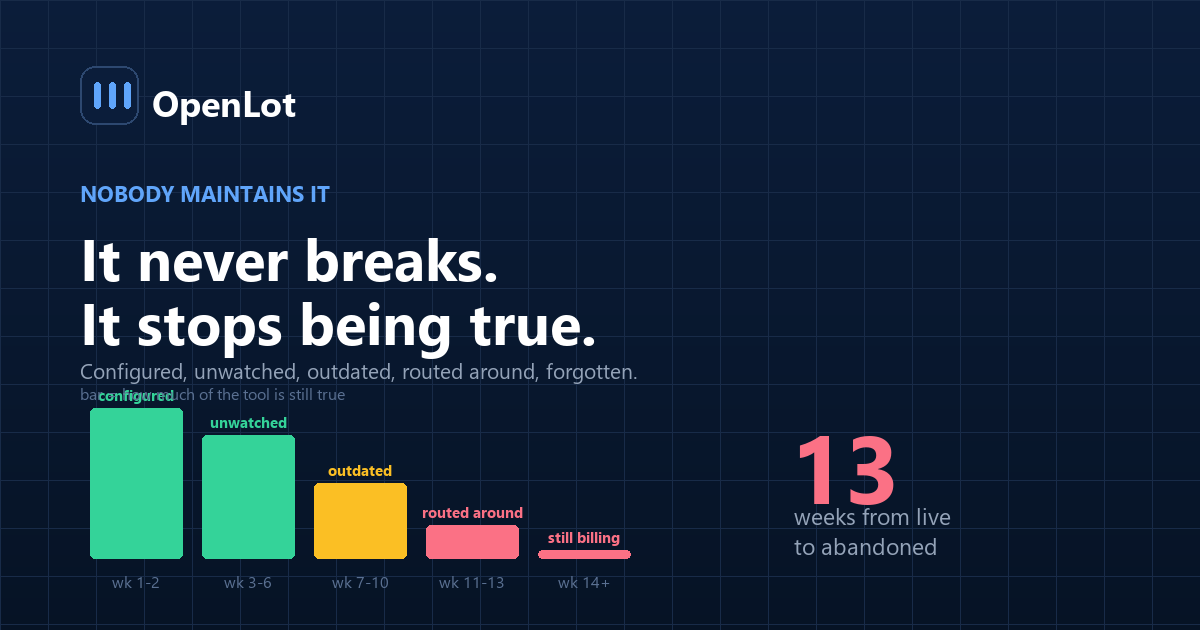
The quarter
Illustrative, and recognisable at most small stores.
Week State 1–2 Configured, watched closely, working 3–6 Working. Nobody is reading the output any more 7–10 Something changed — a template, a lead source, a staff member. Nobody updated it 11–13 Output is now wrong often enough that people route around it 14+ Still billing. Nobody has logged in for a month No single step is a failure. The tool never broke. It just stopped being true, and nothing in the store was designed to notice.
This is the most common outcome of small-dealership software purchases, and it is why tools with no named owner are the cheapest saving available in most stacks.
The six questions that reveal the burden
Ask these in the demo, before price.
- What does this need from me weekly? The direct version. A vendor who says "nothing" has either built it well or not thought about it, and the follow-ups tell you which.
- What breaks when a salesperson leaves? Routing rules, assignment, templates with names in them.
- What happens when I add a lead source? If the answer is a support ticket, every change costs a week.
- How do I know it is still working? Covered in how integrations fail silently — there has to be an alert, not a dashboard nobody opens.
- Can I change a message myself? If not, your copy is frozen at whatever it was on day one.
- What does the vendor do if I stop touching it? Honest answers to this one are rare and valuable.
Question 4 is the one that separates products. A tool that tells you it has stopped working is in a different category from one that waits to be checked.
What does self-sustaining look like?
Five properties. A tool with all five survives at a store with no admin; one missing two or three will not.
1. It alerts rather than waits. When a connection breaks, a volume drops, or output stops, somebody gets a message. Not a dashboard — a message.
2. Defaults that degrade safely. When a rule no longer applies, the system escalates to a person rather than guessing. The same principle as capability limits over instructions.
3. Self-healing assignment. A salesperson leaving should not strand their queue. Routing should fall back to a role, not a name.
4. Editable without support. Messages, hours and basic rules changeable by whoever is standing there.
5. Works on a phone. Because the person who can fix it is on the lot, not at a desk.
The honest trade-off: tools with these properties are often less configurable, and that is the point. Configurability is a maintenance liability at a store with nobody to do the maintaining.
How do you keep a tool alive?
Three habits, none of which takes long.
A named owner, in writing. One person per tool, with the explicit expectation that they check it. The title does not matter; the name does.
A monthly 15-minute check. Is it running, is the output still right, has anything changed that it does not know about. Fifteen minutes, monthly, calendared.
A quarterly kill review. Every tool, every quarter: what number is this moving, and who logged in last month. Anything failing both is cancelled. This single habit pays for most small-store software budgets, because a stack always contains at least one tool nobody has opened since the person who bought it left — the sequencing discipline applies to removal as well as to purchase.
What should you measure?
| Metric | How to compute | What it catches |
|---|---|---|
| Weekly maintenance hours, per tool | Logged honestly for one month | Usually far above the estimate |
| Days since last login, per tool | From the vendor's admin view | The decay indicator |
| Tools with a named owner | Count ÷ total tools | Should be all of them |
| Alerts received vs incidents | Did it tell you when it broke? | Property 1, tested |
| Time to change a message | Request to live | Property 4, tested |
| Tools cancelled per quarter | Count | A healthy number is not zero |
Row six is the surprising one. A stack where nothing is ever cancelled is a stack that is accumulating rather than being managed, and at a small store that accumulation is a meaningful share of fixed cost.
Frequently asked questions
What is the hidden cost of dealership software at a small store?
Maintenance: configuration drift, data hygiene, reviewing output, noticing when integrations break, and vendor management. At a group these land on someone whose job includes them. At a small store there is no such person, so they land on the GM and then stop happening.
How does a tool stop working without breaking?
Gradually. It is configured and watched for a fortnight, then nobody reads the output, then something changes that nobody updates it for, then the output is wrong often enough that people route around it. By the end of a quarter it is still billing and nobody has logged in for a month.
What should I ask a vendor about maintenance?
What it needs weekly, what breaks when a salesperson leaves, what happens when you add a lead source, how you find out it has stopped working, whether you can edit a message yourself, and what the vendor does if you stop touching it. The fourth question separates products more than any other.
What makes a tool survive without an administrator?
Five properties: it alerts rather than waiting to be checked, it escalates to a person when a rule no longer applies, routing falls back to a role rather than a named individual, messages and basic rules are editable without support, and it works on a phone.
Is a highly configurable tool better for a small store?
Usually worse. Configurability is a maintenance liability where there is nobody to do the maintaining, and the tools that survive at small stores tend to be the ones with fewer settings and safer defaults. The trade-off is real and it generally favours the simpler product.
How often should software be reviewed at a small dealership?
A fifteen-minute check monthly per tool, and a kill review quarterly that asks two questions of everything: what number is this moving, and who logged in last month. Anything failing both should be cancelled.
Does every tool need a named owner?
Yes, and it should be written down. The title does not matter, but the name does — tools without one decay silently, and counting them is usually the fastest way to find money in a small store's software budget.
What is a healthy rate of cancelling tools?
Not zero. A stack where nothing is ever removed is accumulating rather than being managed, and at a small store that accumulation becomes a significant fixed cost. Cancelling something most quarters is a sign the review is actually happening.
Conclusion
- The quote covers the licence. The burden is separate and it is paid in hours you do not have.
- Tools do not break, they stop being true, and the sequence takes about a quarter.
- Ask what it needs weekly, and how you find out when it has stopped.
- Configurability is a liability where nobody is maintaining it.
- Quarterly kill review. Two questions, and cancelling something most quarters is healthy.
Last updated: