Software demos are built for the largest buyer in the room, and most dealership platforms were designed for groups. Nine commonly demonstrated features do nothing at a single rooftop — and recognising them is worth more at a small store than any amount of advice about what to buy.
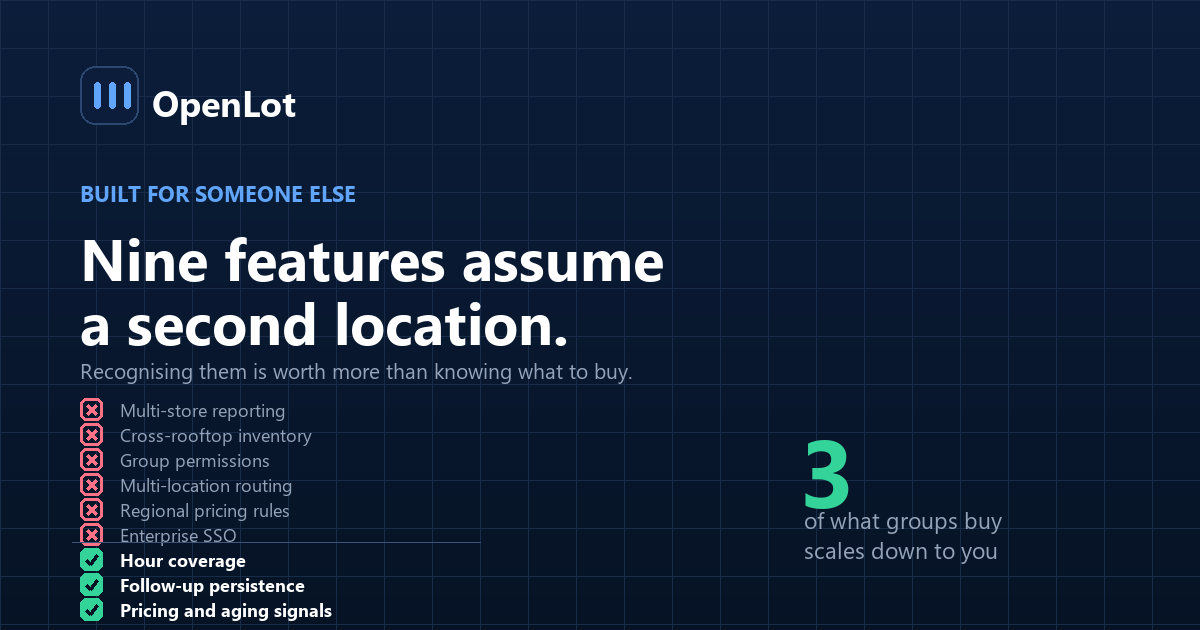
This guide covers the nine features to skip, the three that genuinely scale down, how to run a demo as a small store, where small stores waste money, and what to measure.
The nine to skip
| Feature | Why it does not apply |
|---|---|
| Consolidated multi-store reporting | You have one store. The report is the store |
| Cross-rooftop inventory visibility | There is no second lot to see |
| Group permission hierarchies | Three people, all of whom know each other |
| Multi-location lead routing | Routing between what? |
| Regional pricing rules | One market, one price strategy |
| Enterprise SSO and directory sync | Four logins |
| Dedicated implementation services | Weeks of professional services for a store that can be set up in days |
| Custom reporting builders | You need six numbers, and they are standard |
| Multi-tier approval workflows | The approver is standing ten feet away |
None of these are bad features. Each exists because a group genuinely needs it. The problem is that they are bundled, demonstrated and priced into an offer made to a store that cannot use any of them.
The practical test, during any demo: does this feature assume a second location, a hierarchy, or a person whose only job is this software? If yes, it is not for you.
The three that genuinely scale down
Not everything built for groups is useless small. Three things scale down well and are worth paying for:
1. Coverage of unstaffed hours. A single rooftop has exactly the same 168-hour week as a twenty-store group, and a smaller team to cover it. The coverage arithmetic is worse at a small store, not better.
2. Follow-up persistence. Attempts two through eight fail at every store size, and they fail harder where one person is doing six jobs — the decay documented in automated follow-up.
3. Pricing and aging signals. The arithmetic that breaks manual repricing kicks in around 150 units, but the discipline of knowing which units are aging matters at 40 — and it is the same data either way.
These three are where a small store gets genuine leverage, because they address constraints that get worse rather than better as the store gets smaller.
How should a small store run a demo?
Four rules that change the conversation.
1. State the store size in the first minute. "One rooftop, 60 units, three salespeople." Half the demo should disappear.
2. Ask for the single-store price before seeing anything. If the answer is a range or "it depends on your needs," the pricing is built around a larger buyer and it will take work to get it down.
3. Ask what breaks with no dedicated admin. Most platforms assume somebody owns the system. Ask directly what happens when nobody does — the question explored in AI that does not need an admin.
4. Ask for month-to-month. The answer tells you how confident they are and how much they expect you to use it.
The single question that saves the most money
Ask the vendor: "Which of the features you just showed me require more than one location to be useful?"
A good vendor answers honestly and the demo gets shorter. A bad one says "all of it applies" — and you have learned that the proposal will be priced for someone else.
Then ask what is removed from the price when those are removed. The answer is frequently "nothing", which is itself the finding.
Where do small stores actually waste money?
1. Overlapping tools. Three products that each do lead follow-up, bought at different times for different reasons, all still billing.
2. Annual contracts on unproven tools. Twelve months is a long time at this budget.
3. Features nobody was trained on. The tool does the thing; nobody knows it does.
4. Tools with no owner. Still billing, nobody has logged in since the champion left.
5. Paying for implementation. A single-rooftop setup rarely needs a professional services engagement, and the fee is frequently negotiable to zero.
6. Buying before measuring. The most expensive one. A store that buys lead response when its actual leak is missed phone calls has spent the budget on the wrong leak — which is why the three measurements come first.
What genuinely matters at one rooftop?
Three things, and they are unglamorous:
Does it work when nobody is watching it? Small stores have no admin. A tool requiring weekly configuration is a tool that will stop working within a quarter.
Does it work on a phone? The people who will use it are on the lot, not at a desk.
Can you leave it? Month-to-month, your data exportable, no integration you cannot unwind. At this size, the ability to stop is worth more than most features.
What should you measure?
| Metric | How to compute | What it catches |
|---|---|---|
| Features used ÷ features paid for | Audit a contract against actual usage | Usually a small fraction |
| Tools with no named owner | Count | Pure waste |
| Overlapping capability | Map tools against the four categories | The cheapest saving |
| Monthly cost per unit sold | Software spend ÷ units | The number for the whole stack |
| Configuration hours per month | Time spent maintaining tools | Whether something needs an admin you do not have |
| Contract exit cost | Notice period plus data extraction | How trapped you are |
Row four is the one to track over time. Software cost per unit sold is a simple number that makes the whole stack comparable to any other expense, and it is a conversation that rarely happens at small stores.
Frequently asked questions
What dealership software features do small stores not need?
Consolidated multi-store reporting, cross-rooftop inventory, group permission hierarchies, multi-location routing, regional pricing rules, enterprise SSO, dedicated implementation services, custom report builders and multi-tier approvals. Each exists because groups need it, and none functions at a single location.
How do I tell during a demo what applies to my store?
Ask whether each feature assumes a second location, a management hierarchy, or a person whose only job is the software. If any of those is true, it is not for you. Asking the vendor directly which features require more than one rooftop usually shortens the demo considerably.
Does anything built for groups work well at a small store?
Three things: coverage of unstaffed hours, follow-up persistence, and pricing and aging signals. All three address constraints that get worse as the store gets smaller, because a single rooftop has the same 168-hour week and a smaller team to cover it.
Should a small dealership sign an annual contract?
Rarely, and not for an unproven tool. Twelve months is a long commitment relative to a small store's software budget, and month-to-month also tells you how confident the vendor is that you will keep using it.
Is implementation worth paying for at one rooftop?
Usually not. Single-rooftop deployments can generally be completed in days rather than weeks, and implementation fees attached to platform contracts are frequently sized for a group deployment. It is a line worth negotiating to zero before signing.
What is the biggest waste at small dealerships?
Overlapping tools nobody consolidated, and tools with no named owner that are still billing. Both are found in an afternoon by mapping every contract against what it actually does and asking who logged into it last.
What should a small store prioritise in any tool?
That it keeps working without anyone maintaining it, that it works on a phone, and that leaving is easy. At this size the ability to stop — month-to-month, exportable data, no integration you cannot unwind — is worth more than most features on a comparison grid.
How should software spend be measured at a small store?
As monthly cost per unit sold. It makes the entire stack comparable to any other expense line and surfaces the question of whether the software is earning its place, which is a conversation that rarely happens at small stores until something goes wrong.
Conclusion
- Nine commonly demoed features assume a second location. Recognising them is the saving.
- Three things scale down well: hour coverage, follow-up persistence, pricing signals.
- State your store size in the first minute and half the demo disappears.
- The waste is overlap and orphaned tools, not the headline price.
- At one rooftop, the ability to leave is worth more than most features.
Last updated: