Independent dealers are sold software designed for franchise groups and priced accordingly. Four categories cover almost everything a single-rooftop store genuinely needs, and a working stack lands well under what one enterprise platform charges for the same ground.
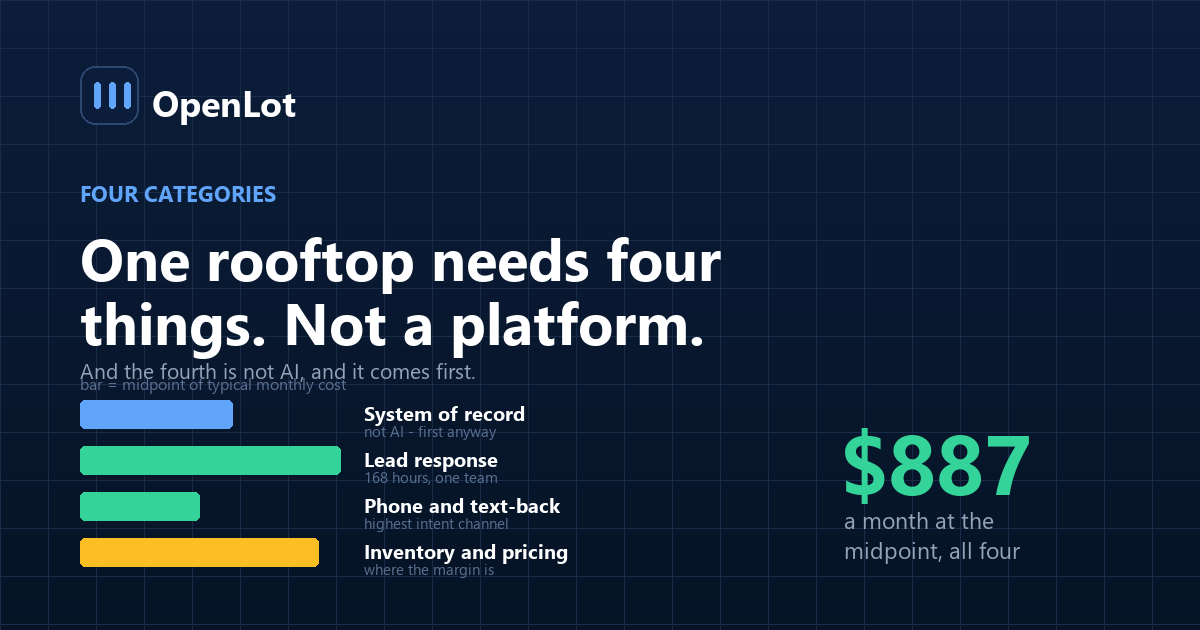
This guide covers the four categories that matter, what a working stack costs, what to buy first, where independents get oversold, and what to measure.
The four categories
Everything genuinely useful at one rooftop falls into one of four buckets. Anything that does not fit one of them is worth questioning hard.
| Category | What it does | Why it matters at one rooftop |
|---|---|---|
| 1. Lead response | Answers and follows up, including nights and weekends | You cannot staff 168 hours. Nobody can |
| 2. Phone | Catches missed calls, texts back, routes | Independents lose a larger share of calls than franchises |
| 3. Inventory and pricing | Repricing signals, aging alerts, acquisition support | Where the margin actually lives |
| 4. The system of record | A CRM that is current, and one place deals live | Everything above degrades without it |
Category 4 is not AI and it comes first anyway. Automation running on a database full of duplicates contacts the same person three times, which is the data decay problem made visible to customers.
What does a working stack cost?
A single-rooftop stack
Illustrative. Prices vary; the shape is the point.
Category Typical monthly CRM for a small store $100–250 Lead response and follow-up $200–400 Phone, missed-call text-back $75–200 Inventory and pricing signals $150–400 Total $525–1,250 Against that, a single enterprise platform marketed as covering "everything" commonly runs $600–1,500 a month for one rooftop, before integration fees and before per-rooftop charges that do not apply to you.
The point is not that platforms are overpriced. It is that you are paying for group-scale features at single-store volume, and the overlap between them is where the money goes.
What should an independent buy first?
Not a platform. One thing, chosen by where your own leak is — the sequencing question in full.
Run three measurements before buying anything:
- First-touch time by day-part. Bucket 90 days of lead timestamps by hour and weekday — the method in the four baseline numbers.
- Missed calls, filtered. Pull the phone report and remove vendors and wrong numbers.
- Units over 45 days in stock, and what each is costing you to hold.
Then buy against the largest one:
| Largest leak | Buy first |
|---|---|
| Hours-long response outside staffed hours | Lead response |
| Calls going unanswered at peak or after close | Phone and text-back |
| Aged units and stale pricing | Inventory and pricing |
| None of the above is measurable | Fix the CRM first |
The last row is more common than any of the others. A store that cannot produce those three measurements has a system-of-record problem, and no amount of automation fixes it — it only amplifies it.
Where do independents get oversold?
1. Per-rooftop pricing on one rooftop. Pricing models designed for groups rarely discount back down for a single store. Ask what the single-store price is, specifically.
2. Features that assume multiple stores. Consolidated reporting, cross-store inventory, group permissions, multi-location routing. All real value — none of it yours, and the full list of nine is worth having in front of you during a demo.
3. Integration fees for systems you do not run. A platform quoting a DMS integration for a DMS you do not have is quoting a generic proposal.
4. Implementation packages. A single-rooftop deployment does not need a multi-week professional services engagement, and the ones sold alongside platform contracts frequently assume one.
5. Annual contracts on unproven tools. At this scale the right term is month-to-month until a tool has shown it moves a number you measured first.
6. A CRM replacement bundled with everything else. Changing your system of record is the most disruptive project a small store can undertake. It should be a separate decision, made for its own reasons — and the integration questions alone make it a project rather than a line item.
What does the big-platform pitch get right?
Two things, genuinely.
Integration overhead is real. Four separate tools means four connections to maintain and four vendors to chase when something stops. A platform removes that, and for a store with nobody technical, that has value.
One inbox matters. A customer who texts, then calls, then messages on Facebook should be one conversation. Fragmented tools make that hard, and the fragmentation is visible to the customer.
The honest framing: buy the platform if the integration burden is the binding constraint, and buy the pieces if cost is. For most single-rooftop independents, cost is the constraint and the pieces win — until the third or fourth store, when it reverses.
What should you measure?
| Metric | How to compute | What it decides |
|---|---|---|
| Cost per tool, per month, all in | Licence + fees + per-lead charges | Usually higher than anyone's estimate |
| Overlap | Features paid for in two places | The cheapest saving available |
| First-touch by day-part | Bucketed | Whether lead response is the leak |
| Missed calls, filtered | From the phone report | Whether phone is the leak |
| Units over 45 days | Count and holding cost | Whether inventory is the leak |
| Tools with no owner | Count | The ones quietly not being used |
The last row catches the most common waste at small stores: a tool bought eighteen months ago, still billing, that nobody has opened since the person who championed it left.
Frequently asked questions
What AI should an independent car dealer buy first?
Whichever addresses your largest measured leak. Run three measurements first — first-touch time by day-part, filtered missed calls, and units over 45 days in stock — and buy against the biggest number. If you cannot produce those three measurements, the first purchase is a working CRM rather than any AI tool.
How much should a single-rooftop dealer spend on software?
A functional stack covering CRM, lead response, phone and inventory signals typically lands in the mid hundreds to low four figures monthly. The figure matters less than the overlap: most stores are paying for the same capability in two tools and for group-scale features that do not apply to one location.
Is a single platform better than separate tools?
It depends on which constraint binds. A platform removes integration overhead, which matters when nobody at the store is technical. Separate tools cost less and avoid paying for group features. For most single-rooftop independents cost is the binding constraint, and that reverses somewhere around the third or fourth store.
What do the big platforms charge for that an independent does not need?
Consolidated multi-store reporting, cross-rooftop inventory views, group permission structures, multi-location routing, and implementation packages sized for an enterprise deployment. All of it is real value to a group and none of it applies to one lot.
Should an independent sign an annual contract?
Not for an unproven tool. Month-to-month until the tool has moved a number you measured before installing it is the right posture at this scale, where a twelve-month commitment to something that does not work is a meaningful share of the software budget.
Does automation work if the CRM is a mess?
No, it makes things worse. Running automated contact against duplicate records means the same customer is messaged from several threads at once, which turns an internal reporting problem into something customers experience. Measuring duplicate rate and cleaning first is cheaper than discovering it through complaints.
What is the most common waste at a small dealership?
A tool still billing that nobody has opened since the person who championed it left. Counting tools with no named owner is a five-minute exercise that frequently pays for the next purchase outright.
When does it make sense to move to a platform?
When integration burden starts costing more than the licence difference, which usually coincides with a second or third rooftop or with the first time a broken connection goes unnoticed for a week. Before that, the pieces are cheaper and the connections are few enough to manage.
Conclusion
- Four categories cover it: lead response, phone, inventory, and a system of record.
- The system of record comes first, and it is not AI.
- Measure three numbers before buying anything. Buy against the largest.
- Per-rooftop pricing and group features are where independents overpay.
- Platform versus pieces is a question of which constraint binds — integration or cost.
Last updated: