Aged inventory is treated as a pricing problem and is usually an attention problem. Four interventions exist and discounting is the last of them — the three cheaper ones come first, cost almost nothing, and are skipped at most stores because nobody is accountable for a unit until it is already a problem.
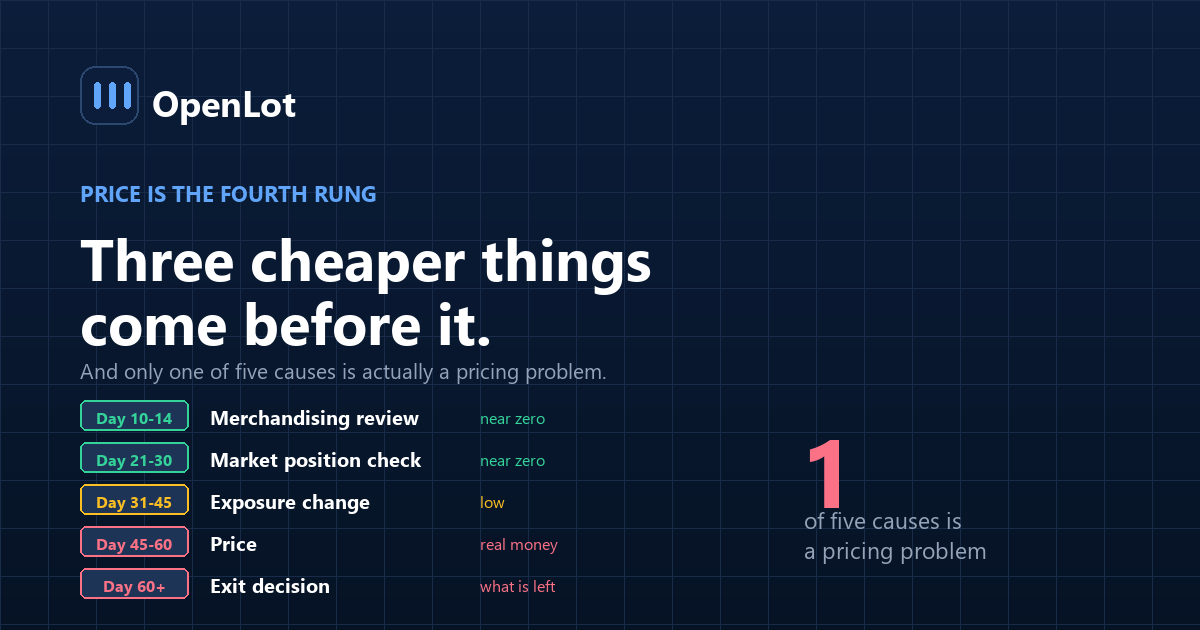
This guide covers the intervention ladder by day band, why discounting comes last, how an alert becomes a mechanism, where aging programmes fail, and what to measure.
The ladder, by day band
| Band | Intervention | Cost | Who |
|---|---|---|---|
| Day 10–14 | Merchandising review — photos, description, completeness | Near zero | Whoever lists |
| Day 21–30 | Market position check — is the price actually where we think | Near zero | Used car manager |
| Day 31–45 | Exposure change — channels, feature placement, retargeting | Low | Marketing |
| Day 45–60 | Price | Real money | Manager, with a reason |
| Day 60+ | Exit decision | The remaining value | Manager |
The ladder matters because the rungs are ordered by cost, and the first two cost nothing. A store that reaches for price at day 30 is spending gross to solve a problem that might have been photographs.
Why is discounting the last rung?
Because it is the only rung that permanently removes money, and because it frequently addresses the wrong cause.
A unit sitting at day 35 is sitting for one of five reasons:
- Nobody is seeing it — merchandising or channel problem
- People see it and do not enquire — photos, description or price position
- People enquire and do not come in — a response and follow-up problem
- People come in and do not buy — condition, or the car is genuinely wrong
- The market moved — a real pricing problem
Only reason 5 is a pricing problem. Discounting fixes it. Discounting also papers over reasons 1 through 4, which is why the symptom returns next quarter with a different unit — the dynamic described in reading the aging profile.
The diagnostic is cheap: days to first enquiry. A unit with no enquiries by day 14 has reason 1 or 2. A unit with enquiries and no appointments has reason 3. A unit with appointments and no sale has reason 4.
How does an alert become a mechanism?
Four properties. An alert missing any of them is a notification, and notifications accumulate unread.
1. It names a person. Not "the used car team." A name.
2. It names an action. "Review photos on stock #4412" rather than "unit aging."
3. It requires a response. Acknowledged, actioned, or deliberately deferred with a reason. An alert nobody has to answer is optional.
4. It escalates. Unacknowledged at 48 hours, it goes to the manager. This is the property that separates a working system from a dashboard.
Where AI helps is in the ranking rather than the alerting: with forty units in the 31–45 band, which three matter most this week given holding cost, market movement and remaining demand. That triage is genuinely hard by hand and genuinely easy for a model.
The arithmetic of the tail
Illustrative. Substitute your own holding cost and gross by band.
Days in stock Units Avg gross Holding cost to date 0–30 92 $2,350 $340 31–45 38 $1,870 $610 46–60 22 $1,420 $890 60+ 19 $780 $1,460 The 60+ band is 12% of units and roughly 4% of gross, while consuming the most holding cost and the most management attention.
Run this once with your own numbers. The conversation about turn changes permanently when the tail has a dollar figure attached to it rather than being an abstract preference.
Where do aging programmes fail?
1. Price first. The most common, and it spends gross on problems that were free to fix.
2. Alerts with no owner. Covered above. The single most frequent reason nothing changes.
3. The band that is actually the problem is ignored. Most attention goes to 60+ units, where little value remains. The 31–45 band is where intervention still works.
4. No days-to-first-enquiry. Without it, every aged unit looks like the same problem.
5. Aging measured from front line. Hides recon inside the number — see days to front line, and the turn benchmarks that depend on counting it correctly.
6. No feedback to acquisition. The same segments keep producing aged units and nobody tells the buyer, which is where the aging problem starts.
7. Clearing the tail and declaring victory. The shape returns next quarter if the cause was upstream.
What should you measure?
| Metric | How to compute | What it decides |
|---|---|---|
| Aging distribution by band | Share of units in each | Where to intervene |
| Days to first enquiry | Listing → first lead on that unit | Which of the five reasons applies |
| Units passing each band untouched | No action logged in the band | Whether the ladder exists in practice |
| Gross by aging band | Average, per band | The cost of the tail, in money |
| Alert acknowledgement rate | Acknowledged ÷ sent | Whether alerts are a mechanism |
| Aged units by acquisition segment | Split | The feedback loop to buying |
Row three is the one that tells you whether you have a programme or a report. If most units pass through the 31–45 band with no logged action, nothing in the store is operating on aging until it is too late to do anything but discount.
Frequently asked questions
What should a dealership do with a unit at 30 days?
Check market position and review merchandising before touching price. The first two rungs of the ladder — a merchandising review around day 10 to 14 and a market position check by day 30 — cost nothing, and reaching for a discount at day 30 spends gross on a problem that may have been photographs.
Why is discounting the last intervention rather than the first?
Because it is the only one that permanently removes money, and because it addresses only one of the five reasons a unit sits. Nobody seeing it, nobody enquiring, nobody coming in and nobody buying are all distinct problems, and discounting papers over them so the pattern returns next quarter.
How do you tell why a specific unit is sitting?
Days to first enquiry. No enquiries by around two weeks points at visibility or merchandising. Enquiries without appointments points at response and follow-up. Appointments without a sale points at condition or at the car being genuinely wrong for the market.
What makes an aging alert actually work?
Four properties: it names a person rather than a team, it names a specific action, it requires a response, and it escalates if unacknowledged. An alert missing any of these is a notification, and notifications accumulate unread alongside the reports nobody opens.
Which aging band deserves the most attention?
The 31 to 45 day band, where intervention still works. Most management attention goes to units past 60 days, where little value remains and the only realistic decision is the exit — by then the cheaper interventions have all been missed.
What does the aged tail actually cost?
Run the arithmetic once: average gross by aging band alongside accumulated holding cost. A tail that is a tenth of units and a small fraction of gross while consuming the most holding cost and management attention changes the internal conversation about turn permanently.
How does AI help with aged inventory?
Mainly in triage. With dozens of units in the intervention band, deciding which three matter most this week — given holding cost, market movement and remaining demand — is hard by hand and straightforward for a model. The alerting itself is a process question rather than a technology one.
How do you stop the same pattern recurring?
Report aged units split by acquisition segment and route it back to whoever buys. Without that loop, the tail is cleared each quarter and reappears, because the decision that created it was made at acquisition rather than at day 60.
Conclusion
- Four interventions, and price is the fourth. The first two cost nothing.
- Only one of five causes is a pricing problem. Discounting hides the other four.
- Days to first enquiry is the diagnostic, and it is one query.
- An alert needs a name, an action, a response and an escalation. Otherwise it is a notification.
- Measure units passing a band untouched. That number tells you whether a programme exists.
Last updated: