Reconditioning time is the most expensive period in a used vehicle's life and the least measured. Every day in recon carries full holding cost and generates no exposure — and most stores cannot say which stage consumes the time, because the stage timestamps that would answer it are not being captured.
This guide covers why days to front line is the metric, where the time goes, the four bottlenecks, what has to be captured first, and what to measure.
Why days to front line?
Because it is the only recon number that connects to money.
Technician efficiency, cost per unit and comeback rate all matter operationally. But the number that moves inventory performance is the elapsed time between acquiring a unit and it being available to sell, and that elapsed time is mostly waiting, not working.
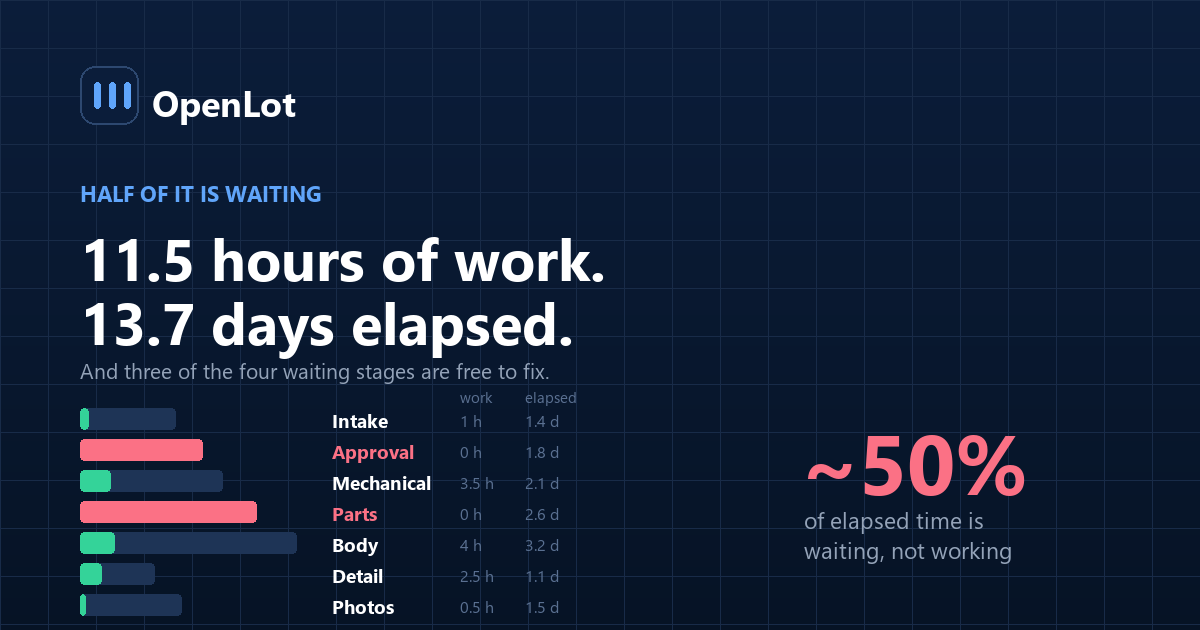
Working time against elapsed time
Illustrative. Instrument your own — the ratio is the finding, not the levels.
Stage Working hours Elapsed days Intake and inspection 1.0 1.4 Waiting for approval 0 1.8 Mechanical 3.5 2.1 Waiting for parts 0 2.6 Body and paint 4.0 3.2 Detail 2.5 1.1 Photography 0.5 1.5 Total 11.5 hrs 13.7 days Eleven and a half hours of work spread across nearly fourteen days. Roughly half the elapsed time is waiting, and three of the four waiting stages cost nothing to fix — they are coordination problems rather than capacity problems.
This also explains why adding technicians frequently does not reduce days to front line. The constraint is not the work.
The four bottlenecks
1. Approval. A unit sits because somebody has to authorise the spend and that person is busy. Fixable with a standing authority threshold: anything under a set figure proceeds without approval.
2. Parts. Ordered after inspection rather than anticipated, and the unit waits. Partly fixable by ordering common items against the inspection rather than against the approval.
3. Photography. Frequently the most absurd one — a retail-ready unit waiting days for photographs, which is a scheduling problem with no cost attached to solving it.
4. Queue priority. The newest arrival gets worked because it is in front of someone, while an older unit waits. Aging should drive recon priority and usually does not.
None of the four is a technician capacity problem, and all four are invisible without stage timestamps.
What has to be captured first?
Stage-level timestamps, recorded close to real time. Without them there is nothing to analyse, and retroactive entry at the end of the week produces fiction.
The minimum viable version: six timestamps per unit — acquired, inspected, approved, work complete, detailed, front line. That is enough to separate working time from waiting time and to locate the bottleneck.
What makes it stick: capture at the point of handoff rather than as a separate administrative task. A technician marking work complete when they move the unit is realistic; a manager entering seven timestamps on Friday is not.
This is the gate on everything else in this article, and it is why recon sits last in the used car AI ranking: the use case is sound and the data usually does not exist yet.
What does AI contribute?
Three things, once the timestamps exist.
Bottleneck identification over time. Which stage is consuming elapsed days this month, which changes seasonally and with staffing.
Priority ranking. Given twelve units in the shop, which order minimises total holding cost given each unit's age and expected demand. Genuinely hard by hand.
Estimating recon before purchase. A model that has seen your own recon costs by segment and condition can estimate what a prospective acquisition will cost to make front-line ready, which feeds appraisal and acquisition directly.
What it cannot do is diagnose a vehicle or decide whether a repair is worth making. Those stay with people.
Where does recon management go wrong?
1. Measuring cost per unit instead of elapsed days. Cost control that extends elapsed time is a false economy — the holding cost exceeds the saving, and it shows up in turn rate rather than in the recon budget.
2. No stage timestamps. Covered above, and it is the gate.
3. Approval as a bottleneck with no threshold. The cheapest fix on the list and frequently unmade.
4. Priority by arrival order. Aging should drive the queue.
5. Photography treated as the last step rather than a parallel one. Several stages can overlap and photography is the most commonly serialised unnecessarily.
6. Days-in-stock counted from front line. This hides the entire recon period inside the number that is supposed to measure it — the measurement artefact flagged in reading the aging profile.
What should you measure?
| Metric | How to compute | What it tells you |
|---|---|---|
| Days to front line | Acquisition → retail-ready | The headline |
| Working hours ÷ elapsed days | Per unit | The waiting ratio, usually around half |
| Elapsed days by stage | From stage timestamps | Where the time goes |
| Approval wait | Inspected → approved | Usually the cheapest to fix |
| Parts wait | Work started → parts received | The second cheapest |
| Recon cost vs segment average | Per unit | Feeds appraisal, and signals condition |
Row two is the number that reframes the conversation. A store discovering that half its recon elapsed time is waiting stops trying to hire technicians and starts fixing coordination, which is faster and free.
Row six does double duty: it is the condition proxy that pricing models lack, and it is the input that makes recon estimation at appraisal possible.
Frequently asked questions
What is the right metric for reconditioning?
Days to front line — the elapsed time from acquiring a unit to it being available to sell. Technician efficiency and cost per unit matter operationally, but elapsed time is what carries holding cost with no exposure, and it is mostly waiting rather than working.
Why does adding technicians not reduce recon time?
Because the constraint usually is not the work. In a typical breakdown, roughly half the elapsed time is waiting — for approval, for parts, for photography — and none of those is a technician capacity problem. Adding capacity to a coordination problem changes very little.
What has to be measured before anything can improve?
Stage-level timestamps, captured close to real time. Six per unit is enough: acquired, inspected, approved, work complete, detailed, front line. Retroactive entry at the end of the week produces fiction rather than data.
How do you make timestamp capture stick?
By capturing at the point of handoff rather than as a separate administrative task. A technician marking work complete as they move the unit is realistic; a manager entering seven timestamps on Friday afternoon is not, and that difference decides whether the data is usable.
What is the cheapest recon fix?
A standing approval threshold, so work under a set figure proceeds without waiting for authorisation. Approval wait is frequently among the largest waiting stages and the fix costs nothing beyond the decision to delegate.
Should photography be the last step?
Not necessarily. It is the most commonly serialised stage for no reason, with retail-ready units waiting days for photographs. Overlapping it with other stages where possible removes elapsed days at zero cost.
What does AI add to recon management?
Bottleneck identification over time, priority ranking across units in the shop given each one's age and holding cost, and estimating recon cost before purchase based on your own history by segment and condition. It cannot diagnose a vehicle or decide whether a repair is worth making.
Why does days-in-stock often exclude recon?
Because many systems count from the front-line date rather than the acquisition date. That hides the entire reconditioning period inside the number meant to measure inventory age, and it makes every downstream aging and pricing decision look better than it is.
Conclusion
- Days to front line is the metric, because it is the one carrying holding cost with no exposure.
- About half of it is waiting, and three of the four waiting stages are free to fix.
- Stage timestamps are the gate. Six per unit, captured at handoff.
- An approval threshold is the cheapest fix available and frequently unmade.
- Recon cost is the condition signal that pricing and appraisal both lack.
Last updated: