An appraisal model is accurate where the data is thick and unreliable where it is thin — which means it is most useful on common, recent, average-condition vehicles. Those are precisely the cars an experienced appraiser finds easy, and the hard ones remain hard.
This guide covers where appraisal models are accurate, the four categories they struggle with, how to use the number without deskilling appraisers, where it fails, and what to measure.
Where is the model accurate?
Where three conditions hold: recent, common, and average.
A three-year-old mainstream sedan with typical mileage and no unusual history has hundreds of close comparables in the data. The model's estimate on that unit is good, frequently better than a quick human estimate, and consistently so across appraisers — which is the genuine value.
Accuracy degrades as any of those three conditions weakens, and it degrades faster than confidence scores usually indicate.
Where confidence should fall
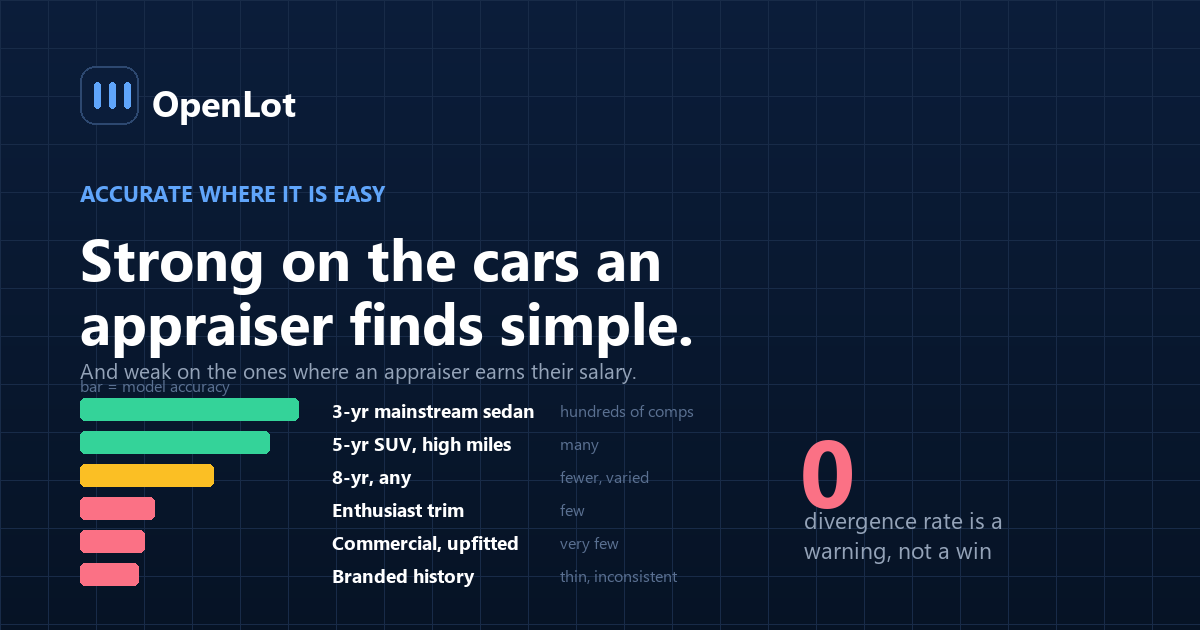
Illustrative. Measure your own by comparing appraised against realised.
Vehicle Comparables Model accuracy 3-yr mainstream sedan, average miles Hundreds High 5-yr mainstream SUV, high miles Many Good 8-yr vehicle, any Fewer, and more varied Moderate Enthusiast or specialty trim Few Low Commercial or upfitted Very few Low Anything with branded history Thin and inconsistent Low The pattern is that the model is strongest on the cars an appraiser would value quickly anyway, and weakest on the ones where an appraiser earns their salary.
That is not an argument against the tool. It is an argument for using it to free attention rather than to replace judgment.
The four categories it struggles with
1. Age past roughly seven or eight years. Condition variance explodes and comparables stop being comparable. Two 2016 vehicles of the same model can be $3,000 apart for reasons invisible in a listing.
2. Low-volume trims and enthusiast vehicles. Thin data, and the market is driven by buyer preferences the model has no feature for.
3. Commercial, upfitted and modified. The modification either adds value or destroys it depending on who the buyer is, and the data does not distinguish.
4. Branded or unusual history. Titles, accident records and inconsistent reporting. The model applies an average adjustment to a situation that is not average.
In all four, the correct behaviour is a wider confidence range, not a different number. A tool that produces a single confident figure on an eight-year-old modified truck is giving you precision it does not have.
How do you use the number without deskilling appraisers?
This is the real risk and it builds slowly.
An appraiser who takes the model's number for two years stops developing the judgment that makes them valuable on the hard cars. Then a hard case arrives and nobody in the building can price it.
Four practices that prevent it, and they are the same discipline that keeps acquisition measurable:
1. Appraise first, then look. The appraiser commits to a number before seeing the model's. It takes thirty seconds and it preserves the skill.
2. Record both, always. The appraiser's number, the model's number, and the realised result. Over a year this tells you who is better at what, by segment.
3. Require a written reason when they diverge. Not to challenge the appraiser — to capture the thing the model cannot see, which is the only way condition knowledge enters the system at all.
4. Review the misses together, monthly. Both kinds: where the model was closer and where the appraiser was. It improves both.
The output of this practice is genuinely valuable: a store that has recorded appraised, modelled and realised values for a year knows exactly which segments to trust the tool on, and that is a better answer than any vendor can supply.
Where does appraisal AI fail?
1. Single confident number on a thin comparable set. Precision without accuracy.
2. Feeding the number to the customer. A trade value sent by your system is treated as an offer — the dynamic behind why trade offers get rejected.
3. No feedback from realised results. A tool that never learns from what you actually sold units for stays a market report.
4. Wholesale outcomes not recorded. A large share of appraisals end in wholesale, and if those results are not captured against the appraisal, the model and the store both learn only from the retail half — which also breaks the exit arithmetic and distorts turn rate.
5. Condition captured as a dropdown. "Good / Fair / Poor" carries almost no information. Recon estimate is a far better condition signal, and it is a number.
6. Appraisers stop looking. The slow failure, and the expensive one.
What should you measure?
| Metric | How to compute | What it tells you |
|---|---|---|
| Appraised vs realised, by segment | Retail and wholesale results against the appraisal | The accuracy map |
| Model vs appraiser, by segment | Both against realised | Where to trust which |
| Divergence rate | Appraisals where human and model differed materially | Should not be near zero |
| Confidence vs error | Model error, split by its own confidence score | Whether the confidence is honest |
| Wholesale capture rate | Wholesale results recorded ÷ wholesale units | Usually low, and it matters |
| Recon vs appraisal assumption | Actual recon against what was assumed | The condition signal |
Row three is the one that catches deskilling early. A divergence rate approaching zero means appraisers have stopped forming independent views, and the store has quietly become dependent on a tool that is weakest exactly where it matters.
Frequently asked questions
How accurate is AI vehicle appraisal?
Accurate on recent, common vehicles in average condition, where there are many close comparables — frequently better than a quick human estimate and more consistent across appraisers. Accuracy falls on older vehicles, low-volume trims, commercial or modified units, and anything with unusual history, and it falls faster than confidence scores typically suggest.
Which vehicles do appraisal models struggle with?
Four categories: vehicles past roughly seven or eight years where condition variance dominates, enthusiast and low-volume trims with thin data, commercial or upfitted vehicles where modifications may add or destroy value, and anything with branded or inconsistent history where an average adjustment is applied to a non-average situation.
Should the appraiser see the model's number first?
No. Having the appraiser commit to a number before seeing the model's takes thirty seconds and preserves the judgment that matters on hard cases. It also produces the comparison data that tells you, by segment, which source to trust.
Does AI appraisal deskill appraisers?
It can, slowly, if the number is taken without an independent view being formed first. The symptom is a divergence rate approaching zero, and the consequence appears when an unusual vehicle arrives and nobody in the building can price it confidently.
Should an appraisal number be shown to the customer?
Not as an offer. Any figure your system sends will be treated as a commitment regardless of hedging, and the gap between an instant estimate and what the store will actually honour is where trade-in conversations break down.
How should condition be captured?
As a recon estimate rather than a dropdown. "Good / Fair / Poor" carries almost no information, while an estimated reconditioning cost is a number that can be compared against the segment average and fed back into the model as a condition proxy.
Why do wholesale results need to be recorded?
Because a large share of appraisals end in wholesale, and if those outcomes are never captured against the original appraisal, both the model and the store learn only from the retail half of their own results. That biases the accuracy picture in a way nobody notices.
What is the most useful thing to build from this?
A record of appraised, modelled and realised values by segment over a year. It produces an accuracy map specific to your store and your market, which is a better answer about where to trust the tool than any vendor can provide.
Conclusion
- Accurate where the data is thick: recent, common, average condition.
- Weakest on the cars that need an appraiser most — old, rare, modified, unusual history.
- Appraise first, then look. Thirty seconds, and it preserves the skill.
- Recon estimate is the condition signal. A three-option dropdown is not.
- A divergence rate near zero is a warning, not a sign the tool is working.
Last updated: