Every aged unit reaches a point where the expected retail outcome no longer covers the cost of waiting for it. That crossover is computable per unit — and most stores pass it by several weeks, because the decision is framed as admitting a mistake rather than as arithmetic.
This guide covers the exit arithmetic, why stores hold too long, what AI contributes, where the calculation goes wrong, and what to measure.
The exit arithmetic
Three quantities, all of which you have.
Expected retail outcome. What this unit realistically sells for, net, given its current market position and remaining demand — not what you hoped when you bought it.
Cost of continuing. Holding cost per day, plus the expected further price reduction needed to move it, plus the opportunity cost of the capital.
Wholesale value today. What it makes at auction or to a wholesale buyer this week.
The unit should exit when expected retail net, minus the cost of getting there, falls below wholesale value today.
One unit, worked through
Illustrative. Substitute your own holding cost and your own realistic retail expectation.
A unit at day 68, cost $14,200, currently listed at $16,400.
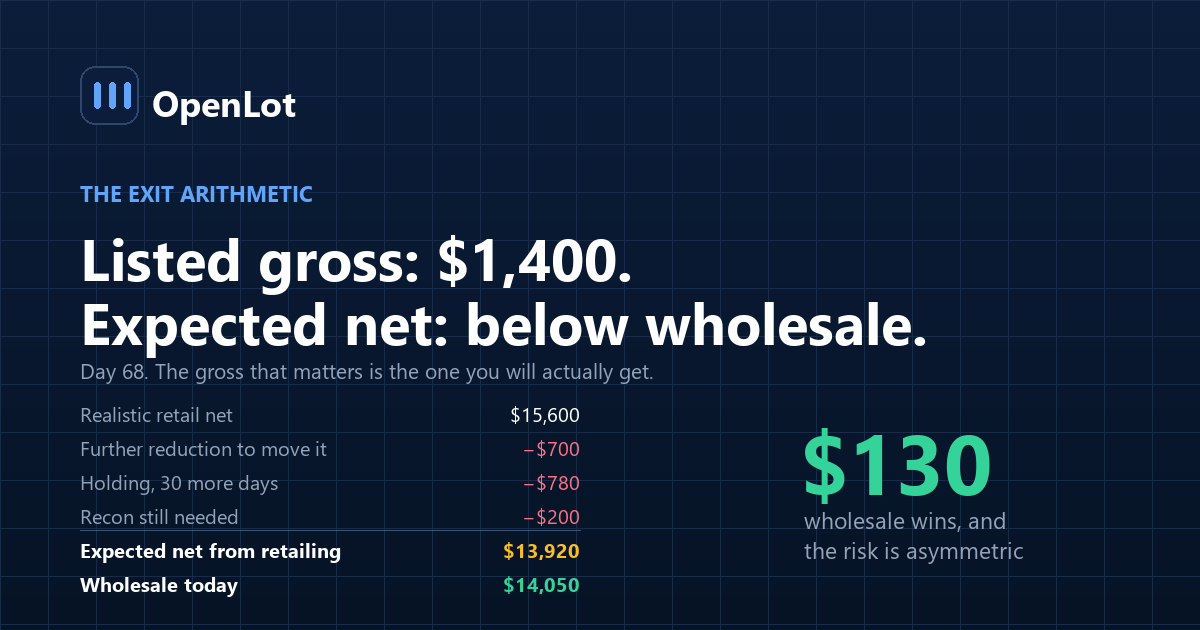
Realistic retail net, if it sells $15,600 Expected further reduction to move it −$700 Holding cost, est. 30 more days at $26/day −$780 Reconditioning still needed −$200 Expected net from retailing $13,920 Wholesale today $14,050 Wholesale wins by $130, and that understates it, because the retail path also carries the risk of taking 60 more days rather than 30.
The uncomfortable part: this unit shows a $1,400 "gross" at the listed price, which is what most stores look at. The gross that matters is the expected net, and it is already below wholesale.
Why do stores hold too long?
Four reasons, none of them analytical.
1. The loss is realised at wholesale. Holding keeps it unrealised, which feels better and costs more. This is the dominant reason.
2. The listed gross looks fine. Nobody is computing expected net, so the unit appears profitable right up until it is sold at a loss.
3. Sunk recon. Money already spent is irrelevant to the decision and dominates the conversation anyway.
4. Nobody owns the decision. Exit decisions are rarely assigned, so they happen when someone notices rather than when the arithmetic says.
The fix for all four is the same: compute it per unit, on a schedule, and give the output to a named person. The decision stops being a judgment about whether a mistake was made and becomes a number that is either above or below a line — which is the same reframing that makes the aging ladder work.
What does AI contribute here?
Three things, and none of them is making the decision.
Expected retail outcome, estimated honestly. A model that has your own sold results can estimate what this unit realistically nets, which is the number stores are worst at guessing because hope is involved.
Wholesale value, current. Auction data moves weekly and is genuinely hard to track manually across a lot.
Ranking. With nineteen units past day 60, which five are furthest past the line. That triage is the practical output.
What it must not do is move units automatically. The exit is a capital decision with a reputational component — a unit wholesaled that a customer was coming to see on Saturday is a different kind of mistake.
Where does the calculation go wrong?
1. Using listed price as expected retail. The listed price is an asking number, not an outcome. Use realistic net.
2. Omitting holding cost. The most commonly left out term, and over 60 days it is substantial — it is the cost behind every turn rate argument.
3. Including sunk recon. It is spent. It belongs in the lesson, not in the decision.
4. Ignoring the time distribution. "It will sell in 30 days" is a median, not a promise, and the tail risk is asymmetric.
5. Computing it once. Both sides move. Wholesale values shift weekly and expected retail declines with age.
6. Not acting on the output. The most common failure, and it is organisational rather than analytical.
How does this connect upstream?
Units that reach the exit decision were usually bought wrong, priced wrong at listing, or belong to a segment the store does not serve — which makes the wholesale log one of the most useful acquisition documents in the building.
A store that reviews its wholesaled units quarterly, by segment and by buyer, learns more about its own acquisition strategy than any market report provides. The pattern is almost always visible: a particular segment, a particular price band, or units acquired at a particular time of month.
That review is the loop that closes predictive stocking, and it is free.
What should you measure?
| Metric | How to compute | What it decides |
|---|---|---|
| Units past the crossover | Expected net vs wholesale, per unit | The list to act on |
| Average days past crossover at exit | How long you hold after the line | The cost of hesitation |
| Wholesale loss vs modelled | Actual result against the estimate | Whether the model is honest |
| Wholesale units by acquisition segment | Split | The acquisition lesson |
| Holding cost per day | Floor plan + insurance + lot cost ÷ units | The term everyone omits |
| Gross on units sold past day 60 | Average | Why the tail is worth avoiding |
Row two is the number that quantifies the behaviour. If units are typically exited three or four weeks after the arithmetic said they should be, that delay has a dollar value, and it is usually enough to fund the discipline that removes it.
Frequently asked questions
When should a dealership wholesale a unit instead of retailing it?
When the expected retail net, minus the further price reduction needed to move it and the holding cost of getting there, falls below what it makes at wholesale today. That crossover is computable per unit and most stores pass it by several weeks.
Why do dealerships hold aged units too long?
Mainly because wholesaling realises the loss while holding keeps it unrealised, which feels better and costs more. The listed gross also looks healthy right up to the sale, sunk reconditioning dominates the conversation despite being irrelevant, and the decision is rarely assigned to anyone.
Should sunk reconditioning cost affect the exit decision?
No. Money already spent is irrelevant to whether holding the unit longer is worthwhile, and including it reliably produces the wrong answer. It belongs in the acquisition review rather than in the exit calculation.
What is the most commonly omitted term?
Holding cost per day. Over a 60-day hold it is substantial, and leaving it out makes retailing look better than it is in exactly the situations where the decision is closest.
What does AI contribute to the exit decision?
Three things: an honest estimate of the realistic retail outcome based on your own sold results, a current wholesale value that moves weekly, and ranking across all aged units so the five furthest past the line surface first. It should not move units automatically, because the exit is a capital decision with a reputational component.
How often should the calculation be run?
Weekly, because both sides move. Wholesale values shift and expected retail declines with age, so a unit that was marginal a fortnight ago may be clearly past the line now. Computing it once and filing it produces no decisions.
What should be done with the wholesale log?
Reviewed quarterly by segment and by buyer. Units that reached the exit decision were usually bought wrong or belong to a segment the store does not serve, and the pattern is almost always visible — making it one of the most useful acquisition documents in the building.
How do you measure the cost of holding too long?
Track the average number of days between when the arithmetic said a unit should exit and when it actually did. That delay has a dollar value in holding cost and further depreciation, and it is usually large enough to justify the weekly discipline that removes it.
Conclusion
- Three quantities decide it: expected retail net, cost of continuing, wholesale today.
- Listed gross is not the number. It looks healthy right up to the loss.
- Sunk recon is irrelevant to the decision and dominates the conversation anyway.
- Run it weekly. Both sides of the comparison move.
- The wholesale log is an acquisition document. Review it quarterly, by segment.
Last updated: