Instant trade valuation tools generate a number before anyone has seen the car, which is both the product and the problem. The gap between the online figure and the honoured figure is where trade conversations break down — and the customer experiences that gap as a bait rather than as an estimate.
This guide covers why offers get rejected, how to measure the honour gap, what to show instead of a single number, where instant valuation fails, and what to measure.
The four reasons an offer gets rejected
1. Condition. The model priced an average example and this one has four worn tyres and a damaged bumper. Legitimate, and it is the majority of real gaps.
2. Optimistic self-reporting. The customer selected "excellent" because they believe it. Not dishonesty — almost nobody rates their own vehicle below "good".
3. The offer was deliberately high. Generated to secure the appointment, with an expectation of revising it down. This is the one that poisons the category.
4. The store's position changed. The model priced to market; by the time the customer arrives the store already has three of that model.
Only the first is unavoidable. The second is manageable with better questions. The third is a choice. The fourth is a process failure.
Sizing the honour gap
Illustrative. Compute your own by segment — it is a single query against your own records.
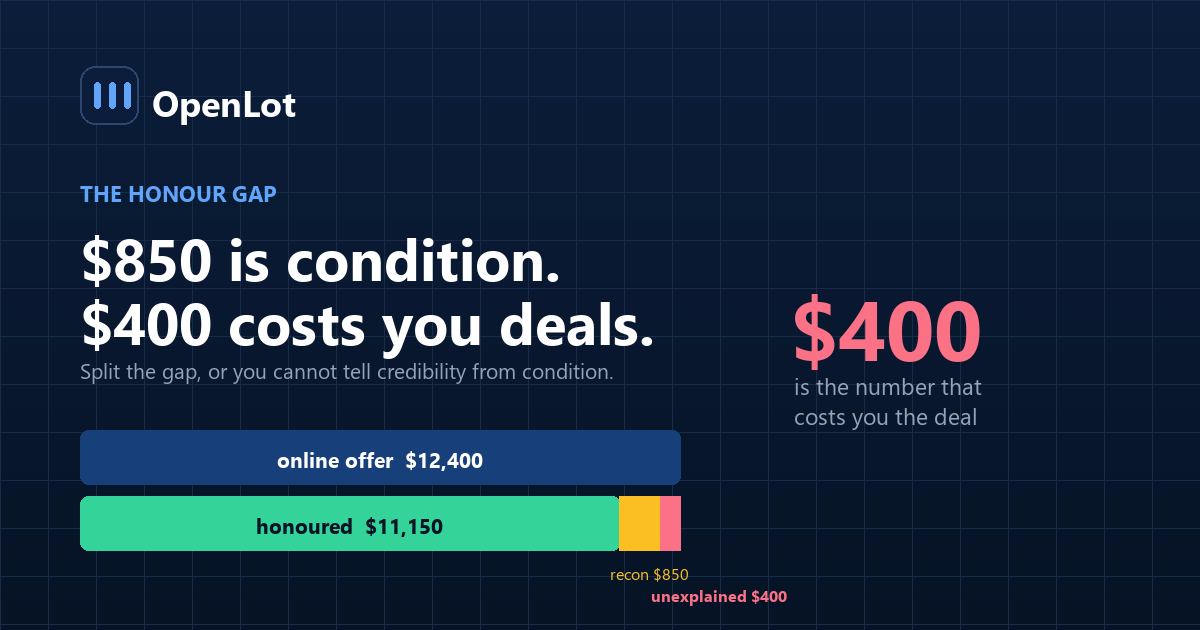
Online offer Honoured Gap Average, all trades $12,400 $11,150 −$1,250 Gap explained by recon — — −$850 Unexplained gap — — −$400 The $850 is condition and it is defensible, provided you can show it. The $400 is the number that costs you deals, because it is the part the customer experiences as the offer not being real.
Most stores have never separated the two, which means they cannot tell a condition conversation from a credibility problem.
How do you reduce the gap?
Ask fewer, better condition questions. Not a 1–5 scale. Specific, answerable, verifiable: tyres replaced in the last year, any warning lights currently on, any panel repainted, does the air conditioning work. Four concrete questions outperform a condition slider by a wide margin, because people can answer facts and cannot calibrate adjectives.
Give a range, not a number. "Between $11,000 and $12,600 depending on condition" is honest, sets a defensible expectation, and still gets the appointment. A single figure creates a commitment and the range does not — the same distinction that governs what an agent may say.
Show the arithmetic. When the figure is revised, show why: tyres, brakes, the panel. A customer shown a reconditioning estimate accepts a lower number far more readily than one simply told the offer changed.
Price to your position, not only to market. If you already hold three of that model, say so and offer accordingly rather than generating a market number you will not honour.
What should you show instead of one number?
| Instead of | Show |
|---|---|
| A single instant figure | A range, with the condition factors that move it |
| "Subject to inspection" | The four specific things inspection will check |
| A revised number at the store | The recon estimate that produced the revision |
| Nothing, until they arrive | The range, honestly — silence loses the appointment |
The last row matters. The alternative to a bad instant offer is not no offer: customers shopping trades will use whoever gives them a number. A defensible range beats both a fake precision and a refusal.
Where does instant valuation fail?
1. Deliberately high offers. It works once per customer and it is the reason the category is distrusted.
2. A condition slider. Produces no usable information and gives the customer a false sense that they have disclosed something — the same failure as condition dropdowns in appraisal, and it feeds turn badly.
3. No link to the appraisal that follows. The in-store appraiser starts from scratch, produces a different number, and the customer sees two unexplained figures.
4. Priced to market with no store position. Covered above, and it generates offers the desk will not approve.
5. Treating the offer as the lead. A trade enquiry is a selling opportunity, and a store that collects the valuation request and does nothing with it has bought a lead and discarded it.
6. Wholesale reality ignored. If a large share of your trades go to wholesale, the retail-anchored model is pricing the wrong exit — the problem in wholesale pricing.
How does this connect to acquisition?
Trade is the cheapest acquisition channel most stores have, and it is managed as a concession rather than as a source.
A store that consistently under-offers on trade is choosing to buy its inventory at auction instead, which costs more and arrives with less history. A store that over-offers and revises is damaging the retail conversation to win a number nobody honoured.
The useful framing: the trade offer is an acquisition decision with a customer attached. Both halves matter, and the acquisition strategy should be what sets the number rather than the trade conversation setting it by default.
What should you measure?
| Metric | How to compute | What it tells you |
|---|---|---|
| Honour gap | Online offer − amount actually paid | The headline |
| Gap explained by recon | Recon estimate on acquired trades | The defensible portion |
| Unexplained gap | Honour gap − recon | The part that costs deals |
| Trade offer acceptance rate | Accepted ÷ offered | The outcome |
| Appointment rate from valuation requests | Appointments ÷ requests | Whether the lead is worked at all |
| Acquisition cost: trade vs auction | Per unit, all in | Whether trade is being used as a channel |
Row three is the one to drive to zero. Condition gaps are explainable and customers accept them. Unexplained gaps are what make the next customer distrust the number before they arrive.
Frequently asked questions
Why do customers reject online trade-in offers at the dealership?
Four reasons: genuine condition differences, optimistic self-reporting by the customer, offers that were deliberately set high to secure the visit, and a change in the store's own position such as already holding several of that model. Only the first is unavoidable.
How do you measure the trade-in honour gap?
Compare the online offer against what was actually paid, then split the difference into the part explained by reconditioning and the part that is not. The unexplained portion is the number that costs deals, because it is what the customer experiences as the offer not being real.
Should an online tool give a single trade number or a range?
A range, with the condition factors that move it. A single figure creates a commitment the store may not honour, while a range sets a defensible expectation and still secures the appointment. Fake precision is worse than honest uncertainty.
What condition questions actually work?
Specific, verifiable ones: were the tyres replaced in the last year, are any warning lights currently on, has any panel been repainted, does the air conditioning work. Four concrete questions outperform a condition slider substantially, because people can answer facts and cannot calibrate adjectives.
What should happen when the in-store number is lower?
Show the arithmetic. A customer presented with a reconditioning estimate — tyres, brakes, the panel — accepts a revised figure far more readily than one simply told the number changed. Unexplained revisions are what create the distrust.
Is it better to give no offer at all?
No. Customers shopping their trade will use whoever gives them a number, so declining loses the appointment to someone else. A defensible range beats both a refusal and a precise figure you will not honour.
Should the store's inventory position affect the trade offer?
Yes, and saying so is better than generating a market number the desk will not approve. If you already hold three of that model, the honest offer reflects that, and explaining it is a more credible conversation than a market figure followed by a revision.
How does trade-in connect to acquisition strategy?
Trade is usually the cheapest acquisition channel a store has, and under-offering means buying at auction instead — more expensive, with less history. The offer should be set by acquisition strategy rather than treated as a concession made during a sales conversation.
Conclusion
- Four causes of rejection, and only condition is unavoidable.
- Split the gap: the recon-explained part is defensible, the rest costs deals.
- A range beats a number. Fake precision creates a commitment you may not honour.
- Four specific condition questions beat any slider, because facts are answerable.
- Trade is an acquisition decision with a customer attached. Price it as one.
Last updated: