Booking a test drive from a messaging thread needs exactly four facts, and the common failure is collecting nine. Every question asked before the time is agreed lowers the odds of agreeing to a time — and the questions that feel most useful to the store are usually the ones that cost the appointment.
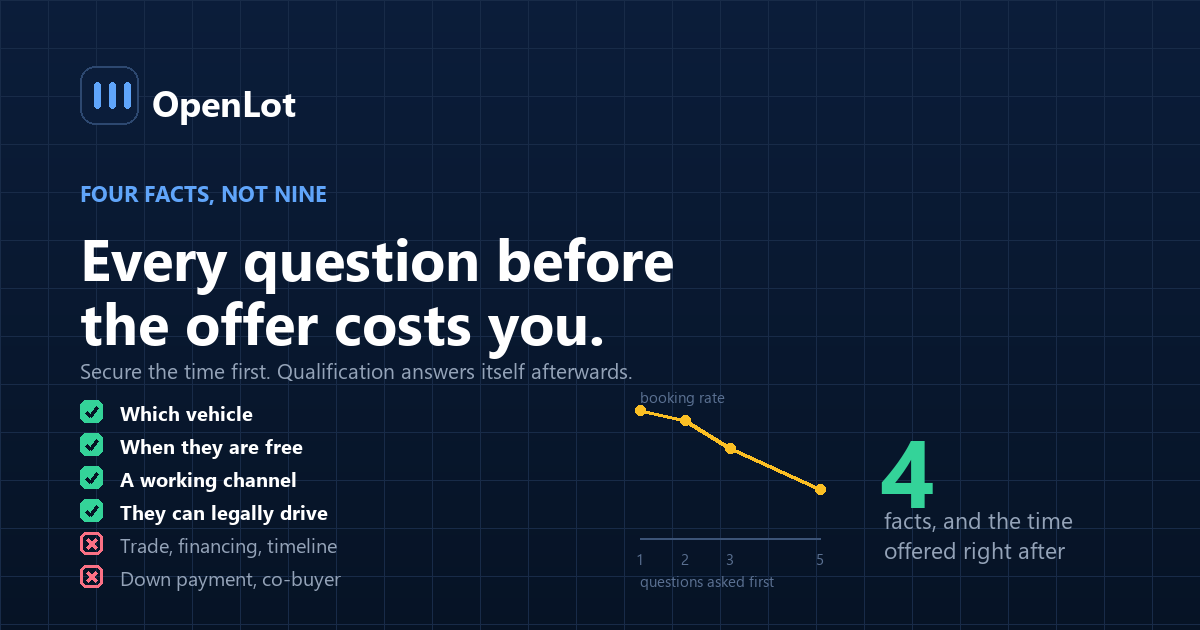
This guide covers the four facts that are genuinely required, when in a thread to offer a time, what to collect afterwards, where test drive booking fails, and what to measure.
What four facts are actually needed?
To offer a time for a test drive, a system needs:
- Which vehicle — or close enough to pull two options.
- When they are free — a window, not a precise slot.
- A working contact channel — the one they are already on.
- That they can legally drive it — a licence, asked at booking only as a reminder to bring it.
That is the whole list. Everything else — trade, financing, timeline, down payment, who else is deciding — is qualification, and qualification belongs after the appointment is set.
What the extra questions cost
The store's instinct is to qualify before committing floor time, and in a world of unlimited leads that would be correct. In a world where most leads never reach a conversation at all, it is expensive.
Questions before the offer
Illustrative. Count your own from real threads — the pattern is consistent even if the levels differ.
Questions asked first Reply rate Booking rate 1 High Highest 2 High High 3 Moderate Moderate 5+ Low Low Each question is an opportunity to stop replying, and the ones that feel most diagnostic — budget, trade, financing — are the ones most likely to end the thread, because they read as pre-screening rather than as help.
The counter-argument is that unqualified appointments waste floor time. That is true and it is a smaller cost than the appointments never set, provided show rate is being watched.
When should the time be offered?
Earlier than feels comfortable: as soon as the vehicle is established.
The sequence that works:
- Confirm the vehicle and say something specific about it.
- Offer two concrete times.
- Once a time is agreed, collect what you need — trade, timing, who is coming.
- Confirm, with the person's name and what to bring.
Step 3 is where qualification lives, and customers answer those questions readily once an appointment exists, because the questions now have an obvious purpose. The same question asked at step 1 reads as a gate; at step 3 it reads as preparation.
What about "just send me the price"?
The most common thread-killer, and the point at which an automated system must stop.
A test drive conversation frequently turns into a price question, and a system that answers it has created a commitment — the boundary set out in where agent autonomy should end. A system that ignores it loses the customer.
The working middle is to acknowledge, be honest about why, and keep the offer alive: "I can't quote a final number over text — the manager works that with your trade and terms. What I can do is have it ready Thursday at 6, and he can go through it with you then. Does that work?"
That answer does three things: it does not pretend, it explains why, and it converts the price question into a reason to come in.
Where does test drive booking fail?
1. Qualifying first. The whole subject above.
2. Offering a vehicle without checking stock. Covered in booking against real availability, and it is the failure that happens in person.
3. No mention of what to bring. A customer arriving without a licence cannot drive, and that is preventable with one sentence in the confirmation — the same discipline as the first-response template, where the content does more work than the speed.
4. Booking the vehicle, not the person. Two customers booked on the same unit an hour apart, with no plan for which one drives it.
5. Pretending to quote. Any number sent is treated as an offer, regardless of hedging.
6. No sales schedule check. The appointment lands with nobody and the customer waits on arrival — the handoff failure in its simplest form. Whether the appointment was worth setting at all is answered by the appointment-to-sold ratio, not by booking count.
What should be in the confirmation?
Short, and four items:
- The vehicle, named specifically
- The time and the person who will meet them
- What to bring — licence, and insurance if your process requires it
- A one-tap way to change it
The last one matters more than the other three combined. A customer who can move an appointment in two taps moves it; one who has to call does not call, and becomes a no-show — the mechanism covered in confirmation sequences.
What should you measure?
| Metric | How to compute | What it decides |
|---|---|---|
| Questions before first offer | Count, sampled from real threads | The main lever |
| Booking rate by question count | Split | Confirms the lever at your store |
| Reply rate after a price question | Replies ÷ threads where price was asked | Whether the deflection works |
| Licence-missing arrivals | Count | Pure confirmation-copy failure |
| Show rate | Attended ÷ set | The guardrail against over-booking soft appointments |
| Appointment-to-sold by question count | Split | Tests whether early qualification actually helps |
The last row is the honest check on this article's own argument. If appointments set with one question close at a much lower rate than those set with four, the trade-off shifts. Measure it rather than assuming either way.
Frequently asked questions
What information is needed to book a test drive?
Four things: which vehicle, roughly when the customer is free, a working contact channel, and confirmation that they can legally drive. Everything else — trade, financing, timeline, decision-makers — is qualification and belongs after the appointment is set rather than before.
Why does asking more questions reduce bookings?
Because each question is an opportunity for the customer to stop replying, and the most diagnostic ones read as pre-screening rather than help. A question about budget asked before any appointment exists feels like a gate; the same question after a time is agreed reads as preparation and gets answered.
When should a time be offered in the conversation?
As soon as the vehicle is established, which is usually earlier than feels comfortable. Confirm the vehicle, say something specific about it, then offer two concrete times. Qualification follows naturally once there is an appointment to prepare for.
How should an automated system handle a price question?
By acknowledging it, explaining honestly why a final number cannot be given over text, and converting it into a reason to visit. Quoting a figure creates a commitment the store must honour, and ignoring the question loses the customer, so the workable path is the honest middle.
What should a test drive confirmation contain?
The vehicle named specifically, the time and the person who will meet them, what to bring including a licence, and a one-tap way to change the appointment. The reschedule option matters most, because a customer who cannot easily move an appointment becomes a no-show instead.
What happens if two customers book the same vehicle?
Someone waits or someone is disappointed, unless the store has a plan. Booking should hold the unit for the appointment window where the process allows it, and where it does not, the second booking needs a named alternative ready rather than being discovered at arrival.
Does booking with less qualification produce worse appointments?
It produces more appointments, and whether they are worse is a measurement rather than an assumption. Track appointment-to-sold rate split by how many questions were asked before the offer — if lightly qualified appointments close far less often, the balance shifts, and if they do not, the extra questions were costing appointments for nothing.
Why do customers arrive without a driving licence?
Because nobody told them to bring it. It is entirely a confirmation-copy failure, fixable with one sentence, and it is worth counting because the number is usually higher than anyone in the store expects.
Conclusion
- Four facts, not nine. Vehicle, window, channel, licence.
- Offer a time as soon as the vehicle is established, and qualify after.
- A price question is not a dead end — acknowledge, explain, keep the offer alive.
- The reschedule link is the most important line in the confirmation.
- Watch appointment-to-sold by question count. It is the honest test of booking lightly.
Last updated: