The replacement question gets asked with a cost saving in mind, and the arithmetic does produce a saving. It is roughly half what the pitch implies, and it is taken from the wrong half of the function — which is why stores that replace their BDC outright tend to rebuild it within a year.
This guide covers the headcount arithmetic, what the saving really is, what breaks when the team goes, the partial version that works, and what to measure.
The arithmetic, done honestly
A three-person BDC against an AI deployment
Illustrative. Substitute your own wages, burden and quotes.
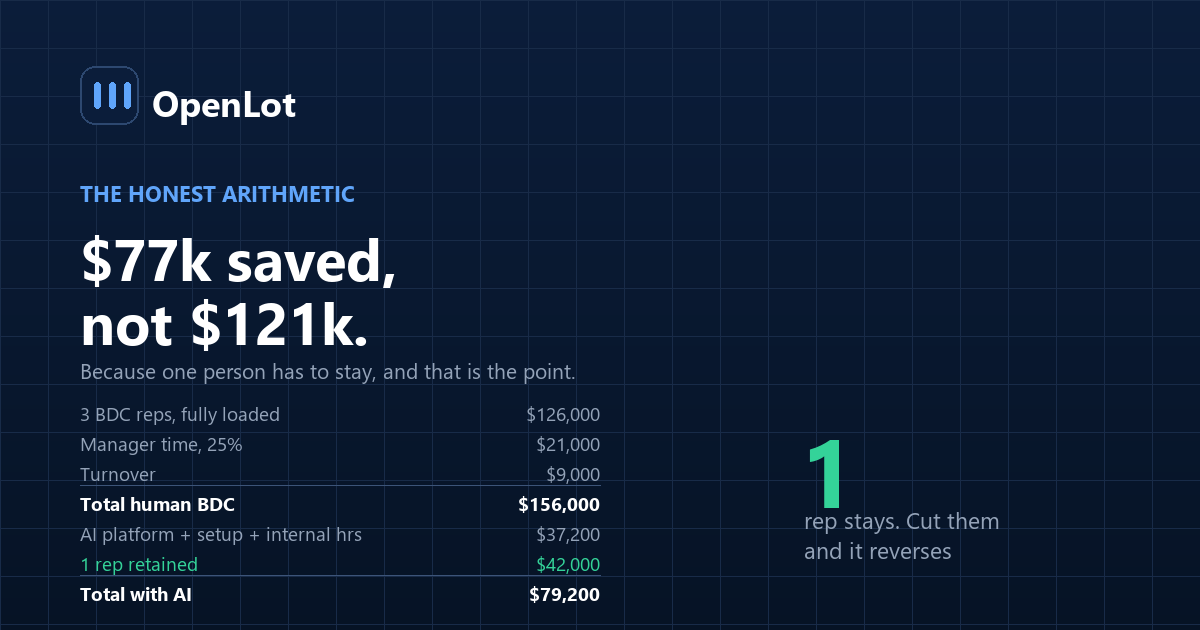
Annual 3 BDC reps, $42k fully loaded $126,000 Manager time, 25% $21,000 Turnover cost, ~1.2 replacements/yr $9,000 Total human BDC $156,000
Annual AI platform, $1,100/mo $13,200 Integration and setup, amortised $6,000 Internal hours: review, tuning, escalation handling $18,000 1 rep retained for engaged conversations $42,000 Total $79,200 A saving of roughly $77,000, which is real — and notice the fourth row. The version with zero people saves $121,000 and does not work, for the reasons below.
The honest headline is therefore not "replace the BDC." It is "the same coverage with one person instead of three, plus better hours."
What breaks when the team goes entirely?
Four things, in the order they appear.
1. The engaged conversation. A customer who replies at 11pm is engaged by morning, and the system cannot take it further. With nobody to hand to, the conversation that the system successfully started dies in a queue.
2. The objection. "It's more than I wanted to spend" is the single most common reply in the category and it needs a person. A system that handles it produces a discount it had no authority to offer or a dead thread.
3. Exception judgment. The trade that is unusual, the customer who is difficult, the lead that does not fit any pattern. Rare individually and constant in aggregate.
4. Local knowledge. A BDC rep who has worked the same market for three years knows which employer just announced a shift change. That is not recoverable from a model — the same reason an outsourced BDC cannot sound like your store. Which tasks actually run unattended is the subject of the fourteen-task inventory.
The sequence matters: 1 appears within days, 2 within a week, 3 within a month, 4 within a year. Stores that replace outright frequently judge the deployment successful at thirty days, and reverse it at nine months.
The partial version that works
Keep one person per shift, not three. That is the real shape of the change.
| Was | Becomes |
|---|---|
| 3 reps working leads, staffed hours | AI first touch, 168 hours |
| Cadence executed when there is time | AI cadence, always complete |
| 3 reps handling engaged conversations | 1 rep, engaged conversations only |
| Manager chasing activity logs | Logs automatic |
| Nobody on nights and Sundays | AI, with escalation to the next morning |
The retained person's job changes shape: no first touches, no cadence chasing, no data entry. Entirely engaged conversations, which is both higher-value work and a better job — relevant, given that turnover is the human side's main failure mode.
Where does the replacement case go wrong?
1. Counting only wages. Manager time, turnover and the hours someone will spend reviewing AI output are real and routinely omitted — the six missing costs apply here as everywhere.
2. Assuming zero internal hours. Somebody reads transcripts, tunes escalation rules and handles the queue. That is a part-time job, not nothing.
3. Replacing before measuring. Without the four baseline numbers, there is no way to know whether the replacement worked.
4. Cutting the handoff person. The most expensive error. The whole value of the AI layer is conversations it hands over, and with nobody to hand to there is no value.
5. Expecting the saving in month one. Integration, tuning and the learning curve consume most of the first quarter.
6. Treating it as a headcount decision rather than a coverage decision. The gain is mostly the 99 uncovered hours, not the three salaries.
What should you measure before deciding?
| Metric | How to compute | What it decides |
|---|---|---|
| Fully loaded BDC cost | Wages + burden + manager time + turnover | The real left side |
| Share of BDC time on first touches | Sampled or logged | What automation actually displaces |
| Share on engaged conversations | The remainder | What has to stay |
| Leads arriving outside staffed hours | Bucketed by hour | The coverage gain, which is the real prize |
| Contact-to-appointment rate | Current | The number that must not fall |
| Escalations per day, projected | From lead volume and expected contact rate | How many people the handoff needs |
Row two is the one that decides the shape of the answer. A BDC spending most of its time on first touches and cadence is a BDC where automation displaces most of the work. One spending most of its time in engaged conversations is not, and the headcount saving is correspondingly smaller.
Frequently asked questions
Can AI fully replace a dealership BDC?
Not without losing the half of the function that closes. Automation covers first response, qualification, cadence and logging. It does not cover engaged conversations, objections, exception judgment or local market knowledge, and a deployment with nobody to hand to produces conversations that die in a queue.
What does replacing a BDC with AI actually save?
On a three-person BDC costing around $156,000 fully loaded, a deployment retaining one person for engaged conversations lands near $79,000 — a saving of roughly $77,000. The zero-person version saves more and reverses within a year, which makes the smaller number the honest one.
What breaks first when the team is removed?
The engaged conversation, within days. A customer who replies overnight is ready to talk by morning and there is nobody to continue it. Objections follow within a week, exception judgment within a month, and the loss of local market knowledge becomes visible over about a year.
How many people should be retained?
Roughly one per shift rather than three, with a job that changes shape entirely: no first touches, no cadence chasing, no activity logging. Engaged conversations only, which is higher-value work and a better role in a function with high turnover.
What costs get left out of the comparison?
Manager time, turnover cost on the human side, and integration plus internal hours on the automation side. Somebody has to read transcripts, tune escalation rules and work the handoff queue, and that is a part-time job rather than nothing.
When does the saving actually appear?
Rarely in the first quarter. Integration, tuning and the learning curve consume most of it, and a deployment judged at thirty days is being judged before the costs have finished landing and before the gaps have shown up.
What should be measured before reducing headcount?
Fully loaded BDC cost, the share of BDC time currently spent on first touches versus engaged conversations, leads arriving outside staffed hours, current contact-to-appointment rate, and the projected number of daily escalations. The second of those decides the shape of the whole answer.
Is this a headcount decision or a coverage decision?
A coverage decision, mostly. The larger prize is the ninety-nine uncovered hours a week rather than the salaries, and framing it as headcount leads to cutting the person who takes the handoff — which removes the value the automation was creating.
Conclusion
- The saving is real and roughly half the pitch, because one person has to stay.
- Four things break when the team goes, on a timeline of days to a year.
- One per shift, not three, with a job that is entirely engaged conversations.
- Cutting the handoff person removes the value the automation was producing.
- It is a coverage decision. The ninety-nine hours matter more than the three salaries.
Last updated: