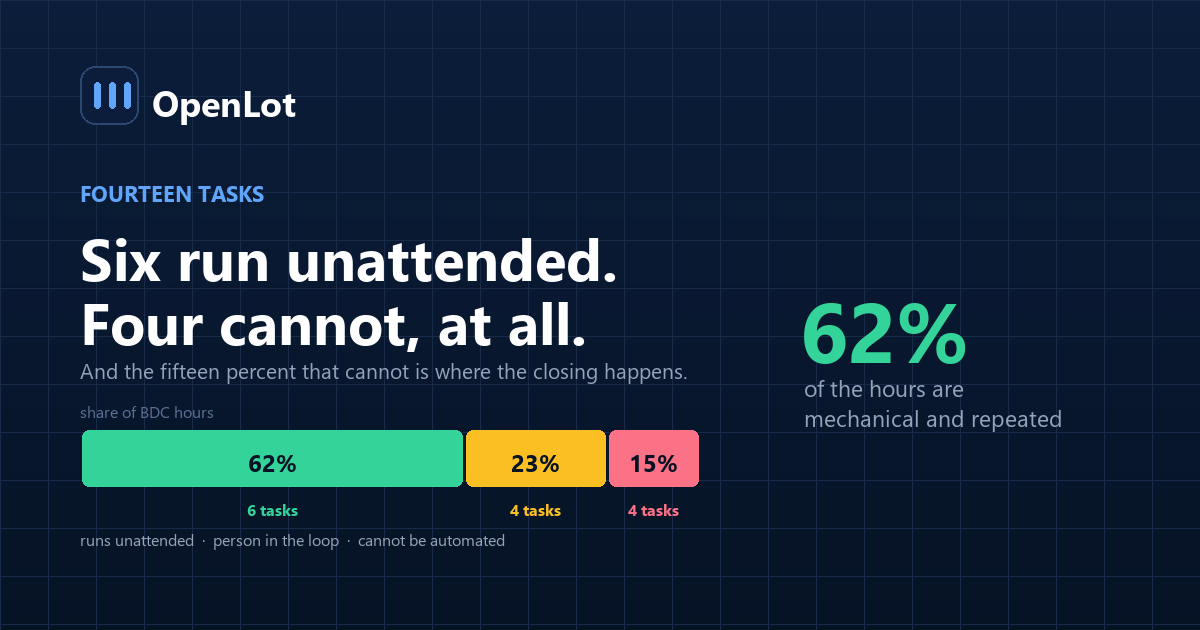
"Automated BDC" describes a function, and the function is fourteen separate tasks with very different automation profiles. Six run unattended, four need a person in the loop and four cannot be automated at all — and the useful version of the conversation is task by task rather than about the department.
This guide covers the fourteen tasks sorted three ways, what unattended really means, where the boundary moves, where automation fails per task, and what to measure.
The fourteen tasks
Runs unattended (6)
| Task | Why it works |
|---|---|
| First response to an inbound lead | Template plus lead data. No judgment |
| Qualification questions | A fixed set, asked in order |
| Follow-up cadence on quiet leads | Scheduled, mechanical, endlessly repeated |
| Appointment confirmation and reminder | Time-triggered |
| Reschedule on request | A calendar operation |
| Activity logging | Automatic by construction |
These six are where the hours go in most BDCs, and they are mechanical in a way that is not a comment on the people doing them — the job genuinely is template, schedule and repetition.
Needs a person in the loop (4)
| Task | What the person adds |
|---|---|
| Responding to an engaged customer | Interpretation |
| Working an aged or reactivation list | Segmentation judgment, and the consent check |
| Handling a lead with incomplete information | Deciding what is worth pursuing |
| Escalation triage | Routing by urgency rather than by order |
Each of these can be assisted substantially — drafts, ranking, a prepared list — while the decision stays with a person.
Cannot be automated (4)
| Task | Why not |
|---|---|
| Objection handling | Judgment, and the answer varies by customer |
| Anything touching price, trade or terms | Commitment |
| An upset customer | Escalate, always |
| Relationship with a repeat customer | Not a task a system can hold |
Where the hours actually go
Illustrative. Time-sample your own BDC for a week.
Group Share of BDC hours Runs unattended (6 tasks) ~62% Needs a person in the loop (4) ~23% Cannot be automated (4) ~15% The first row is the automation case and it is larger than most managers estimate, because the tasks in it are individually small and endlessly repeated.
The third row is the whole argument against replacing the department: fifteen percent of the hours is where the closing happens, and it is not a fifteen percent you can skip.
What does "unattended" actually mean?
Not "nobody looks at it." It means no person initiates each instance.
Somebody still reads transcripts weekly, revises the escalation list, checks that the integration is alive and works the escalation queue. That is a part-time job and it is the cost most commonly omitted from the comparison — the pattern in the six costs the quote leaves out.
The distinction matters because vendors use "fully automated" to mean the first thing and buyers hear the second.
Where does the boundary move?
Three things shift tasks between groups.
Data quality moves tasks backward. Aged-list work is in group two partly because consent and duplication need a human check. In a store with clean data and reliable consent records, it moves closer to group one — the dependency in CRM data decay.
Escalation rule maturity moves tasks forward. A store with a well-revised trigger list can let the system handle more, because the boundary is enforced rather than hoped for.
Volume moves nothing. This is worth stating: higher volume does not make a group-three task automatable. It makes the group-one tasks more valuable to automate and changes nothing else.
Where does automation fail, per task?
First response: generic copy that reads as spam. The content problem, not the speed one.
Qualification: asking too many questions before offering anything, which lowers reply rate — the argument in four facts, not nine.
Cadence: no stop conditions, so the sequence runs after a reply or a sale. Which of these the system may attempt at all is set by the escalation document, and the division of the remainder is in AI BDC vs human BDC.
Confirmation: announcing rather than asking, which surfaces nothing.
Reschedule: forcing the customer to rebuild the booking.
Logging: complete and useless, because nobody reads it. Volume of activity is not a result.
What should you measure?
| Metric | Task group | What it tells you |
|---|---|---|
| BDC hours by task group | All | The size of the opportunity |
| First-touch time by day-part | Group 1 | Whether the unattended part works |
| Cadence completion rate | Group 1 | Attempts 2–8 actually delivered |
| Escalation queue depth | Group 2 | Whether the in-the-loop work is staffed |
| Contact-to-appointment | Group 3 | The human half, unchanged or better |
| Internal hours on oversight | — | The cost nobody budgets |
Row one takes a week of time-sampling and is worth more than any vendor analysis. Most BDC managers estimate the unattended share at well under what it actually is, which is why the automation case usually looks smaller before it is measured than after.
Frequently asked questions
What can an automated BDC actually do without a person?
Six tasks: first response to an inbound lead, qualification questions, the follow-up cadence on quiet leads, appointment confirmation and reminders, rescheduling on request, and activity logging. These are mechanical, repeated, and together consume the majority of BDC hours.
What still needs a person in the loop?
Responding to an engaged customer, working aged or reactivation lists where segmentation and consent need judgment, handling leads with incomplete information, and triaging escalations by urgency. Each can be substantially assisted with drafts, ranking or prepared lists while the decision stays human.
What cannot be automated at all?
Objection handling, anything touching price, trade or terms, an upset customer, and the relationship with a repeat customer. Those four are a modest share of BDC hours and they are where the closing happens, which is why removing the department entirely does not work.
Does "fully automated" mean nobody is involved?
No. It means no person initiates each instance. Somebody still reads transcripts weekly, revises the escalation list, verifies the integration is alive and works the escalation queue — a part-time job, and the cost most commonly left out of the comparison.
How much of BDC time is automatable?
More than most managers estimate, because the automatable tasks are individually small and endlessly repeated. The reliable way to find out is a week of time-sampling against the fourteen-task list rather than an estimate, which tends to understate it substantially.
Does higher lead volume change what can be automated?
No. Volume makes the mechanical tasks more valuable to automate and changes nothing about which tasks need judgment. A task that requires interpretation at twenty leads a day still requires it at two hundred.
What moves a task from needing a person to running unattended?
Two things: clean data with reliable consent records, which removes the manual check from aged-list work, and a mature escalation trigger list, which lets the system handle more because the boundary is enforced rather than hoped for.
What is the most common automation failure in a BDC?
Generic first-response copy. The system responds in seconds with a message that reads as a template, which produces a timestamp rather than a conversation — a content failure rather than a speed one, and the easiest of the six to fix.
Conclusion
- Fourteen tasks, three groups. Six unattended, four in the loop, four not at all.
- The unattended share is larger than managers estimate, because those tasks are small and repeated.
- Fifteen percent of the hours is where the closing happens, and it is not skippable.
- Unattended means no person initiates each instance, not that nobody is involved.
- Volume changes nothing about the boundary. Data quality and rule maturity do.
Last updated: