Comparing an AI BDC to a human one as alternatives produces a bad answer, because they are not alternatives. They fail at opposite things — latency and persistence against judgment and recovery — and the deployments that work use each where the other breaks.
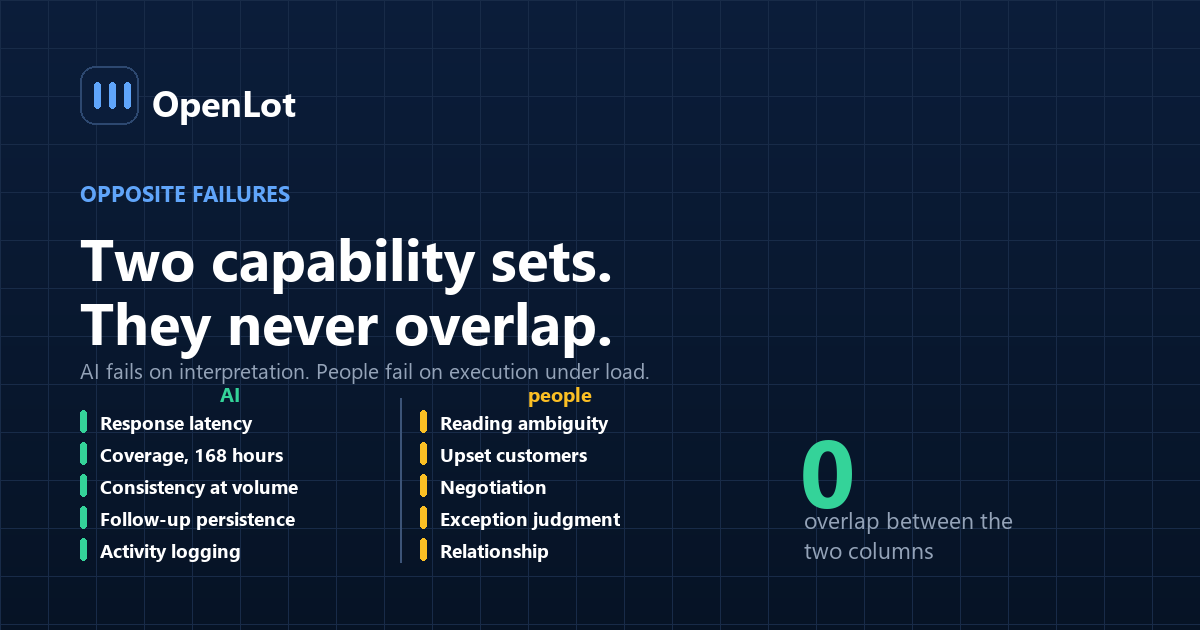
This guide covers the capability comparison, why the failures are complementary, the division that works, where each degrades, and what to measure.
The capability table
| Capability | AI BDC | Human BDC |
|---|---|---|
| Response latency | Seconds, consistently | Minutes to hours, worse under load |
| Coverage | All 168 hours | Staffed hours only |
| Consistency at volume | Unchanged at 10 or 500 leads | Degrades exactly when volume spikes |
| Follow-up persistence | Executes the full cadence every time | Collapses after attempt two or three |
| Activity logging | Automatic and complete | Manual, incomplete when busy |
| Reading an ambiguous customer | Poor | Strong |
| Handling an upset customer | Poor — must escalate | Strong |
| Negotiation and commitment | Should not attempt | The actual job |
| Judgment on exceptions | None | Strong |
| Building a relationship | None | The thing that closes |
The top five rows and the bottom five rows do not overlap at any point. That is the whole argument, and it is unusual — most technology comparisons involve a trade-off within the same capability rather than two disjoint sets.
Why are the failures complementary?
Because they have different causes.
AI fails on interpretation. It cannot tell whether "I need to think about it" means a budget problem, a spouse who has not seen the car, or genuine disinterest. A person hears the difference in the first three seconds.
Humans fail on execution under load. Not from inattention — from arithmetic. A rep with sixty active leads and a full appointment calendar cannot run an eight-touch cadence on all sixty, and the cadence is the first thing to go. That collapse is documented in automated follow-up, and it is worst on the days with the most leads.
Neither failure is fixable by improving the other side. A better model does not acquire judgment; a better rep does not acquire 168 hours.
The division that works
Who owns what
Stage Owner Why First response, any hour AI Latency, and most of it is outside staffed hours Qualification questions AI Mechanical, and consistent Follow-up cadence on quiet leads AI Persistence without memory The moment they engage Human Interpretation starts here Any price, trade or terms question Human Commitment Objection and hesitation Human Judgment Appointment confirmation sequence AI Mechanical again Arrival and everything after Human Obviously The pattern: AI owns the mechanical first touch and the boring middle; people own the conversation once it is real.
Note the row that switches back to AI near the end. Confirmation is mechanical even though it sits after a human conversation, and that is the kind of boundary a sensible deployment gets right and a careless one does not.
Where does each degrade over time?
The AI side degrades on data. A CRM accumulating duplicates means the system contacts the same human from several threads, which is data decay made visible to customers. It also degrades on an escalation list written once and never revised against real transcripts.
The human side degrades on turnover. A BDC is a high-turnover role and every departure resets the relationship knowledge and the local judgment that made the person valuable — the dynamic in why good people leave.
The two degradations have different remedies and different costs, and conflating them is how a store concludes that "the BDC is not working" without knowing which half.
Where does the comparison go wrong?
1. Framing it as a replacement decision. It is a division-of-labour decision, and the arithmetic of replacement is covered separately in can you replace your BDC.
2. Measuring both sides on the same metrics. AI should be judged on first-touch time, coverage and cadence completion. People should be judged on contact-to-appointment and appointment-to-show. Using one set for both makes both look wrong.
3. Giving AI the engaged conversation. The most expensive error, because it is the one customers experience — and it is prevented by the escalation document, not by hoping.
4. Giving people the 2am first touch. The most expensive error in the other direction, because it does not happen.
5. Not staffing the handoff. The gains from the AI column land in a queue, and the whole thing produces nothing.
What should you measure?
| Metric | Side it judges | Target |
|---|---|---|
| First-touch time by day-part | AI | Seconds in uncovered hours |
| Cadence completion rate | AI | Attempts 2–8 actually delivered |
| Escalation accuracy | AI | Triggers fired when they should have |
| Contact-to-appointment rate | Human | The judgment stage |
| Appointment-to-show | Human | Relationship, partly |
| Handoff pickup time | Both | Where the division either works or does not |
The last row belongs to neither side and determines whether either one matters. A system that escalates correctly into a queue nobody works has produced a faster path to the same silence.
Frequently asked questions
Is an AI BDC better than a human BDC?
Neither, because they are not alternatives. AI is stronger on response latency, coverage across all hours, consistency under volume, follow-up persistence and logging. People are stronger on interpretation, negotiation, handling upset customers and judgment on exceptions. The two sets do not overlap.
Why do the two fail at opposite things?
Different causes. AI fails on interpretation because it cannot tell what "I need to think about it" actually means. Humans fail on execution under load, not from inattention but from arithmetic — a rep with sixty active leads cannot run a full cadence on all sixty, and the cadence is the first thing dropped.
What should the AI side own?
The first response at any hour, the qualification questions, the follow-up cadence on leads that have gone quiet, and the appointment confirmation sequence. All four are mechanical and benefit from consistency rather than from judgment.
What should people own?
The conversation from the moment a customer actually engages, any question touching price, trade or terms, every objection and hesitation, and everything from arrival onward. These need interpretation, and interpretation is the thing the AI side does not have.
Should both sides be measured the same way?
No, and doing so makes both look bad. AI should be judged on first-touch time by day-part, cadence completion and escalation accuracy. People should be judged on contact-to-appointment and appointment-to-show. Handoff pickup time belongs to neither and determines whether either matters.
How does an AI BDC degrade over time?
On data and on rules. Duplicate CRM records cause the system to contact the same person from several threads, and an escalation list written once and never revised against real transcripts drifts out of step with how customers actually phrase things.
How does a human BDC degrade over time?
On turnover. The role has high churn, and each departure resets the relationship knowledge and local judgment that made the person effective. That is a different problem with a different remedy, and conflating the two is how stores conclude the whole function is broken.
What is the most expensive mistake in dividing the work?
Giving the engaged conversation to the system. That is the error customers experience directly, and it produces commitments the store has to unwind. The mirror error — expecting people to make the 2am first touch — is cheaper only because it simply does not happen.
Conclusion
- Two disjoint capability sets. The comparison is not which is better but which fails where.
- AI fails on interpretation; people fail on execution under load. Neither is fixable from the other side.
- AI owns the first touch and the boring middle. People own the conversation once it is real.
- Measure each side on its own metrics, or both will look like they are failing.
- Handoff pickup time belongs to neither and decides whether either one matters.
Last updated: