"Virtual BDC" usually means outsourced, sometimes means automated, and the two are not the same trade. Outsourcing buys coverage and pays for it in context; automation buys coverage and pays for it in judgment — and which price is cheaper depends on a measurement most stores have never taken.
This guide covers the three models, the handoff measurement that decides between them, the hybrid most stores land on, where each fails, and what to measure.
The three models
| Outsourced | In-house | Automated | |
|---|---|---|---|
| Cost shape | Per lead or per seat | Salaries, fixed | Licence, near-fixed |
| Coverage | Contracted, often 24/7 | Staffed hours | 168 hours |
| Control of script | Limited | Complete | Complete, within scope |
| Context about your store | Low | High | What it is given |
| Latency | Minutes | Minutes, worse under load | Seconds |
| Handoff quality | Low | High | Depends on integration |
| Judgment | Moderate | High | None |
Two rows decide most of it: handoff quality and judgment. Cost is where the conversation starts and rarely where it should end.
The measurement that decides it
Most stores choose between these models on price and coverage. The number that actually separates them is how much context survives from first contact to showroom arrival.
Context survival
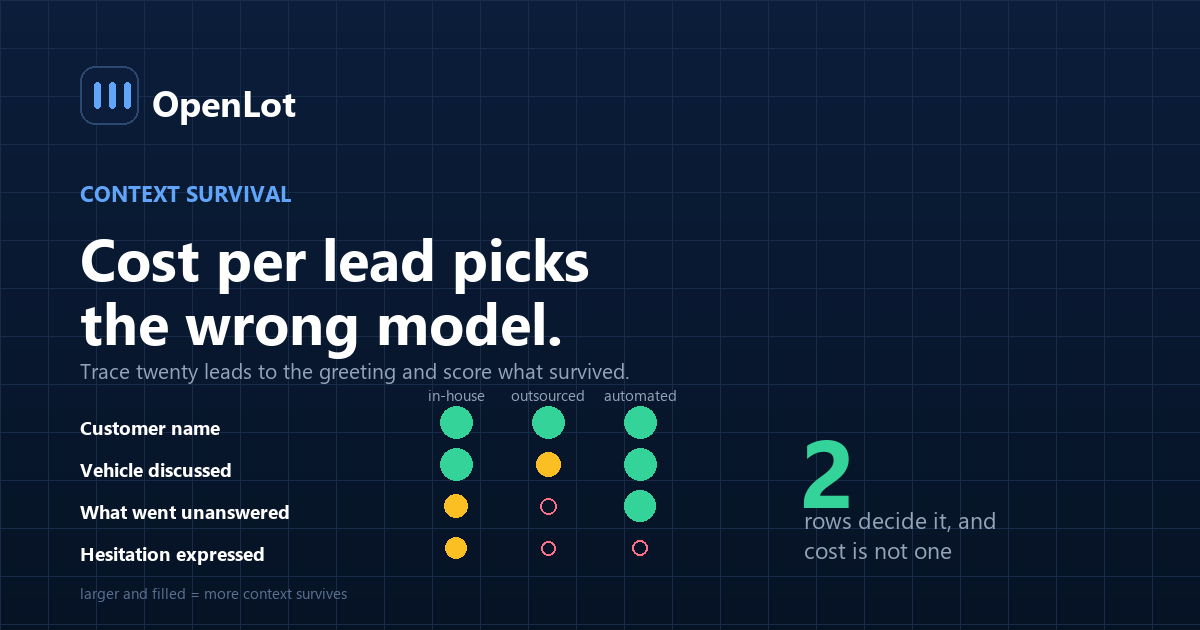
Trace twenty leads from first contact to arrival and score what the salesperson knew at the greeting.
Knew at greeting In-house Outsourced Automated Customer's name Usually Usually Always Specific vehicle discussed Usually Sometimes Always What they asked that went unanswered Sometimes Rarely Always, if logged Hesitation expressed Sometimes Rarely Rarely — it is not a field Who they spoke to Yes A name they will never meet n/a Row three and row four are where deals are lost, and they are the rows where outsourcing is weakest — an agent covering eleven stores does not record the hesitation, and nobody reads it if they do.
Automation is strong on rows one to three and weak on row four for a different reason: hesitation is interpretation, and the system does not have it. That is an argument for a person on the engaged conversation rather than against automation on the first touch.
The hybrid most stores land on
Not one model. Usually automated plus a small in-house team, with outsourcing used for a specific gap rather than as the structure.
| Function | Owner |
|---|---|
| First response, all hours | Automated |
| Follow-up cadence | Automated |
| Appointment confirmation | Automated |
| Engaged conversations | In-house, one per shift |
| Overflow at extreme peak | Outsourced, occasionally |
| Anything judgment-dependent | In-house |
Outsourcing in this picture is a release valve rather than the model. That reflects the honest trade: it solves a volume problem well and a context problem badly, and the context problem is the one that costs appointments.
Where does each model fail?
Outsourced fails at the handoff. Covered above, and it is structural rather than a matter of vendor quality. An agent who handled your customer at 1am is not in your showroom at 10am, and the note they left is one of eleven stores' worth of notes.
In-house fails at coverage and at turnover. The coverage arithmetic is unavoidable, and the role has high churn which resets local knowledge — the pattern in why good people leave.
Automated fails at judgment. No interpretation, which is why the engaged conversation stays human — the division in AI BDC vs human BDC.
Each failure is addressed by one of the other two, which is why pure versions of any single model are rare in stores that have been at it a while.
Where does the decision go wrong?
1. Choosing on cost per lead. It flatters outsourcing, which is priced that way, and ignores handoff quality entirely.
2. Expecting outsourced agents to sound like your store. They cannot, at eleven stores each, and scripting harder does not fix it.
3. Treating automation as a cheaper outsourced BDC. Different trade. One loses context, the other loses judgment.
4. No context pipeline from any of them. If the briefing does not reach the salesperson before the greeting, all three models perform worse than their potential.
5. Changing model without measuring the current one. Without the context-survival trace, the comparison is impressions — and the cost side has to be built the way the full comparison builds it.
What should you measure?
| Metric | How to compute | What it decides |
|---|---|---|
| Context survival score | Trace 20 leads to arrival | The real differentiator |
| First-touch time by day-part | Bucketed | Coverage, per model |
| Contact-to-appointment | By model, where they overlap | Quality of the conversation |
| Appointment-to-show | By model | Whether the appointments are real |
| Cost per appointment | Not per lead | The honest cost comparison |
| Handoff pickup time | Escalation → human | The constraint all three share |
Row five is the correction to the usual comparison. Cost per lead favours whichever model is priced per lead; cost per appointment compares what the models actually produce, and the ordering frequently changes.
Frequently asked questions
What is a virtual BDC?
Usually an outsourced team working your leads remotely, and sometimes an automated system doing the same job. The two are different trades: outsourcing buys coverage and loses context, automation buys coverage and loses judgment, and the costs of those two losses differ by store.
What is the main weakness of an outsourced BDC?
The handoff. An agent who handled your customer overnight is not in your showroom the next morning, and the note they left is one among many stores' worth of notes. The context that would have made the greeting work does not survive, and that is structural rather than a vendor quality issue.
How do you compare the three models properly?
By tracing twenty leads from first contact to showroom arrival and scoring what the salesperson knew at the greeting. That context-survival measure separates the models far more usefully than cost per lead, which simply favours whichever model happens to be priced that way.
What does the typical working configuration look like?
Automation for first response, cadence and confirmations; a small in-house team for engaged conversations and anything judgment-dependent; and outsourcing used occasionally as a release valve at extreme peak rather than as the structure.
Why does cost per lead mislead?
Because it compares inputs rather than outputs and favours per-lead pricing by construction. Cost per appointment compares what each model actually produces, and the ordering between models frequently changes when the comparison is made that way.
Can an outsourced team be scripted to sound like our store?
Only up to a point. An agent covering many dealerships cannot hold the local knowledge that makes a conversation sound native, and tightening the script usually makes it sound more generic rather than less. That is a limit of the model, not of effort.
What do all three models share as a constraint?
The handoff to a person at the store. Whichever model produces the engaged conversation, somebody has to receive it, and if the briefing does not reach the salesperson before the greeting then all three perform below their potential.
How does turnover affect the comparison?
It is the in-house model's main weakness. Each departure resets local knowledge and relationship context, which is exactly the advantage in-house has over the other two — so a store with high BDC churn is paying for an advantage it keeps losing.
Conclusion
- Three models, two distinct trades. Outsourcing loses context; automation loses judgment.
- Trace twenty leads to arrival. Context survival separates the models; cost per lead does not.
- The hybrid is usually automation plus one in-house person per shift.
- Outsourcing works as a release valve, not as the structure.
- Compare cost per appointment, not per lead. The ordering changes.
Last updated: