Chat placement is treated as a design question and it is a segmentation one. A widget on the vehicle page collects a different customer than one on the homepage — not more of the same customer — and the page it sits on determines both the intent captured and what the widget needs to know.
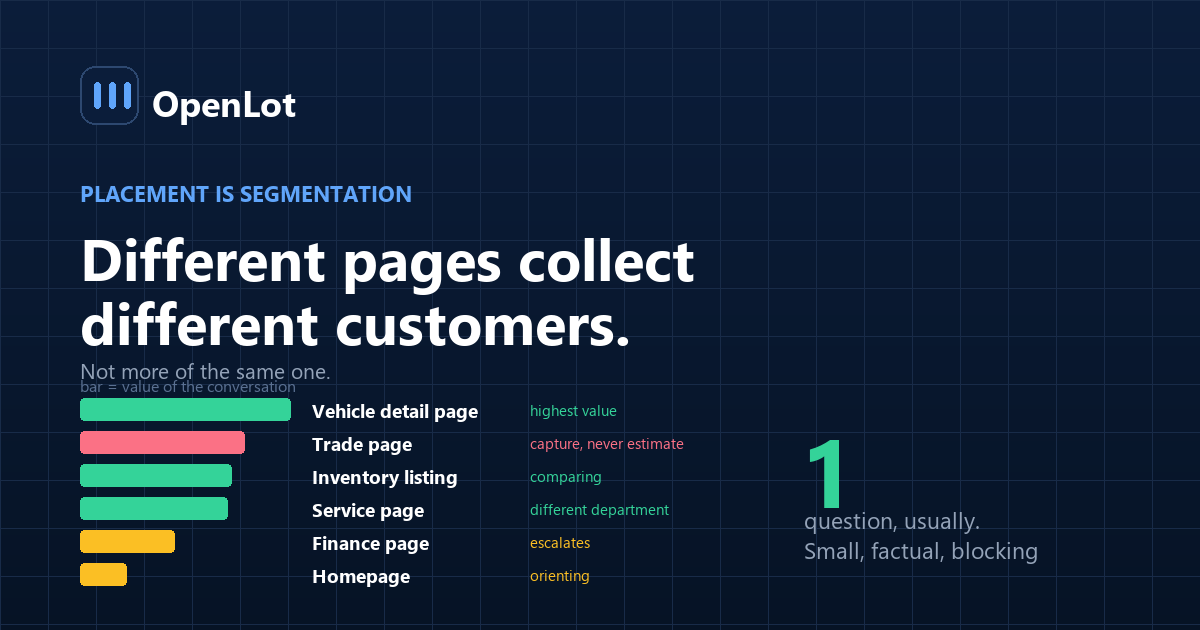
This guide covers how placement changes intent, what each page type produces, the context the widget needs, where placement goes wrong, and what to measure.
How does placement change intent?
Because where a visitor is tells you how far along they are.
| Page | Visitor state | Typical question | Value |
|---|---|---|---|
| Vehicle detail page | Looking at a specific car | "Is it still there?", "what's the mileage?" | Highest |
| Inventory listing | Comparing | "Do you have anything with..." | High |
| Homepage | Orienting | "What are your hours?" | Low |
| Service page | Existing customer | "Can I book for Thursday?" | High, different department |
| Finance page | Early, researching | "What credit do I need?" | Moderate, escalates |
| Trade page | Has a car to dispose of | "What's mine worth?" | High, and escalates immediately |
The spread is wide, and treating all six placements as one deployment produces a blended result that describes none of them.
The vehicle detail page is where the money is. A visitor on a specific vehicle has done the work of choosing, and the question blocking them is usually small and factual — which is exactly what a chat widget is good at.
The trade page is a trap. The question there is "what's my car worth", the answer is a number, and the number is a commitment — the dynamic in why trade offers get rejected. Chat on a trade page should capture and escalate, never estimate.
What context does the widget need per page?
This is where most deployments are thin.
On a vehicle page: the vehicle. Year, trim, mileage, price, stock number, and current availability. A widget asking "which vehicle are you interested in?" on a vehicle page tells the visitor nothing is connected — the same failure as asking a known caller who they are.
On an inventory listing: the filters applied. Someone who filtered to SUVs under $25,000 has stated their criteria, and a widget that asks for them again has wasted the signal.
On a service page: the customer, if identifiable, and real scheduling capacity.
On a trade page: nothing beyond capture. The less this widget attempts, the better it performs.
The availability check
On a vehicle detail page, one question dominates: is it still available?
A widget answering it from a live inventory feed is useful. One answering from a nightly sync will confidently confirm a car that sold this morning, and the visitor finds out when they arrive — the failure described in booking against real availability.
If the feed is not live, the correct behaviour is to say so and offer to confirm, which is less impressive and does not produce a wasted journey.
Where does placement go wrong?
1. One widget, every page, no context. The default install, and it produces generic conversations everywhere.
2. Covering the photos. On mobile especially, a widget obscuring vehicle images costs more than the chat produces.
3. Proactive prompts on the vehicle page. The visitor is reading. Interrupting a VDP read is the most expensive place to interrupt — the behaviour question in chat that converts versus annoys.
4. Estimating on the trade page. Covered above.
5. No service routing. A chat on the service page that routes to sales is a department error the visitor experiences as incompetence.
6. Not segmenting the reporting. Blended chat metrics hide which placement works — the same segmentation argument as in website conversion rate.
What should the widget do differently per page?
| Page | Opening behaviour |
|---|---|
| Vehicle detail | Silent, available. Named vehicle in context if opened |
| Inventory listing | Silent. Offer narrowing help if opened |
| Homepage | May prompt after a delay. Low cost either way |
| Service | May prompt. Booking intent is high and the flow is mechanical |
| Finance | Silent. Capture and escalate |
| Trade | Silent. Capture and escalate, never estimate |
The pattern: prompt where the visitor is undirected, stay silent where they are reading. A homepage visitor who has not decided anything may welcome an offer of help. A visitor three quarters of the way down a vehicle page does not.
What should you measure?
| Metric | How to compute | Why per page |
|---|---|---|
| Engagement rate by page type | Chats started ÷ sessions, split | Placements differ enormously |
| Completion rate by page type | Contact details obtained ÷ started | Where the conversion is |
| Chat-to-appointment by page type | Appointments ÷ chats | The business outcome, segmented |
| Availability questions answered correctly | Sampled against actual stock | The feed test |
| Prompt-triggered vs visitor-initiated | Split, and compare outcomes | Whether prompting helps |
| Trade-page estimates given | Count | Should be zero |
Row five is the one that settles the most arguments internally. Comparing outcomes between conversations the visitor started and conversations a prompt started usually shows a clear difference, and it is specific to your site rather than to general advice about proactive chat.
Frequently asked questions
Where should a dealership place its chat widget?
On every page, with different behaviour on each. The vehicle detail page produces the highest-value conversations because the visitor has already chosen a car and usually has one small factual question blocking them. The homepage produces the lowest-value ones.
Does chat placement change who you capture?
Yes, and that is the point. Placement is a segmentation decision rather than a design one: a visitor on a vehicle page, an inventory listing and a trade page are at different stages with different questions, and a blended deployment produces a result that describes none of them.
What does the widget need to know on a vehicle page?
The vehicle: year, trim, mileage, price, stock number and current availability. A widget asking which vehicle the visitor is interested in, on the page for that vehicle, signals that nothing is connected and costs goodwill immediately.
Should chat answer "is it still available"?
Only from a live inventory feed. Answering from a nightly sync will confidently confirm a car that sold that morning, and the visitor discovers it on arrival. If the feed is not live, saying so and offering to confirm is less impressive and avoids a wasted journey.
Why is the trade page a trap?
Because the question there is what the customer's car is worth, the answer is a number, and any number your system provides will be treated as an offer. Chat on a trade page should capture the enquiry and escalate it, never estimate.
Should the widget prompt proactively?
It depends on the page. Prompt where the visitor is undirected, such as the homepage, and stay silent where they are reading, particularly on a vehicle detail page. Interrupting someone three quarters of the way through a vehicle listing is the most expensive place to interrupt.
What is the most common placement mistake?
Installing one widget across every page with no page context, which produces generic conversations everywhere and discards the intent signal that placement provides. The second most common is a widget that obscures vehicle photographs on mobile.
How should chat performance be reported?
Split by the page type the conversation started on. Blended chat metrics hide which placements work, and the differences between a vehicle page and a homepage conversation are large enough that the blended number is not actionable.
Conclusion
- Placement is segmentation, not design. Different pages collect different customers.
- The vehicle detail page is where the value is — one small factual question, blocking.
- The widget must know the vehicle. Asking which car on a car page undoes everything.
- Trade pages capture and escalate. Never estimate.
- Prompt where undirected, stay silent where they are reading.
Last updated: